Inspired by a cotton candy machine, engineers put a new spin on creating tiny nanofibers
May 25, 2010
Inspired by a cotton candy machine, engineers put a new spin on creating tiny nanofibers

Enlarge

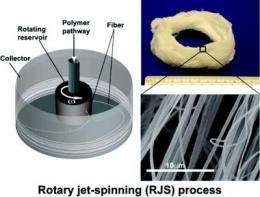
Left: A diagram of the rotary jet spinner; upper right: The resulting "spun" nanofibers; bottom right: The nanofibers viewed at 10um. Credit: Kit Parker, Disease Biophysics Group at the Harvard School of Engineering and Applied Sciences

Hailed as a "cross between a high-speed centrifuge and a cotton candy machine," bioengineers at Harvard have developed a new, practical technology for fabricating tiny nanofibers.

The reference by lead author Mohammad Reza Badrossamay to the fairground treat of spun sugar is deliberate, as the device literally—and just as easily—spins, stretches, and pushes out 100 nanometer-diameter polymer-based threads using a rotating drum and nozzle.

The invention, reported in the May 24 online edition of , could be a boon for industry, with potential applications ranging from artificial organs and to clothing and air filters. The researchers have filed a patent on their discovery.

"This is a vastly superior method to making as compared to typical methods, with production output many times greater," says co-author Kit Parker, Thomas D. Cabot Associate Professor of Applied Science and Associate Professor of in the Harvard School of Engineering and Applied Sciences (SEAS); a core faculty member of the Wyss Institue for Biologically Inspired Engineering at Harvard; and member of the Harvard Stem Cell Institute. "Our technique will be highly desirable to industry, as the simple machines could easily bring nanofiber production into any laboratory. In effect, with this technique we can mainstream nanotextiles."

By contrast, the most common method of creating nanofibers is through electrospinning, or sending a high voltage electric change into a droplet of polymer liquid to draw out long wisps of nanoscale threads. While effective, electrospinning offers limited control and low output of the desired fibers.

The Harvard researchers turned to a simpler solution, using rotary jet spinning. Quickly feeding and then rotating the inside a reservoir atop a controllable motor offers more control and greater yield.

When spun, the material stretches much like molten sugar does as it begins to dry into thin, silky ribbons. Just as in cotton candy production, the nanofibers are extruded through a nozzle by a combination of hydrostatic and centrifugal pressure.

The resulting pile of extruded fibers form into a bagel like shape about 10 cm in diameter.

"The new system offers fabrication of naturally occurring and synthetic polymers as well as a lot of control over fiber alignment and web porosity, hierarchical and spatial organization of fibrous scaffold and three-dimensional assemblies," says Badrossamay, a postdoctoral fellow in the Wyss Institute and member of Parker's lab at SEAS.

The researchers tested the new device using a variety of synthetic and natural polymers such as polylactic acid in chloroform, a biodegradable polymer created from corn starch or sugarcane that has been used as eco-friendly alternative to plastic in items like disposable cups.

Moreover, the rapid spinning method provides a high degree of flexibility as the diameter of the fibers can be readily manipulated and the structures can be integrated into an aligned three-dimensional structure or any shape simply by varying how the fibers are collected.

The shape of the fibers can also be altered, ranging from beaded to textured to smooth.

Parker's Disease Biophysics Group (DBG), which has extensive expertise in cardiac tissue engineering, also used the technology to form tissue engineering scaffolds, or artificial structures upon which tissue can form and grow.

Heart tissue from rats was integrated and aligned with the nanofibers, and, as seen in past studies, formed beating muscle.

"I was visiting the Society of Laproscopic Surgeons a couple of years ago to look at the equipment demos and it dawned on me that we needed to develop techniques to miniaturize scaffold production so we could do it in vivo. Our finding is the first step," explains Parker. "The initial testing suggests that our technique is incredibly versatile for both research and everyday applications. As rotary jet spinning does not require high voltage, it really brings nanofiber fabrication to everyone."

The researchers expect to further refine the process for tissue engineering applications and to look for opportunities to exploit the advance in other textile applications.

Provided by Harvard University (news : web)

4.8 /5 (4 votes)  

Filter


Move the slider to adjust rank threshold, so that you can hide some of the comments.


Display comments: newest first

KronosDeret
May 26, 2010

Rank: not rated yet
Hmm nanoclothing... i would definetly like to wear that, dust water and dirt rejecting material, that would breathe and keet me warm. Antiseptic properties, no sweating, no smell, sing me up :)
Rank 4.8 /5 (4 votes)
Relevant PhysicsForums posts
  • polymer nanocomposites
    created4 hours ago
  • Corrosion Tests on Magnesium
    created17 hours ago
  • polyethylene copper nanocomposite
    created23 hours ago
  • Output of xrd analysis
    createdFeb 08, 2012
  • Transport phenomena problem based on problems 18.B11 and 19B.6 from Bird, stewart, lw
    createdFeb 06, 2012
  • Help with material selection - Car Piston
    createdFeb 05, 2012
  • More from Physics Forums - Materials & Chemical Engineering

More news stories

'Dark plasmons' transmit energy

Microscopic channels of gold nanoparticles have the ability to transmit electromagnetic energy that starts as light and propagates via "dark plasmons," according to researchers at Rice University.

Nanotechnology / Nanophysics

created 13 hours ago | popularity 5 / 5 (5) | comments 0 | with audio podcast

Nanotube therapy takes aim at breast cancer stem cells

Wake Forest Baptist Medical Center researchers have again proven that injecting multiwalled carbon nanotubes (MWCNTs) into tumors and heating them with a quick, 30-second laser treatment can kill them.

Nanotechnology / Bio & Medicine

created 18 hours ago | popularity 5 / 5 (1) | comments 0 | with audio podcast

Inspired by steel, nanomanufacturing gets wear-resistant carbide tip

(PhysOrg.com) -- Scientists at the University of Pennsylvania, the University of Wisconsin-Madison and IBM Research - Zurich have fabricated an ultrasharp silicon carbide tip possessing such high strength ...

Nanotechnology / Nanophysics

created 23 hours ago | popularity 5 / 5 (3) | comments 1 | with audio podcast

New kind of solar cell could capture significantly more energy than current cells

New solar cells could increase the maximum efficiency of solar panels by over 25%, according to scientists from the University of Cambridge.

Nanotechnology / Nanophysics

created Feb 08, 2012 | popularity 4.5 / 5 (11) | comments 14 | with audio podcast

New technology platform for molecule-based electronics

Researchers at the Nano-Science Center at the University of Copenhagen have developed a new nano-technology platform for the development of molecule-based electronic components using the wonder material graphene. At the same ...

Nanotechnology / Nanomaterials

created 20 hours ago | popularity 5 / 5 (2) | comments 0


Humans may have helped the decline of African rainforests 3000 years ago

(PhysOrg.com) -- Large areas of rainforests in Central Africa mysteriously disappeared over three thousand years ago, to be replaced by savannas. The prevailing theory has been that the cause was a change ...

Protein libraries in a snap

(PhysOrg.com) -- A Rice University undergraduate will depart with not only a degree but also a possible patent for his invention of an efficient way to create protein libraries, an important component of biomolecular ...

Sleep breathing machine shows clear benefits in children with sleep apnea

Children and adolescents with obstructive sleep apnea had substantial improvements in attention, anxiety and quality of life after treatment with positive airway pressure (PAP)—a nighttime therapy in which a machine ...

Neurologic improvement detected in rats receiving stem cell transplant

In a study to be presented today at the Society for Maternal-Fetal Medicine's annual meeting, The Pregnancy Meeting, in Dallas, Texas, researchers will report that early transplantation of human placenta-derived mesenchymal ...

Miami battling invasion of giant African snails

No one knows how they got there. But an invasion of African giant snails has southern Florida in a panic over potential crop damage, disease and general yuckiness surrounding the slimy gastropods.

NASA budget will axe Mars deal with Europe: scientists

US President Barack Obama's budget proposal to be submitted next week for 2013 will cut NASA's budget by 20 percent and eliminate a major partnership with Europe on Mars exploration, scientists said Thursday.