Launch of Mars500 mission on 3 June in Moscow
May 25, 2010
Launch of Mars500 mission on 3 June in Moscow

Enlarge

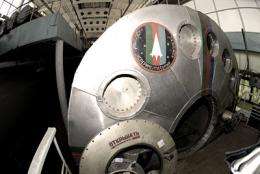
The simulations will take place here on Earth inside a special facility in Moscow. A precursor 105-day study is scheduled to early 2009, possibly followed by another 105-day study, before the full 520-day study begins late 2009. Credits: ESA - S. Corvaja

(PhysOrg.com) -- The first full-duration simulation of a human mission to Mars is about to begin. After closing the hatch, the crew of six will remain in their 'spacecraft' for 520 days.

The 520-day simulated mission to Mars will start on 3 June, when the isolation facility is sealed and the international crew start their record-breaking experiment.
The crew will basically live and work like astronauts on the International Space Station, with maintenance work, scientific experiments and daily exercise. They will follow a seven-day week, with two days off, except when special and emergency situations are simulated.

There are six crewmembers plus a Russian backup: ESA-selected Diego Urbina (Italian/Colombian, age 27) and Romain Charles (French, 31); Sukhrob Kamolov (32), Alexey Sitev (38), Alexandr Smoleevskiy (33) and Mikhail Sinelnikov (37) from Russia; and Wang Yue (26) from China.

Housed in Russia’s Institute of Biomedical Problems (IBMP) in Moscow, the 550 m3 sealed space mockup includes an interplanetary spaceship, a and a martian landscape.

Mars500 mission

In order to investigate the human factors of such a mission, ESA has teamed up with the Russian Institute of Biomedical Problems (IBMP) and will send a joint crew of six on a 520-day simulated mission to Mars. The simulation follows the mission profile of a real , including an exploration phase on the surface of Mars. Nutrition will be identical to that provided on board the International Space Station.

The simulations will take place here on Earth inside a special facility in Moscow. A precursor 105-day study is scheduled to early 2009, possibly followed by another 105-day study, before the full 520-day study begins late 2009.

The crew will have to take care of themselves for almost two years during the roundtrip. Their survival is in their own hands, relying on the work of thousands of engineers and scientists back on Earth, who made such a mission possible.

They will experience extreme isolation and confinement. They will lose sight of planet Earth. A radio contact will take 40 minutes to travel to us and then back to the space explorers.

A human mission to Mars is a bold vision for the time beyond the . However, preparations have already started today. They are geared and committed to one goal: to send humans on an exploration mission to Mars, individuals who will live and work together in a spaceship for over 500 days.

Provided by European Space Agency (news : web)


Rank 3 /5 (2 votes)
Related Stories
Relevant PhysicsForums posts
  • Scale of the Universe
    created2 hours ago
  • Titan's lack of impact craters
    createdFeb 09, 2012
  • Real pictures of black hole eating a star?
    createdFeb 08, 2012
  • Hypothetical way to travel faster than light, but not technically exceed lightspeed
    createdFeb 06, 2012
  • How do scientists monitor the Sun's activity?
    createdFeb 05, 2012
  • Search patterns in observational studies
    createdFeb 05, 2012
  • More from Physics Forums - General Astronomy

More news stories

NASA sees wide-eyed cyclone Jasmine

Cyclone Jasmine's eye has opened wider on NASA satellite imagery, as it moves through the Southern Pacific Ocean.

Space & Earth / Earth Sciences

created 1 hour ago | popularity not rated yet | comments 0

NASA sees Giovanna reach cyclone strength, threaten Madagascar

Tropical Storm 12S built up steam and became a cyclone on February 10, 2012 as NASA's Terra satellite passed overhead. Residents of east-central Madagascar should prepare for this cyclone to make landfall ...

Space & Earth / Earth Sciences

created 1 hour ago | popularity not rated yet | comments 0

Humans may have helped the decline of African rainforests 3000 years ago

(PhysOrg.com) -- Large areas of rainforests in Central Africa mysteriously disappeared over three thousand years ago, to be replaced by savannas. The prevailing theory has been that the cause was a change ...

Space & Earth / Environment

created 13 hours ago | popularity 4.2 / 5 (6) | comments 10 | with audio podcast report

Could Venus be shifting gear?

(PhysOrg.com) -- ESA’s Venus Express spacecraft has discovered that our cloud-covered neighbour spins a little slower than previously measured. Peering through the dense atmosphere in the infrared, the ...

Space & Earth / Space Exploration

created 9 hours ago | popularity 5 / 5 (7) | comments 7 | with audio podcast

Mars Science Laboratory computer issue resolved

(PhysOrg.com) -- Engineers have found the root cause of a computer reset that occurred two months ago on NASA's Mars Science Laboratory and have determined how to correct it.

Space & Earth / Space Exploration

created 10 hours ago | popularity 4.7 / 5 (6) | comments 3 | with audio podcast


Google users warned of threat to smartphone wallets

Users of Google smartphone wallets were being warned on Friday that there is a way to crack pass codes intended to thwart thieves from going on illicit shopping sprees.

CIA website offline, Anonymous takes credit

The website of the Central Intelligence Agency was unresponsive on Friday after the hacker group Anonymous claimed to have knocked it offline.

Complex wiring of the nervous system may rely on a just a handful of genes and proteins

Researchers at the Salk Institute have discovered a startling feature of early brain development that helps to explain how complex neuron wiring patterns are programmed using just a handful of critical genes. ...

Putting the squeeze on planets outside our solar system

(PhysOrg.com) -- Using high-powered lasers, scientists at Lawrence Livermore National Laboratory and collaborators discovered that molten magnesium silicate undergoes a phase change in the liquid state, abruptly ...

The power of estrogen -- male snakes attract other males

A new study has shown that boosting the estrogen levels of male garter snakes causes them to secrete the same pheromones that females use to attract suitors, and turned the males into just about the sexiest ...

New error-correcting codes guarantee the fastest possible rate of data transmission

Error-correcting codes are one of the triumphs of the digital age. They’re a way of encoding information so that it can be transmitted across a communication channel — such as an optical fiber o ...