Engineers Help Power Solar Use by 'Mapping' the Sun
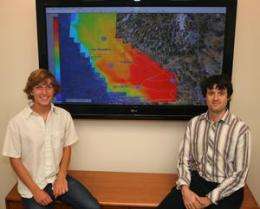
(PhysOrg.com) -- As the use of solar power grows in California it will become more important to know exactly how much radiation and energy are generated in regions throughout the state. That’s the basis behind an improved solar map for the state created by UC San Diego environmental engineering professor Jan Kleissl and his Ph.D. student Anders Nottrott.
They presented this work at the American Solar Energy Society conference in Phoenix, Az. today.
The map, which can be viewed via Google Earth for free, allows homeowners, photovoltaic installers and utilities to better predict how much power they will get out of their solar systems.
“This map is important for the state of California because it provides residents, the industry, and policy makers with a simple yet accurate way to evaluate the ‘solar resource’ at a specific geographic location,” Nottrott said. “This map can also be used to help determine the best place to build new solar photovoltaic energy collectors and perform long-term economic analysis for those systems.”
The original data for the state’s solar map came from the National Solar Radiation Database and was modeled from geostationary satellites. Instead of using satellite data, the UCSD engineers used long time histories of measured ground data provided by ground stations through the California Department of Water Resource’ California Irrigation Management System (CIMIS) to evaluate and improve the accuracy of the original satellite dataset.
Satellite data covers the entire United States. However, ground stations, Kleissl said, give more accurate information than satellites on how much solar radiation occurs. Ground stations are also more affordable, costing about $5,000, compared to a $5 billion satellite, he said.
“Satellites are not as accurate because they can only see what the clouds reflect,” he said. “What we found through the use of the ground stations is that the summer morning clouds on the whole California coastline are thicker than observed by the satellite. The previous map predicted too much radiation during the summer months along the California coast.
“My hope is that our new map will make the decision for consumers a little easier about using solar energy,” Kleissl added. “I also hope that solar installers and data providers will adjust their predictions to provide homeowners with the more accurate data.”
Kleissl’s solar map project is funded as part of a two-year $130,000 grant through the California Solar Energy Collaborative, a partnership between UCSD and UC Davis and funded by the California Energy Commission to expand the development and use of solar energy in the state. Under a new California Solar Initiative grant, Kleissl and his students plan to further improve the solar map with thousands of ground data sites allowing users to zoom in mile-by-mile. That map is expected to be released in 2011. Currently, the new map has a 6-mile-by-6-mile radius.
“This research will allow us to gather data and do much more site-by-site and neighborhood assessment of how much solar radiation occurs in a microclimate,” Kleissl said.
The map also includes a free solar energy calculator created by Kleissl and his environmental engineering student Bryan Urquhart that allows homeowners and solar installers to compute the monthly and annual solar energy their systems will produce.
“This kind of research helps to remove the barriers for implementing solar energy conversion systems in California and promotes clean, renewable energy generation, which is an important part of our global energy future,” Nottrott said.
Notrott, in his first year as an environmental engineering Ph.D. student at the UCSD Jacobs School of Engineering, said he became interested in this field because it is a discipline that combines aspects of mechanical engineering with physical sciences to solve complex problems that arise from a need for sustainable development.
“As an environmental engineer my research will focus on helping to minimize the environmental impacts of urban development which has consequences for human comfort and health and global climate change,” he said.
Provided by University of California - San Diego


