Study pinpoints new role of molecule in the health of body's back-up blood circulation
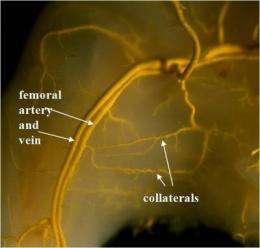
When the arteries delivering oxygen to our vital organs are obstructed by atherosclerosis or clots, the result is almost always a stroke, heart attack or damage to a peripheral tissue such as the legs (peripheral artery disease). But the severity of tissue injury or destruction from a choked-off blood supply varies from person to person, and may depend in large part on whose circulatory system has the best back-up plan to provide alternate routes of circulation.
This "back-up system" - called the collateral circulation - involves a small number of tiny specialized blood vessels, called collaterals, that can enlarge their diameters enough to carry significant flow and thus bypass a blockage.
Researchers at the University of North Carolina at Chapel Hill School of Medicine have now discovered that the abundance of these vessels in a healthy individual and their growth or remodeling into "natural bypass vessels" depends on how much of a key signaling molecule -- called nitric oxide -- is present.
The study, conducted in animal models, suggests that nitric oxide not only is critical in maintaining the number of collateral vessels while individuals are healthy. It also is key in the amount of collateral vessel remodeling that occurs when obstructive disease strikes.
The research findings recently appeared online in the journal Circulation Research and will be published in the print edition on June 25th. They could one day enable researchers to predict people's risk for catastrophic stroke, myocardial infarction, or peripheral artery disease. Such knowledge could inform individuals with poor collateral capacity to adopt a lifestyle that can help reduce their chances of getting diseases that could further lower their number of collateral vessels.
"If you've got a good number of these natural bypass vessels, you have something of an 'insurance policy' that favors you suffering less severe consequences if you get atherosclerosis or thrombotic disease" said senior study author James E. Faber, Ph.D., professor of cell and molecular physiology at UNC.
"And if you were born with very few, the last thing you would want to do is subject yourself to environmental factors that might further cut down the number of these vessels." Faber also is a member of the McAllister Heart Institute at UNC. Earlier this year, his team reported that these vessels form early in life and that genetic background has a major impact on how many you end up with.
The factors that put people at risk for developing stroke, heart attack, or peripheral artery disease include the usual suspects -- smoking, diabetes, hypertension, high cholesterol, family history, age. But until recently, researchers didn't know what linked those risk factors together, when it comes to insufficiency of the collateral circulation.
Faber says studies have shown that all of these factors cause the endothelial cells that line our blood vessels to produce less nitric oxide, a "wonder molecule" that protects our vasculature from disease. Now, he says, his group's findings indicate that this molecule is also a critical factor maintaining the health of the collateral circulation.
So Faber and lead study author Xuming Dai, M.D., Ph.D., of UNC's departments of medicine and physiology, wondered whether collateral vessels would be lost if the levels of nitric oxide were suppressed. They counted the number of these vessels in the brains of mice genetically engineered to lack the enzyme - called eNOS -- that makes most of the nitric oxide in blood vessel walls.
The researchers found that from the ages of three months to six months (equivalent to about twenty-one to forty-five years of age in humans) there was a 25 percent reduction in the number of collateral vessels in the mutant mice as compared to normal ones. They also saw the same percentage decrease in collateral vessels supplying the legs, where they were trying to model peripheral artery disease.
Next, the investigators wanted to know if a lack of nitric oxide would affect the way that existing collaterals respond to an obstruction in a main artery.
By blocking an artery in the legs of these genetically engineered mice, Faber and Dai were able to reroute circulation through the collateral vessels. Over a period of 2-3 weeks, the flow of detoured blood usually causes the little collaterals to enlarge their diameters by 3 to 4 fold through a process called collateral remodeling. But the researchers found that such remodeling was impaired in the mutant mice that produced less nitric oxide when compared to their normal counterparts.
In the first such experiment of its kind, Dai then succeeded in surgically removing these tiny collaterals from the mice and scanned their entire genomes for differences between the mutant and normal rodents that might explain this variation in remodeling.
"The only category of genes that was dramatically different between the two was the cell cycle control genes, genes that are involved in the proliferation of cells in the vascular wall—a process that's required for collaterals to remodel," said Dai, a clinical cardiology fellow receiving basic science training in Faber's laboratory. "This is an important function of eNOS that had not been discovered before."
Faber says that possessing a variant form of the eNOS gene that results in loss of collaterals may be one more item on the list of risk factors for cardiovascular disease. There is already evidence that healthy people may vary up to ten-fold in the abundance of their collateral circulation, so the trick may be figuring out a way to upgrade that back-up plan for those who are lacking.
"If we can figure out how these unique vessels are made and maintained in healthy tissues, we hope we can then uncover how to induce them to be made with treatments in patients who don't have enough," Faber said.


