Researchers analyze performance of first updatable holographic 3D display
May 26, 2010 By Lisa Zyga
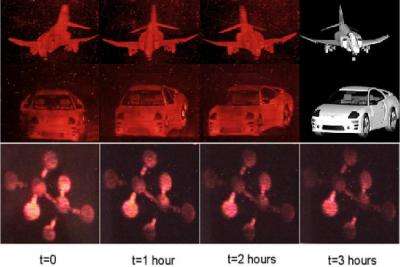
These digital camera images show holograms created with the photorefractive polymer in an updatable holographic 3D display. Image credit: Christenson, et al. ©2010 IEEE.
(PhysOrg.com) -- In 2008, researchers from the University of Arizona created a holographic 3D display that could write and erase images, making it the first updatable (or rewritable) holographic 3D display ever demonstrated. The key to the display was a photorefractive polymer material, which enabled the researchers to take advantage of the potential of holography to a greater extent than previously allowed. Now, in a follow-up study, the researchers have reported the results of their analysis on the performance of the display, including how the polymer enables display enhancements and what more needs to be done before such displays can be widely used.
As the researchers explain, there is a big jump between developing static holograms, such as those that appear on credit cards and drivers’ licenses, and updatable holograms. A variety of materials can be used to make full-color, large-size static holograms, but none of these materials are updatable. As the researchers’ previous study showed, photorefractive polymers have the potential to offer colorful images and large sizes in an updatable display. The display they demonstrated was, at 4 in. x 4 in., the largest yet created. It could display new images every 3 minutes, and images could be viewed for several hours without the need for refreshing. With these features, the display could serve as the basis for future displays that could offer a variety of glasses-free 3D applications in medical, industrial, military, and entertainment imaging.
“Photorefractive polymers are primarily beneficial because the method for achieving an index of refraction change is reversible and can be very fast, which is necessary for a real-world display,” coauthor Cory Christenson from the University of Arizona told PhysOrg.com. “Some materials currently used to make holograms are permanent and take hours to write. Additionally, the material permits making displays with large sizes (at least 4 in. x 4 in.), and in principle is scalable. Also, a single display device is stable for many months to a year or more before a noticeable drop in performance is observed. Photorefractive polymers are also attractive because modifying them with different polymers is relatively easy. If we want to test the effects of a different or new polymer to see if it helps increase speed or efficiency, it is not a significant challenge to make that composite.”
Holograms, like photographs, are recordings of reflected light. Here, the researchers created a hologram based on a 3D model of an object on a computer, and no real physical object was required. They then generated 2D perspectives of the object on the computer, which were processed and combined to create about 120 holographic pixels, or “hogels.” To create a single hogel, the researchers modulated a laser beam with that hogel, focused the beam on a thin vertical line, and made the beam interfere with a second, unmodulated laser beam. The entire hologram could be written by repeating this process with all 120 hogels and positioning them next to each other. After all hogels were written, the researchers could illuminate the sample with a simple LED to make the 3D hologram viewable. The sensation of 3D is created due to parallax: each eye is seeing a different perspective of the object.
Ideally, a polymer material should have a combination of a fast write-erase rate (required for video applications) and a high efficiency (required for bright images). Getting a high efficiency means adding traps for the charges generated, but traps also take time and slow down the write-erase rate, resulting in a tradeoff between these two features. In their study, the researchers tested two slightly different copolymers, each of which exceeded in one of the two areas.
“In looking at both the standard display material composition and one that was slightly different, we were able to study the effects of adding more sensitizer and traps (in the form of C60) to the material,” Christenson said. “The greatest significance of this is a more in-depth understanding of the physics that leads to the formation of the hologram. This understanding gives us a better idea of its potential for use in new applications and will guide future studies as we attempt to improve the material.”
The researchers determined that improvements could be made by mechanisms such as pulsed writing and reflection geometry, with the ultimate goal of creating realistic 3D holographic applications.
“The primary area for improvement is the sensitivity of the material,” Christenson said. “The media for permanent holograms is more sensitive to light than these photorefractive polymers, which permit better looking holograms. We are trying to find ways of decreasing the light needed to write a hologram, which will make it much easier to expand into the areas mentioned in the paper, such as white-light viewing and writing at video rates.”
More information: -- Cory W. Christenson, et al. “Materials for an Updatable Holographic 3D Display.” Journal of Display Technology. To be published. Doi: 10.1109/JDT.2010.2046620
-- Savaş Tay, et al. “An updatable holographic three-dimensional display.” Nature 451, 694-698. Doi:10.1038/nature06596
Copyright 2010 PhysOrg.com.
All rights reserved. This material may not be published, broadcast, rewritten or redistributed in whole or part without the express written permission of PhysOrg.com.
-
Touchable Hologram Becomes Reality (w/ Video)
Aug 06, 2009 |
not rated yet |
0
-
3D 'holographic' display seems to have ripped off patented technology (w/ Video)
Apr 20, 2010 |
not rated yet |
0
-
'Smart' holograms help patients help themselves
Feb 04, 2008 |
not rated yet |
0
-
Sony Unveils 360-Degree 3D Display (w/ Video)
Oct 22, 2009 |
not rated yet |
0
-
World's Highest Resolution 3D Images
Aug 31, 2004 |
not rated yet |
0
-
Engineers build first sub-10-nm carbon nanotube transistor
Feb 01, 2012 |
4.9 / 5 (31) |
30
-
Something old, something new: Evolution and the structural divergence of duplicate genes
Jan 31, 2012 |
4.6 / 5 (7) |
1
-
The hidden nanoworld of ice crystals: Revealing the dynamic behavior of quasi-liquid layers
Jan 30, 2012 |
5 / 5 (3) |
1
-
Stock market network reveals investor clustering
Jan 27, 2012 |
3.9 / 5 (23) |
8
-
Of microchemistry and molecules: Electronic microfluidic device synthesizes biocompatible probes
Jan 26, 2012 |
5 / 5 (1) |
0
-
changing electric flux caused by a resistor
56 minutes ago
-
Does path integral and loop integral in a Feynman diagram violate special relativity?
1 hour ago
-
Simple Torque from Gravity Problem
3 hours ago
-
Books To Inspire a Beginnig Physics Student
5 hours ago
-
Pith balls problem
5 hours ago
-
Electrostatics
5 hours ago
- More from Physics Forums - General Physics
More news stories
Putting the squeeze on planets outside our solar system
(PhysOrg.com) -- Using high-powered lasers, scientists at Lawrence Livermore National Laboratory and collaborators discovered that molten magnesium silicate undergoes a phase change in the liquid state, abruptly ...
16 hours ago |
4.3 / 5 (7) |
0
|
Hovering not hard if you're top-heavy, researchers find
Top-heavy structures are more likely to maintain their balance while hovering in the air than are those that bear a lower center of gravity, researchers at New York University's Courant Institute of Mathematical Sciences ...
17 hours ago |
5 / 5 (2) |
1
|
Borexino Collaboration succeeds in spotting pep neutrinos emitted from the sun
(PhysOrg.com) -- To learn more about how the sun works, scientists study particles that are emitted from it into space due to thermonuclear reactions that occur inside; by applying known physics principles, ...
Transparent iron? For the first time, an experiment shows that atomic nuclei can become transparent
At the high-brilliance synchrotron light source PETRA III, a team of DESY scientists headed by Dr. Ralf Röhlsberger has succeeded in making atomic nuclei transparent with the help of X-ray light. At the ...
Feb 08, 2012 |
4.8 / 5 (11) |
3
|
SLAC, Stanford team focuses on high-energy electrons to treat cancer
Accelerator physicists at SLAC and cancer specialists from Stanford are working on a new technology that could dramatically reduce the time needed for cancer radiation treatments. The team ran an initial experiment ...
20 hours ago |
5 / 5 (2) |
0
Google users warned of threat to smartphone wallets
Users of Google smartphone wallets were being warned on Friday that there is a way to crack pass codes intended to thwart thieves from going on illicit shopping sprees.
New error-correcting codes guarantee the fastest possible rate of data transmission
Error-correcting codes are one of the triumphs of the digital age. Theyre a way of encoding information so that it can be transmitted across a communication channel such as an optical fiber o ...
The power of estrogen -- male snakes attract other males
A new study has shown that boosting the estrogen levels of male garter snakes causes them to secrete the same pheromones that females use to attract suitors, and turned the males into just about the sexiest ...
Anonymous knocks CIA website offline (Update)
The website of the Central Intelligence Agency was inaccessible on Friday after the hacker group Anonymous claimed to have knocked it offline.
Humans may have helped the decline of African rainforests 3000 years ago
(PhysOrg.com) -- Large areas of rainforests in Central Africa mysteriously disappeared over three thousand years ago, to be replaced by savannas. The prevailing theory has been that the cause was a change ...
Complex wiring of the nervous system may rely on a just a handful of genes and proteins
Researchers at the Salk Institute have discovered a startling feature of early brain development that helps to explain how complex neuron wiring patterns are programmed using just a handful of critical genes. ...
May 26, 2010
Rank: 3.3 / 5 (3)
May 26, 2010
Rank: not rated yet
So how does the seond really work and how is it related to the first? Holography isn't my field, but I still love it.
Thanks.
May 26, 2010
Rank: not rated yet
http://www.ndep.u...nference
May 26, 2010
Rank: not rated yet
Seen it, not really like star wars. That one requires the space to be enclosed. I do think a true starwars hologram is possible, but probably 100 years away.
May 28, 2010
Rank: not rated yet
May 29, 2010
Rank: not rated yet
2nd method works by recreating lightwave reflected/scattered from the original object.
One method is to expose a photographic film to light reflected from the original object. You have to set up condition such that phase of scatterned light wave from the object is captured in the film. This done by intefering a light from the object and a reference beam of light. Then you take the film and shine light on it, and the light going throught film will be modified to 'recreate' wave from the original object.
Another way is to directly write 'phase' pattern in the film or any other optical media, as described in this article. The pattern can be computed from a computer model (largely matrix computation).
May 29, 2010
Rank: not rated yet
The reason 2nd method is not used is because technology doesn't yet exist to make it cheap. Because you are working with phase of lightwave, the resolution of the optical media has to be smaller than the wavelength of light (
May 31, 2010
Rank: not rated yet
Holographic storage using polymers is unreliable, complex, and costly.
I think its time polymer films used in holographic storage should be put to rest.
Jun 01, 2010
Rank: not rated yet
Thanks, understood.
Jun 04, 2010
Rank: not rated yet