Planetary scientists solve 40-year-old mysteries of Mars' northern ice cap
May 26, 2010
Planetary scientists solve 40-year-old mysteries of Mars' northern ice cap

Enlarge

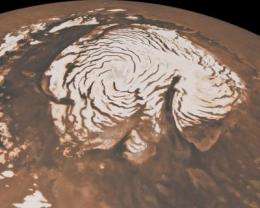
This is a view of the north polar region of Mars from orbit. The ice-rich polar cap (quasi-circular white area at center) is about 1,000 km across. It is bisected by a large canyon, Chasma Boreale, on the right side. Dark, spiral-shaped bands are troughs. Chasma Boreale is about the length of the Grand Canyon in the US and up to 2 km deep. Credit: NASA/Caltech/JPL/E. DeJong/J. Craig/M. Stetson

Scientists have reconstructed the formation of two curious features in the northern ice cap of Mars—a chasm larger than the Grand Canyon and a series of spiral troughs—solving a pair of mysteries dating back four decades while finding new evidence of climate change on Mars.

In a pair of papers to be published in the journal Nature on May 27, Jack Holt and Isaac Smith of The University of Texas at Austin's Institute for Geophysics and their colleagues describe how they used collected by NASA's Reconnaissance Orbiter to reveal the subsurface geology of the red planet's northern ice cap.

On Earth, large ice sheets are shaped mainly by ice flow. But on Mars, according to this latest research, other forces have shaped, and continue to shape, the caps.

The northern ice cap is a stack of ice and dust layers up to two miles (three kilometers) deep covering an area slightly larger than Texas. Analyzing radar data on a computer, scientists can peel back the layers like an onion to reveal how the ice cap evolved over time.

One of the most distinctive features of the northern ice cap is Chasma Boreale, a canyon about as long as the Grand Canyon but deeper and wider. Some scientists have suggested Chasma Boreale was created when volcanic heat melted the bottom of the ice sheet and triggered a catastrophic flood. Others have suggested strong polar winds, called katabatics, carved the canyon out of a dome of ice.
Planetary scientists solve 40-year-old mysteries of Mars' northern ice cap
Enlarge

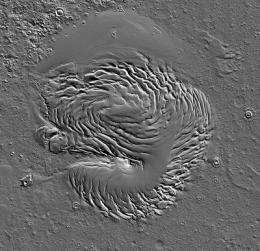
Morphology of the north polar region of Mars. Spiral troughs are seen throughout the ice-rich polar cap (quasi-circular dome at center), and Chasma Boreale is the large canyon dividing the polar cap into two lobes. Chasma Boreale is the size of the Grand Canyon in the US and up to 2 kilometers deep. Shaded-relief image based on Mars Orbiter Laser Altimeter data. Credit: NASA/GSFC

Other enigmatic features are troughs that spiral outward from the center of the ice cap like a gigantic pinwheel. Since they were discovered in 1972, scientists have proposed several hypotheses for how they formed. One suggested that as the planet spins, ice closer to the poles moves slower than ice farther from the poles, causing the semi-fluid ice to crack. Another used an elaborate mathematical model to suggest how increased solar heating in certain areas and lateral heat conduction could cause the troughs to self assemble.

It turns out both the spiral troughs and Chasma Boreale were created and shaped primarily by wind. But rather than being cut into existing ice very recently, the features formed over millions of years as the ice sheet itself grew. By influencing wind patterns, the topography of underlying, older ice controlled where and how the features grew. Topography is the three-dimensional shape of a surface, including peaks, valleys, slopes and plains.

Before this research, conventional wisdom held that the northern ice cap of Mars was made of many relatively flat layers like a layered cake. It was assumed some climate information would be recorded in the layers, limited to what could be gained from layer thickness and dust content. This research, however, reveals many complex features—including layers that change in thickness and orientation, or abruptly disappear in some places—making it a virtual gold mine of climate information.

"Nobody realized that there would be such complex structures in the layers," says Holt, lead author of the paper focusing on Chasma Boreale. "The layers record a history of ice accumulation, erosion and wind transport. From that, we can recover a history of climate that's much more detailed than anybody expected."
Planetary scientists solve 40-year-old mysteries of Mars' northern ice cap
Enlarge

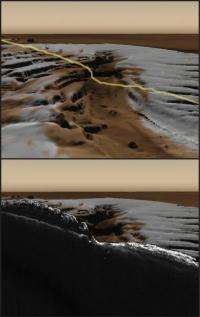
The top panel shows a perspective view of northern polar cap of Mars, looking up Chasma Boreale. The yellow line indicates ground track of SHARAD in orbit. The bottom panel shows a cutaway view of same, showing subsurface layers as viewed by SHARAD. Detailed mapping of layers over many orbits reveals the history of ice accumulation and chasma formation. Credit: NASA/Caltech/JPL/E. DeJong/J. Craig/M. Stetson

The spiral trough results vindicate an early explanation that had fallen out of favor in parts of the Mars scientific community. Alan Howard, a researcher at the University of Virginia, proposed just such a process in 1982 based solely on images of the surface from the Viking mission.

"He only had Viking images with relatively low resolution," says Isaac Smith, doctoral student and lead author on the spiral trough paper. Holt is second author on the trough paper. "Many people proposed other hypotheses suggesting he was wrong. But when you look at a hypothetical cross section from his paper, it looks almost exactly like what we see in the radar data."

Why are the troughs spiral shaped? First, katabatic winds are caused by relatively cold, dense air that rolls down from the poles and out over the ice cap. Second, as they blow down, they are deflected by the Coriolis force, which is caused by the planet's spinning in space. On Earth, this is what causes hurricanes to spin opposite directions in opposite hemispheres. This force twists the winds—and the troughs they create—into spiral shapes.

These breakthroughs were made possible by a new instrument called Shallow Radar (SHARAD). Similar instruments have been used on aircraft in Antarctica and Greenland, but before its use at Mars, some scientists were skeptical it would be able to collect useful data from orbit. Holt is a Co-Investigator on SHARAD.

"These anomalous features have gone unexplained for 40 years because we have not been able to see what lies beneath the surface," said Roberto Seu, team leader for the SHARAD instrument. "It is gratifying to me that with this new instrument we can finally explain them."

More information: For a gallery of images, go to: http://www.jsg.ute … _pole052610/

Provided by University of Texas at Austin (news : web)

4.8 /5 (18 votes)  

Filter


Move the slider to adjust rank threshold, so that you can hide some of the comments.


Display comments: newest first

kevinrtrs
May 27, 2010

Rank: 1 / 5 (1)
OK, I accept that this is one explanation for what is seen now. How can they verify that this explanation is actually true? What kind of predictions would such an explanation elicit about the current structure such that a future mars lander could go and verify or falsify it?

Would it be possible - seeing that there is/are deep canyons on mars - that the structure was formed in a catastrophic event or series of events by fluid motion?
Just a thought - shoot it down if you want.
Rank 4.8 /5 (18 votes)
Related Stories
Relevant PhysicsForums posts
  • Discrepancy between oxygen and carbon-dioxide levels
    created17 hours ago
  • where gems are found in the world
    created20 hours ago
  • Wind Waves in Reservoir ~ Wind run-up and Wind set-up
    createdFeb 08, 2012
  • Balance of oxygen in the atmosphere
    createdFeb 01, 2012
  • The case for a methanol-based economy
    createdJan 30, 2012
  • Weather in a rotating cylinder
    createdJan 25, 2012
  • More from Physics Forums - Earth

More news stories

Humans may have helped the decline of African rainforests 3000 years ago

(PhysOrg.com) -- Large areas of rainforests in Central Africa mysteriously disappeared over three thousand years ago, to be replaced by savannas. The prevailing theory has been that the cause was a change ...

Space & Earth / Environment

created 10 hours ago | popularity 5 / 5 (3) | comments 9 | with audio podcast report

Could Venus be shifting gear?

(PhysOrg.com) -- ESA’s Venus Express spacecraft has discovered that our cloud-covered neighbour spins a little slower than previously measured. Peering through the dense atmosphere in the infrared, the ...

Space & Earth / Space Exploration

created 6 hours ago | popularity 5 / 5 (5) | comments 7 | with audio podcast

Mars Science Laboratory computer issue resolved

(PhysOrg.com) -- Engineers have found the root cause of a computer reset that occurred two months ago on NASA's Mars Science Laboratory and have determined how to correct it.

Space & Earth / Space Exploration

created 7 hours ago | popularity 5 / 5 (5) | comments 3 | with audio podcast

Clam fields found at deep, low-temperature Mariana vents

(PhysOrg.com) -- Scientists have marveled at the unusual life forms thriving at high temperature hydrothermal vents of the deep ocean.

Space & Earth / Earth Sciences

created 6 hours ago | popularity not rated yet | comments 0 | with audio podcast

Two new moons for Jupiter

Advances in technology have lead to the discovery of new planets outside of our Solar System, and now even new moons in our own backyard.

Space & Earth / Space Exploration

created 6 hours ago | popularity not rated yet | comments 3


Human cognitive performance suffers following natural disasters, researchers find

Not surprisingly, victims of a natural disaster can experience stress and anxiety, but a new study indicates that it might also cause them to make more errors - some serious - in their daily lives. In their upcoming Human Fa ...

The power of estrogen -- male snakes attract other males

A new study has shown that boosting the estrogen levels of male garter snakes causes them to secrete the same pheromones that females use to attract suitors, and turned the males into just about the sexiest ...

New error-correcting codes guarantee the fastest possible rate of data transmission

Error-correcting codes are one of the triumphs of the digital age. They’re a way of encoding information so that it can be transmitted across a communication channel — such as an optical fiber o ...

Putting the squeeze on planets outside our solar system

(PhysOrg.com) -- Using high-powered lasers, scientists at Lawrence Livermore National Laboratory and collaborators discovered that molten magnesium silicate undergoes a phase change in the liquid state, abruptly ...

Both maternal and paternal age linked to autism

Older maternal and paternal age are jointly associated with having a child with autism, according to a recently published study led by researchers at The University of Texas Health Science Center at Houston (UTHealth).

Curry spice component may help slow prostate tumor growth

Curcumin, an active component of the Indian curry spice turmeric, may help slow down tumor growth in castration-resistant prostate cancer patients on androgen deprivation therapy (ADT), a study from researchers ...