Palaeontologists solve mystery of 500 million-year-old squid-like carnivore
May 26, 2010
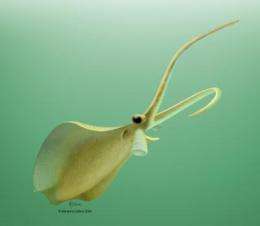
This is a reconstruction of Nectocaris pteryx. Credit: Copyright (c) 2009 Marianne Collins.
A study by researchers at the University of Toronto and the Royal Ontario Museum sheds new light on a previously unclassifiable 500 million-year-old squid-like carnivore known as Nectocaris pteryx.
"We think that this extremely rare creature is an early ancestor of squids, octopuses, and other cephalopods", says Martin Smith of U of T's Department of Ecology and Evolutionary Biology (EEB) and the Department of Natural History at the ROM. "This is significant because it means that primitive cephalopods were around much earlier than we thought, and offers a reinterpretation of the long-held origins of this important group of marine animals."
The new interpretation became possible with the discovery of 91 new fossils that were collected by the ROM from the famous Burgess Shale site (Yoho National Park) in the UNESCO World Heritage Canadian Rocky Mountain Parks, British Columbia over the past three decades, and examined by PhD student Martin Smith along with U of T EEB and Geology assistant professor and ROM palaeontologist Jean-Bernard Caron.
"Previously, all knowledge of Nectocaris came from a lone specimen described in 1976. Due to the ambiguous characteristics evident on that specimen, Nectocaris has remained unclassified until now," says Smith, lead author of the study published this week in Nature. "Our study reveals that Nectocaris is similar to known members of the modern cephalopod group, which includes squid, octopus, cuttlefish and the nautilus, as well as common fossils such as ammonites and belemnites, which are now extinct."
"We know very little about the relationships between the major groups of molluscs, and the early history of the group," says Smith. "Fossils like Nectocaris help us to map out how the groups alive today might be related, and how they evolved. This tells us something about how biodiversity originated in the past, and helps us to understand the rich tapestry of life today."
The new specimens, between two and five centimetres long, show that Nectocaris was kite-shaped and flattened from top to bottom, with large, stalked eyes and a long pair of grasping tentacles, which the researchers believe helped it to hunt for and consume prey. Smith and Caron further suggest that the creature swum using its large lateral fins, and, like modern cephalopods, probably used its nozzle-like funnel to accelerate by jet propulsion. "Some of the specimens' large gills were choked with mud, suggesting that the animals were fossilized after being caught in an underwater mud-flow," says Smith.
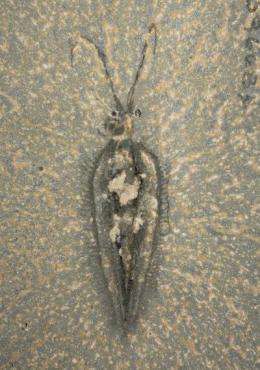
This is a Nectocaris pteryx from the Middle Cambrian Burgess Shale. Credit: Jean-Bernard Caron
"Our findings mean that cephalopods originated 30 million years earlier than we thought, and much closer to the first appearance of complex animals in the 'Cambrian explosion'" says Smith. Nectocaris does not have a mineralized shell, a fact that surprised the scientists. "It's long been thought that cephalopods evolved in the Late Cambrian period, when gradual modifications to the shells of creeping, snail-like animals made them able to float. Nectocaris shows us that the first cephalopods actually started swimming without the aid of gas-filled shells. Shells evolved much later, probably in response to increased levels of competition and predation in the Late Cambrian.""Modern cephalopods are very complex, with intricate organs and startling intelligence. We go from very simple pre-Cambrian life-forms to something as complex as a cephalopod in the geological blink of an eye, which illustrates just how quickly evolution can produce complexity."
Smith says Nectocaris proves that there are still surprises in the fossil record. "Fossils can only ever tell us a part of the story," he says. "Exceptional soft-bodied fossils such as Nectocaris, combined with advances in developmental and molecular biology, still have a lot to bring to the table, and I'm sure that they will continue to help to refine and replace our current hypotheses."
More information: The findings are presented in a paper titled "Primitive soft-bodied cephalopods from the Cambrian", to be published May 27, 2010 in Nature.
-
Fossil find fills in picture of ancient marine life
May 13, 2010 |
not rated yet |
0
-
Fossil record reveals elusive jellyfish more than 500 million years old
Oct 31, 2007 |
not rated yet |
0
-
Geologist analyzes earliest shell-covered fossil animals
Oct 22, 2009 |
not rated yet |
0
-
A convincing mimic: Scientists report octopus imitating flounder in the Atlantic (w/ Video)
Mar 03, 2010 |
not rated yet |
0
-
A new fossil species found in Spain
Mar 25, 2010 |
not rated yet |
0
-
Engineers build first sub-10-nm carbon nanotube transistor
Feb 01, 2012 |
4.9 / 5 (31) |
30
-
Something old, something new: Evolution and the structural divergence of duplicate genes
Jan 31, 2012 |
4.6 / 5 (7) |
1
-
The hidden nanoworld of ice crystals: Revealing the dynamic behavior of quasi-liquid layers
Jan 30, 2012 |
5 / 5 (3) |
1
-
Stock market network reveals investor clustering
Jan 27, 2012 |
3.9 / 5 (23) |
8
-
Of microchemistry and molecules: Electronic microfluidic device synthesizes biocompatible probes
Jan 26, 2012 |
5 / 5 (1) |
0
-
Protease cleavage
5 hours ago
-
Pertubance in a model
12 hours ago
-
Cancer drugs and Alzheimer's, Oh my!
20 hours ago
-
Squishing cells
20 hours ago
-
Any books/articles for evolutionary stable strategy models in humans?
Feb 09, 2012
-
Science behind the bore feeling?
Feb 09, 2012
- More from Physics Forums - Biology
More news stories
Employers feel no love for unscrupulous practice of 'service sweethearting'
A new study led by two Florida State University marketing professors finds that some frontline service employees who are rewarded for hikes in customer loyalty and satisfaction also may engage in "service ...
Other Sciences / Economics & Business
6 hours ago |
4 / 5 (1) |
4
A frank discussion of the power law and linking correlation to causation
(PhysOrg.com) -- Michael Stumpf a mathematics professor at Imperial College in London, and Mason Porter a lecturer at Oxford have teamed together to write and publish a perspective piece in Science regarding the in ...
The question of life in the ancient world
Theres a general feeling that we dont get the Greeks ancient or modern. Many, including heads of state like Angela Merkel, visibly shake their head in exasperation, rightly or wrongly, at ...
Other Sciences / Archaeology & Fossils
11 hours ago |
1 / 5 (1) |
4
Sonic Cradle lands spot in TED exhibition
A Simon Fraser University graduate student project that melds music, meditation and modern technology has landed a rare spot as an exhibit at TEDActive 2012 in Palm Springs, California this month.
8 hours ago |
not rated yet |
0
Chilean miners' rescue capsule on show in London
The capsule used to rescue Chilean miners trapped underground for two months goes on display Saturday at the Science Museum in London -- the first time it has been seen in Europe.
10 hours ago |
not rated yet |
0
Google users warned of threat to smartphone wallets
Users of Google smartphone wallets were being warned on Friday that there is a way to crack pass codes intended to thwart thieves from going on illicit shopping sprees.
Anonymous knocks CIA website offline (Update)
The website of the Central Intelligence Agency was inaccessible on Friday after the hacker group Anonymous claimed to have knocked it offline.
Complex wiring of the nervous system may rely on a just a handful of genes and proteins
Researchers at the Salk Institute have discovered a startling feature of early brain development that helps to explain how complex neuron wiring patterns are programmed using just a handful of critical genes. ...
NASA sees wide-eyed cyclone Jasmine
Cyclone Jasmine's eye has opened wider on NASA satellite imagery, as it moves through the Southern Pacific Ocean.
Putting the squeeze on planets outside our solar system
(PhysOrg.com) -- Using high-powered lasers, scientists at Lawrence Livermore National Laboratory and collaborators discovered that molten magnesium silicate undergoes a phase change in the liquid state, abruptly ...
NASA sees Giovanna reach cyclone strength, threaten Madagascar
Tropical Storm 12S built up steam and became a cyclone on February 10, 2012 as NASA's Terra satellite passed overhead. Residents of east-central Madagascar should prepare for this cyclone to make landfall ...

May 27, 2010
Rank: not rated yet
...And yet, I can't help being hopeful. The idea of Anomalocaris having had living descendants is just so wonderful...Bah. Mustn't get hopes up. Besides, interpretations of fossils DO change over time, and it seems unlikely that this particular interpretation'll go completely unchallenged. Wait and see, I suppose, and keep the name Nectocaris in mind.