Nanoshell structures: Self-assembly method yields materials with unique optical properties
May 27, 2010
Optical Legos: Building nanoshell structures

Enlarge

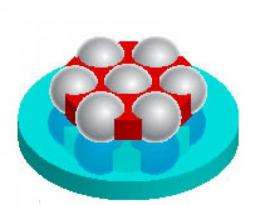
Heptamers containing seven nanoshells have unique optical properties. Credit: Rice University

Scientists from four U.S. universities have created a way to use Rice University's light-activated nanoshells as building blocks for 2-D and 3-D structures that could find use in chemical sensors, nanolasers and bizarre light-absorbing metamaterials. Much as a child might use Lego blocks to build 3-D models of complex buildings or vehicles, the scientists are using the new chemical self-assembly method to build complex structures that can trap, store and bend light.

The research appears in this week's issue of the journal Science.

"We used the method to make a seven-nanoshell structure that creates a particular type of interference pattern called a Fano resonance," said study co-author Peter Nordlander, professor of physics and astronomy at Rice. "These resonances arise from peculiar effects, and they occur only in man-made materials. Because these heptamers are self-assembled, they are relatively easy to make, so this could have significant commercial implications."

Because of the unique nature of Fano resonances, the new materials can trap light, store energy and bend light in bizarre ways that no natural material can. Nordlander said the new materials are ideally suited for making ultrasensitive biological and chemical sensors. He said they may also be useful in nanolasers and potentially in integrated photonic circuits that run off of light rather than electricity.

The research team was led by Harvard University applied physicist Federico Capasso and also included nanoshell inventor Naomi Halas, Rice's Stanley C. Moore Professor in Electrical and Computer Engineering and professor of physics, chemistry and biomedical engineering.

Nordlander, the world's leading theorist on nanoparticle plasmonics, had predicted in 2008 that a heptamer of nanoshells would produce Fano resonances. That paper spurred Capasso's efforts to fabricate the structure, Nordlander said.

The new self-assembly method developed by Capasso's team was also used to make magnetic three-nanoshell "trimers." The optical properties of these are described in the Science paper, which also discusses how the self-assembly method could be used to build even more complex 3-D structures.

Nanoshells, the building blocks that were used in the new study, are about 20 times smaller than red blood cells. In form, they resemble malted milk balls, but they are coated with gold instead of chocolate, and their center is a sphere of glass. By varying the size of the glass center and the thickness of the gold shell, Halas can create nanoshells that interact with specific wavelengths of light.

"Nanoshells were already among the most versatile of all plasmonic nanoparticles, and this new method for complex 2-D and 3-D structures simply adds to that," said Halas, who has helped develop a number of biological applications for , including diagnostic applications and a minimally invasive procedure for treating cancer.

Provided by Rice University (news : web)

4.8 /5 (9 votes)  

Filter


Move the slider to adjust rank threshold, so that you can hide some of the comments.


Display comments: newest first

Quantum_Conundrum
May 27, 2010

Rank: not rated yet
[quote]He said they may also be useful in nanolasers and potentially in integrated photonic circuits that run off of light rather than electricity.[/quote]

Lol. Perfect.

Imagine how much weight and space you could save in modern machines: computers, and automobiles, etc, if you could cut the amount of wiring needed to a mere fraction? If your fuel sensors used light to both recieve and transmit data, as well as recieve power, instead of electrical wiring, etc...

Or poentiality for a servo motor that runs on light instead of electrical wiring...

Would be interested to see the obvious "scaled up" versions of this hexagonal pattern (ring 3=12 shells, ring 4=18 shells, etc,) to see what unique properties they might have...rotationally symetrical shapes are interesting for possibly motors, drills, saws, and generators...

Also would be interested to see if similar nano-devices could be made with aluminum, iron, silver, copper, or titanium instead of the gold...
Parsec
May 28, 2010

Rank: not rated yet

Also would be interested to see if similar nano-devices could be made with aluminum, iron, silver, copper, or titanium instead of the gold...


The metals in this list would probably not have the special optical properties of gold. However, its always interesting to have a new fabrication technique if platinum, palladium, etc. could be substituted, possibly in catalyst design.
Rank 4.8 /5 (9 votes)
Related Stories
Relevant PhysicsForums posts
  • polymer nanocomposites
    created21 hours ago
  • Corrosion Tests on Magnesium
    createdFeb 09, 2012
  • polyethylene copper nanocomposite
    createdFeb 09, 2012
  • Output of xrd analysis
    createdFeb 08, 2012
  • Transport phenomena problem based on problems 18.B11 and 19B.6 from Bird, stewart, lw
    createdFeb 06, 2012
  • Help with material selection - Car Piston
    createdFeb 05, 2012
  • More from Physics Forums - Materials & Chemical Engineering

More news stories

What lies beneath: Mapping hidden nanostructures

The ability to diagnose and predict the properties of materials is vital, particularly in the expanding field of nanotechnology. Electron and atom-probe microscopy can categorize atoms in thin sheets of material, ...

Nanotechnology / Nanophysics

created 13 hours ago | popularity 5 / 5 (1) | comments 1

New kind of solar cell could capture significantly more energy than current cells

New solar cells could increase the maximum efficiency of solar panels by over 25%, according to scientists from the University of Cambridge.

Nanotechnology / Nanophysics

created Feb 08, 2012 | popularity 4.5 / 5 (12) | comments 14 | with audio podcast

Nanoshell whispering galleries improve thin solar panels

Visitors to Statuary Hall in the U.S. Capitol Building may have experienced a curious acoustic feature that allows a person to whisper softly at one side of the cavernous, half-domed room and for another on ...

Nanotechnology / Nanomaterials

created Feb 07, 2012 | popularity 4.3 / 5 (6) | comments 6 | with audio podcast

'Dark plasmons' transmit energy

Microscopic channels of gold nanoparticles have the ability to transmit electromagnetic energy that starts as light and propagates via "dark plasmons," according to researchers at Rice University.

Nanotechnology / Nanophysics

created Feb 09, 2012 | popularity 5 / 5 (6) | comments 1 | with audio podcast

Revealing how a battery material works

Since its discovery 15 years ago, lithium iron phosphate (LiFePO4) has become one of the most promising materials for rechargeable batteries because of its stability, durability, safety and ability to deliver ...

Nanotechnology / Nanomaterials

created Feb 08, 2012 | popularity 5 / 5 (5) | comments 0 | with audio podcast


Anonymous knocks CIA website offline (Update)

The website of the Central Intelligence Agency was inaccessible on Friday after the hacker group Anonymous claimed to have knocked it offline.

Google users warned of threat to smartphone wallets

Users of Google smartphone wallets were being warned on Friday that there is a way to crack pass codes intended to thwart thieves from going on illicit shopping sprees.

New error-correcting codes guarantee the fastest possible rate of data transmission

Error-correcting codes are one of the triumphs of the digital age. They’re a way of encoding information so that it can be transmitted across a communication channel — such as an optical fiber o ...

Complex wiring of the nervous system may rely on a just a handful of genes and proteins

Researchers at the Salk Institute have discovered a startling feature of early brain development that helps to explain how complex neuron wiring patterns are programmed using just a handful of critical genes. ...

Humans may have helped the decline of African rainforests 3000 years ago

(PhysOrg.com) -- Large areas of rainforests in Central Africa mysteriously disappeared over three thousand years ago, to be replaced by savannas. The prevailing theory has been that the cause was a change ...

The power of estrogen -- male snakes attract other males

A new study has shown that boosting the estrogen levels of male garter snakes causes them to secrete the same pheromones that females use to attract suitors, and turned the males into just about the sexiest ...