Scientists detect huge carbon 'burp' that helped end last ice age
May 27, 2010
(PhysOrg.com) -- Scientists have found the possible source of a huge carbon dioxide 'burp' that happened some 18,000 years ago and which helped to end the last ice age.
The results provide the first concrete evidence that carbon dioxide (CO2) was more efficiently locked away in the deep ocean during the last ice age, turning the deep sea into a more 'stagnant' carbon repository - something scientists have long suspected but lacked data to support.
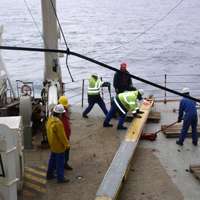
Working on a marine sediment core recovered from the Southern Ocean floor between Antarctica and South Africa, the international team led by Dr Luke Skinner of the University of Cambridge radiocarbon dated shells left behind by tiny marine creatures called foraminifera (forams for short).
By measuring how much carbon-14 (14C) was in the bottom-dwelling forams' shells, and comparing this with the amount of 14C in the atmosphere at the time, they were able to work out how long the CO2 had been locked in the ocean.
By linking their marine core to the Antarctic ice-cores using the temperature signal recorded in both archives, the team were also able compare their results directly with the ice-core record of past atmospheric CO2 variability.
According to Dr Skinner: "Our results show that during the last ice age, around 20,000 years ago, carbon dioxide dissolved in the deep water circulating around Antarctica was locked away for much longer than today. If enough of the deep ocean behaved in the same way, this could help to explain how ocean mixing processes lock up more carbon dioxide during glacial periods."
Throughout the past two million years (the Quaternary), the Earth has alternated between ice ages and warmer interglacials. These changes are mainly driven by alterations in the Earth's orbit around the sun (the Milankovic theory).
But changes in Earth's orbit could only have acted as the 'pace-maker of the ice ages' with help from large, positive feedbacks that turned this solar 'nudge' into a significant global energy imbalance.
Changes in atmospheric CO2 were one of the most important of these positive feedbacks, but what drove these changes in CO2 has remained uncertain.
Because the ocean is a large, dynamic reservoir of carbon, it has long been suspected that changes in ocean circulation must have played a major role in motivating these large changes in CO2. In addition, the Southern Ocean around Antarctica is expected to have been an important centre of action, because this is where deep water can be lifted up to the sea surface and 'exhale' its CO2 to the atmosphere.
Scientists think more CO2 was locked up in the deep ocean during ice ages, and that pulses or 'burps' of CO2 from the deep Southern Ocean helped trigger a global thaw every 100,000 years or so. The size of these pulses was roughly equivalent to the change in CO2 experienced since the start of the industrial revolution.
If this theory is correct, we would expect to see large transfers of carbon from the ocean to the atmosphere at the end of each ice age. This should be most obvious in the relative concentrations of radiocarbon (14C) in the ocean and atmosphere; 14C decays over time and so the longer carbon is locked up in the deep sea, the less 14C it contains.
As well as providing evidence for rapid release of carbon dioxide during deglaciation, the research illustrates how the ocean circulation can change significantly over a relatively short space of time.
"Our findings underline the fact that the ocean is a large and dynamic carbon pool. This has implications for proposals to pump carbon dioxide into the deep sea as a way of tackling climate change, for example. Such carbon dioxide would eventually come back up to the surface, and the question of how long it would take would depend on the state of the ocean circulation, as illustrated by the last deglaciation," says Dr Skinner.
The results are published today in Science.
More information: Skinner, L.C., Fallon, S. Waelbroeck, C., Michel, E. and Barker S., 'Ventilation of the deep Southern Ocean and deglacial CO2 rise' is published in Science on 27 May 2010.
-
Climate change will affect carbon sequestration in oceans, model shows
Sep 07, 2005 |
not rated yet |
0
-
Wind shifts may stir CO2 from Antarctic depths
Mar 12, 2009 |
not rated yet |
0
-
Ocean iron and CO2 interaction studied
Apr 26, 2007 |
not rated yet |
0
-
Ice core studies confirm accuracy of climate models
Sep 11, 2008 |
not rated yet |
0
-
Burying crop residues at sea may help reduce global warming
Feb 02, 2009 |
not rated yet |
0
-
Stars containing dark matter should look different from other stars
Feb 20, 2012 |
4.5 / 5 (17) |
11
-
Physicists discover evidence of rare hypernucleus, a component of strange matter
Feb 17, 2012 |
4.7 / 5 (38) |
22
-
Fast photon control brings quantum photonic technologies closer
Feb 13, 2012 |
5 / 5 (8) |
1
-
Engineers build first sub-10-nm carbon nanotube transistor
Feb 01, 2012 |
4.9 / 5 (36) |
32
-
Something old, something new: Evolution and the structural divergence of duplicate genes
Jan 31, 2012 |
4.6 / 5 (7) |
1
-
Is the Earth really going to die
11 hours ago
-
Do some geologists actually act a lot like Randy Marsh?
Feb 11, 2012
-
Discrepancy between oxygen and carbon-dioxide levels
Feb 09, 2012
-
where gems are found in the world
Feb 09, 2012
-
Wind Waves in Reservoir ~ Wind run-up and Wind set-up
Feb 08, 2012
-
Balance of oxygen in the atmosphere
Feb 01, 2012
- More from Physics Forums - Earth
More news stories
Spitzer finds solid buckyballs in space
(PhysOrg.com) -- Astronomers using data from NASA's Spitzer Space Telescope have, for the first time, discovered buckyballs in a solid form in space. Prior to this discovery, the microscopic carbon spheres ...
11 hours ago |
4.7 / 5 (12) |
6
|
Going up: Japan builder eyes space elevator
A Japanese construction firm claimed Wednesday it could execute an out-of-this-world plan to put tourists in space within 40 years by building an elevator that stretches a quarter of the way to the moon.
Space & Earth / Space Exploration
18 hours ago |
3.5 / 5 (13) |
25
ENASA satellite finds Earth's clouds are getting lower
(PhysOrg.com) -- Earth's clouds got a little lower -- about one percent on average -- during the first decade of this century, finds a new NASA-funded university study based on NASA satellite data. The results ...
Space & Earth / Earth Sciences
15 hours ago |
5 / 5 (8) |
11
|
Fresh scandal embroils US climate science debate
A fresh scandal over climate change has erupted in the United States after leaked documents appeared to show a right-wing funded campaign to influence how climate science is taught in schools.
8 hours ago |
4.5 / 5 (8) |
7
World's oceans get an acid bath
Among the repercussions of global climate change, the effect of ocean acidification on marine life is one of the least-understood variables.
15 hours ago |
4.3 / 5 (6) |
4
|
CT colonography shown to be comparable to standard colonoscopy
Computerized tomographic (CT) colonography (CTC), also known as virtual colonoscopy, is comparable to standard colonoscopy in its ability to accurately detect cancer and precancerous polyps in people ages 65 and older, according ...
Study: Virtual colonoscopy effective screening tool for adults over 65
Computed tomography (CT) colonography can be used as a primary screening tool for colorectal cancer in adults over the age of 65, according to a new study published online in the journal Radiology.
Researchers build first physical 'metatronic' circuit
(PhysOrg.com) -- The technological world of the 21st century owes a tremendous amount to advances in electrical engineering, specifically, the ability to finely control the flow of electrical charges using ...
Faster than light neutrinos? More like faulty wiring
You can shelf your designs for a warp drive engine (for now) and put the DeLorean back in the garage; it turns out neutrinos may not have broken any cosmic speed limits after all.
Physicists surprised by disappearing and reappearing superconductivity in iron selenium chalcogenides
Superconductivity is a rare physical state in which matter is able to conduct electricity -- maintain a flow of electrons -- without any resistance. This phenomenon can only be found in certain materials at low temperatures, ...
Stanford research team cracks animated NuCaptcha
(PhysOrg.com) -- The research team from Stanford University, led by Elie Bursztein, that previously had cracked regular CAPTCHAs and then audio CAPTCHAs, now has also successfully cracked the animated version called NuCapt ...
May 27, 2010
Rank: 2 / 5 (10)
Fluid CO2 is trapped in the Earth's upper mantle under extreme pressure.
The decay products of extinct I-129 and Pu-244 from the nuclear reactions that made our elements were found in CO2 gas wells [Science 174, 1334-1336 (1971) ] and in fluid CO2 inclusions of an olivine xenolith tossed out of a deep Hawaiian volcano [Nature 257, 778-780 (1975)].
With kind regards,
Oliver K. Manuel
May 27, 2010
Rank: 3.6 / 5 (5)
May 27, 2010
Rank: 4.6 / 5 (9)
These findings certainly call into question any strategy involving storing CO2 in the deep ocean. Of course, basaltic reservoirs in deep earth storage have been shown to store the CO2 chemically rather than mechanically, presumably tying up the CO2 indefinitely. Even if those CO2 altered rocks were exposed to the surface, they would not release CO2 except by acidic weathering.
Bottom line however is that this is one more piece of evidence that a 30-40% increase in CO2 atmospheric concentration has huge climate consequences.
May 27, 2010
Rank: 1 / 5 (1)
May 28, 2010
Rank: not rated yet
May 28, 2010
Rank: not rated yet
May 29, 2010
Rank: 1.8 / 5 (5)
May 29, 2010
Rank: 3 / 5 (3)
Until a great deal more research is done, it is clear that the risks of AGW are as uncertain as the risks of "volcanic ash" to airplanes or the risk of deep ocean drilling to coastlines!
We are being regularly bombarded with abundant evidence that we have no clue about the relative risks we face, even in areas totally of our own making like finance and "derivitives". ...and yet we have egotistical fools on all sides who claim everyone else is "ignorant" and foolish.
The only truly ignorant people in this world are those who are so egotistical as to not recognize the vast limitations under which we all toil.
May 29, 2010
Rank: 4 / 5 (4)
It's not a matter of egotism. Look at the Gulf spill: a relatively small catastrophe, that's nevertheless totally out of control. AGW is a very large catastrophe in the making, yet we still have all these people who are "skeptical" and therefore argue that nothing should be done until we're absolutely certain. But that's equivalent to expressing absolute certainty that nothing should be done -- i.e. absolute certainty that anthropogenic greenhouse loading will have no catastrophic effects. Because if one is NOT absolutely certain that no damage is being done, then one would pursue and advocate aggressive action to stem the emissions and avert as much potential damage as possible -- at least, until such time as we can be CERTAIN that these emissions are not as harmful as theory indicates they will be.
May 29, 2010
Rank: 3.7 / 5 (3)
It is getting warmer, weather patterns are changing, we aren't sure why, it looks a lot like it's CO2.
We know CO2 will warm the atmosphere, and that we've been emitting a lot of it in comparison to natural variation.
We are affecting the climate system, potentially through our emissions of greenhouse gasses.
AGW is the current theory that is unrefuted and includes all facts and observations.
Until someone can present a more compelling theory, or a refutation to AGW, that's what we're going to work on. So skeptics and those who are alarmist need ot shut the hell up and start working off of the evidence towards a solution.
May 30, 2010
Rank: 1 / 5 (1)
May 30, 2010
Rank: 2.2 / 5 (6)
Simple 5th grade arithmetic using GW potential and percentage of component in air as specified by the US Dioxide Information Analysis Center and used by IPCC AR4 (2007), DOE, EPA, etc.
95% is from water vapor
5% is from 5 green house gasses (GHG)
Only 0.28% is from man-made GHG
Therefore 99.72% of GW is natural
Only 0.117% is from man-made CO2
Only 0.066% is from man-made Methane
(Reducing the 22% of US man-made GHG by 17% by 2020 as called for by HR 2454 would reduce GW by 22% of 17% of 0.28% or by 0.010472%, or about one part in ten thousand.)
The 83% emissions reduction required by the Kyota treaty might reduce GW by 0.09F by 2050 (Cliff Knappenberger).
On various time scales, from months to millions of years CO2 change always follows temperature change. CO2 change never precedes temp change. The earth was much warmer during the Minoan, Roman, and Medieval Warm periods.
AGW is a scam for money, power, global governance, redistribution of wealth
May 30, 2010
Rank: 5 / 5 (3)
Why not learn something about the subject, before accusing others of being dumb? All you've accomplished, is to advertise your own ignorance to the world. You've managed to repeat some of the most common and wide-spread misconceptions and disinformation prevalent amidst the so-called "skeptics". Personally, I'm tired of repeatedly addressing the same crap over and over, so I'll leave the detailed debunking to someone else.
As for you specifically, you might start by asking yourself whether the American Institute of Physics is collectively smarter than a 5th grader. Then, depending on your conclusion, you might want to start your education with this:
http://www.aip.or.../co2.htm
May 31, 2010
Rank: 1.7 / 5 (6)
I shall respond in kind! I am disgusted with the arrogant, insolent, ignorant AGW promoters who refuse to research the subject and advertise their stupidity to the world. I did not accuse anyone of being dumb. My question shows how simple climate science analysis is. You failed. You are accusing scientists for CDIAC, a part of Dept. of Energy, Environmental Protection Agency, IPCC AR4, various universities and research institutes of lying! For a very simple set of tables and graphs using their arithmetic: http://www.geocra...ata.html
CDIAC data is at http://cdiac.ornl...ghg.html
Warm Periods:
http://www.friend...ents/FOS Essay/Climate_Change_Science.html
700 scientific reports
http://www.popula...ing.html
Scam:
http://www.appins...mary.htm
Video
http://www.vimeo.com/8865909
Are you a shill for CCX, GE Enron or Gore?
May 31, 2010
Rank: 1.7 / 5 (6)
No, it is not getting warmer:
All four international temperature monitors show GW stopped:
http://icecap.us/...pped.pdf
Man produces 3% of 200 billion tons of annual CO2. Man is hardly, if at all, affecting the climate system. Water vapor is responsible for 95% of GW. Man-made gasses are responsible for 0.28%. AGW has been thoroughly refuted.
There are many possible causes of Climate Change. These causes may be acting alone or in concert. For example there are the three Milankovich cycles, solar cycles, Oceanic Oscillations, 24 Dansgaard-Oeschger oscillations.
http://english.pr...06922-2/
http://www.presst...=3510208
http://www.appins..._AMO.htm
http://www.scripp...de/44463
5000 year chart warmer
http://humanbeing...-com.jpg
http://www.vimeo.com/
May 31, 2010
Rank: 4 / 5 (4)
No, Monckton's calculations and cherry picking show warming has stopped. Read more.
No, the statement of percentages is not a refutation simply because it doesn't appear that a small percentage could make the difference.
1% phosphoric acid added to pure water will drop the pH of a 5 gallon bucket from 7.0 to 2.25.
It's still only 1%. Welcome to science.
Those are the solar and thermal cycles that as so far do not explain current warming. Thanks for playing, you're very poorly read on the subject.
Jun 01, 2010
Rank: 5 / 5 (3)
So, you refuse to learn the easy way. Then let's do it the hard way. Start by double-checking your phony numbers:
http://en.wikiped...se_gases
Jun 02, 2010
Rank: 1 / 5 (3)