Arizona man is first to go home with a total artificial heart
May 28, 2010 by Lin Edwards report
Arizona man is first to go home with a total artificial heart

Enlarge

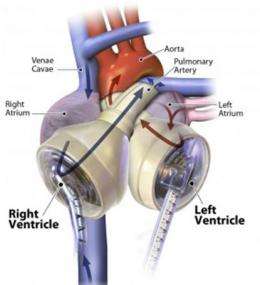
The SynCardia Total Artificial Heart

(PhysOrg.com) -- An Arizona man has left hospital with a completely artificial heart beating in his chest. Father of three Charles Okeke, 43, from Phoenix is the first person to leave hospital with a Total Artificial Heart keeping him alive until he receives a donor heart.

The US (FDA) first approved the for implantation into humans in 2004, and since then around 850 people around the globe have received them. The device uses synthetic pumping chambers to replace the failing left and right ventricles of the recipient’s own heart.

The artificial heart is designed to be used temporarily until a donated heart is available, and recipients have all had to remain in hospital while the heart was fitted, in some cases as long as two and a half years. The artificial heart is used only in patients who have both ventricles failing and enables 80 percent of them to survive long enough to receive the donated heart.

The artificial heart is made in Tucson, Arizona by SynCardia Systems. It consists of a vessel resembling an upside-down funnel and a flexible diaphragm. Surgeons replace each existing ventricle with a vessel and remove all four . They then hook up the artificial “ventricles” to the , with the right vessel receiving blood and pumping it to the lungs for oxygenation, and the left pumping the oxygenated blood to the rest of the body.

The device requires pressurized air from an external machine called “Big Blue,” and the bulk and size of the 190 kg machine has until now prevented recipients from leaving hospital. In the case of Charles Okeke a smaller 6.1 kg version of the pressurizing machine, dubbed “Freedom Driver,” has been used, and this is small enough to fit in a backpack.

This video is not supported by your browser at this time.

Okeke must wear the backpack at all times, but it has at least given him the freedom to leave hospital and go home, after already spending over 600 days in the Mayo Clinic wired up to Big Blue. Okeke’s heart failed after a blood clot “destroyed his heart” and had a heart transplant that lasted around 10 years before his body rejected it.

According to SynCardia, the company now has permission to use the Freedom Driver with 60 more patients. Of these, half will remain in hospital and half will be allowed to go home, which will allow the scientists to compare the health outcomes of the two groups.

SynCardia spokesman Don Isaacs said the artificial ventricles are designed to prevent blood clots forming, but with any device in which tubes pass from outside the body to the inside there is always a risk of infection.

More information: http://www.syncard … l-Heart.html

© 2010 PhysOrg.com

4.7 /5 (26 votes)  

Filter


Move the slider to adjust rank threshold, so that you can hide some of the comments.


Display comments: newest first

ealex
May 28, 2010

Rank: 5 / 5 (4)
Awesome. One more step forward for cardiac medicine.
neiorah
May 28, 2010

Rank: 5 / 5 (2)
wow, it been a long time since the first artificial heart was constructed. It is great that the technology has improved to the point that the patient can go home.
MadPutz
May 28, 2010

Rank: 5 / 5 (1)
Just as with the iron lung, things get better
MarkyMark
May 29, 2010

Rank: 5 / 5 (3)
I really felt for him when he embraced his children at his home.

I wish him well.
trekgeek1
Jun 02, 2010

Rank: not rated yet
Wow, it's amazing technology but still so primitive. I'd be afraid to even move and risk damaging it. I'm so glad that technological advancement is inevitable and soon we will have the capacity to replace the human heart with a perfect mechanical substitute, or just create a new biological replacement, made to order.
cokeke
Jun 29, 2010

Rank: 5 / 5 (1)
Im happy that they put up an article about my dad.
cokeke
Jun 29, 2010

Rank: 5 / 5 (1)
Im happy that they put up an article about my dad.
Rank 4.7 /5 (26 votes)
Related Stories
Relevant PhysicsForums posts
  • Is Everyday Technology Killing Us?
    createdFeb 08, 2012
  • Exercise and weight loss
    createdFeb 08, 2012
  • Why do we have head aches? Our brains can't feel anything.
    createdFeb 07, 2012
  • "The end of diseases" by David Agus, interview from Daily Show with Jon Stewart
    createdFeb 04, 2012
  • Oncolytic adenovirus
    createdFeb 04, 2012
  • Nutrition label stuffs and diets
    createdFeb 02, 2012
  • More from Physics Forums - Medical Sciences

More news stories

Complex wiring of the nervous system may rely on a just a handful of genes and proteins

Researchers at the Salk Institute have discovered a startling feature of early brain development that helps to explain how complex neuron wiring patterns are programmed using just a handful of critical genes. ...

Medicine & Health / Research

created 4 hours ago | popularity 5 / 5 (7) | comments 0 | with audio podcast

Both maternal and paternal age linked to autism

Older maternal and paternal age are jointly associated with having a child with autism, according to a recently published study led by researchers at The University of Texas Health Science Center at Houston (UTHealth).

Medicine & Health / Psychology & Psychiatry

created 9 hours ago | popularity 5 / 5 (1) | comments 0 | with audio podcast

New understanding of DNA repair could eventually lead to cancer therapy

A research group in the Faculty of Medicine & Dentistry at the University of Alberta is hoping its latest discovery could one day be used to develop new therapies that target certain types of cancers.

Medicine & Health / Cancer

created 8 hours ago | popularity 4.8 / 5 (4) | comments 0 | with audio podcast

Curry spice component may help slow prostate tumor growth

Curcumin, an active component of the Indian curry spice turmeric, may help slow down tumor growth in castration-resistant prostate cancer patients on androgen deprivation therapy (ADT), a study from researchers ...

Medicine & Health / Cancer

created 10 hours ago | popularity 4.5 / 5 (6) | comments 0 | with audio podcast

Human cognitive performance suffers following natural disasters, researchers find

Not surprisingly, victims of a natural disaster can experience stress and anxiety, but a new study indicates that it might also cause them to make more errors - some serious - in their daily lives. In their upcoming Human Fa ...

Medicine & Health / Psychology & Psychiatry

created 6 hours ago | popularity 4 / 5 (1) | comments 0


Google users warned of threat to smartphone wallets

Users of Google smartphone wallets were being warned on Friday that there is a way to crack pass codes intended to thwart thieves from going on illicit shopping sprees.

Anonymous knocks CIA website offline (Update)

The website of the Central Intelligence Agency was inaccessible on Friday after the hacker group Anonymous claimed to have knocked it offline.

New error-correcting codes guarantee the fastest possible rate of data transmission

Error-correcting codes are one of the triumphs of the digital age. They’re a way of encoding information so that it can be transmitted across a communication channel — such as an optical fiber o ...

Putting the squeeze on planets outside our solar system

(PhysOrg.com) -- Using high-powered lasers, scientists at Lawrence Livermore National Laboratory and collaborators discovered that molten magnesium silicate undergoes a phase change in the liquid state, abruptly ...

The power of estrogen -- male snakes attract other males

A new study has shown that boosting the estrogen levels of male garter snakes causes them to secrete the same pheromones that females use to attract suitors, and turned the males into just about the sexiest ...

NASA sees wide-eyed cyclone Jasmine

Cyclone Jasmine's eye has opened wider on NASA satellite imagery, as it moves through the Southern Pacific Ocean.