Europa's Churn Leads to Oxygen Burn
May 28, 2010 by Charles Q. Choi
Europa's Churn Leads to Oxygen Burn

Enlarge

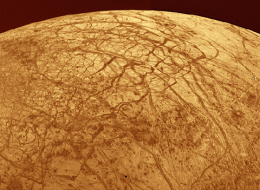
The surface of Europa shows signs of cracks that could allow material to pass to and fro between the ocean below and the irradiated surface. Credit: Calvin J. Hamilton, Voyager Project, JPL, NASA

Jupiter’s moon Europa has a salty ocean, and scientists have long wondered if life could be found there. One scientist says Europa also has enough oxygen to support an ocean teeming with life.

There may be enough oxygen in the waters of Jupiter's moon Europa to support millions of tons worth of fish, according to a new study. While no one is suggesting there are fish on Europa, this finding suggests the Jovian satellite could be capable of supporting the kinds of life familiar to us here on Earth.

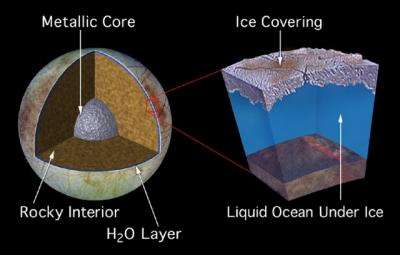
Europa, which is roughly the size of Earth's moon, is enveloped by a global ocean about 100 miles deep (160 km), with an icy crust that may be only a few miles thick. From what we know of Earth, where there is water, there is a chance at life, so for many years scientists have speculated that this Jovian moon could support extraterrestrials.

As we learned more about Jupiter’s effect on its moons, the possibility for life on Europa grew even more likely. Studies showed the moon could have enough oxygen to support the kind of life we are most familiar with on Earth. The ice on the surface, like all water, is made from hydrogen and oxygen, and the constant stream of pouring in from Jupiter reacts with this ice to form free oxygen and other oxidants such as . The reactivity of oxygen is key to generating the energy that helped multi-cellular life flourish on our planet.

Still, researchers had thought there was no effective method for delivering any of this oxygen-rich matter into Europa's ocean. Scientists had assumed the primary way for surface materials to migrate downward was from the impacts it would suffer from cosmic debris, which regularly bombards everything in our . However, past calculations suggested that even after a few billion years, such "impact gardening" would never lead to an oxygenated layer more than some 33 feet (10 meters) deep into the ice shell, nowhere far enough down to reach the underlying ocean.
Europa's Churn Leads to Oxygen Burn
Enlarge

A model of Europa's interior, including a global ocean. If a 100 kilometer-deep ocean existed below Europa’s ice shell, it would be 10 times deeper than any ocean on Earth and would contain twice as much water as Earth's oceans and rivers combined. Image Credit: NASA/JPL

However, the new study suggests this oxygen-rich layer could be far thicker than before thought, potentially encompassing the entire crust. The key is looking at other ways to stir Europa's crust, explained researcher Richard Greenberg, a planetary scientist at the University of Arizona's Lunar and Planetary Laboratory at Tucson.

The gravitational pull Europa experiences from leads to tidal forces roughly 1,000 times stronger than what Earth feels from our moon, flexing and heating Europa and making it very active geologically. This could explain why its surface appears no older than 50 million years old — its surface underwent complete turnover in that time.

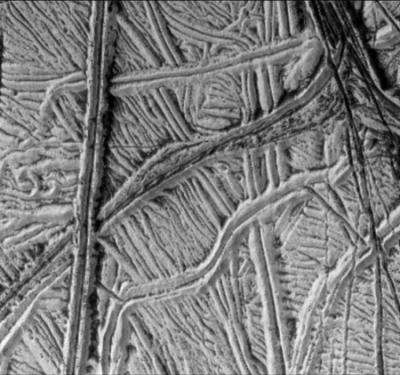
A major resurfacing process on Europa seems to be the formation of double ridges, which cover at least half of its surface. Tidal forces may be causing fresh ice from below — probably newly frozen ocean water — to push upward and over the surface, where it would slowly get oxygenated. As ridges pile on top of ridges, older material gets buried, shoving this oxygen-rich matter downward. After one or two billion years, this process alone could spread oxidants throughout the entire crust, thus reaching the ocean, Greenberg calculated.

Other mechanisms could help stir Europa's crust also. Parts of the surface could partially melt from below, leading rafts of ice to break loose and tumble around before they froze back in place. Roughly 40 percent of Europa's crust appears to be covered with the ensuing "chaotic terrain." Also, as matter comes up from below and widens cracks, the nearby surface crumples, burying some material. These extra processes could help push some oxidants downward, but it would still take at least two billion years or so before radiation loaded the entire crust with oxygen.

As ice on the base of this oxygenated crust melts, even with the most conservative assumptions, after only a half-million years oxidant levels in the ocean would reach the minimum oxygen concentration seen in Earth's oceans, which on Earth is enough to support small crustaceans, Greenberg found. In only 12 million years, oxidant concentrations would reach the same saturation levels of Earth's oceans, enough to support our largest sea life. Given the cold temperatures and high pressures likely seen in Europa's ocean, it could actually take in more oxygen than Earth's oceans could before its water reached its saturation point.
Europa's Churn Leads to Oxygen Burn
Enlarge

Double ridges cover at least half the surface of Europa’s ice shell. Image credit: NASA/JPL

"I was surprised at how much oxygen could get down there," Greenberg said.

One concern about all this oxygen was that it might actually do more harm than good. The extraordinary reactivity of oxygen could in principle disrupt the chemical processes that are thought to lead to the origin of life and that may have been an aspect of early life. On Earth, life had more than a billion years to evolve, before oxygen became plentiful in the atmosphere, and that delay gave organisms plenty of time to develop genetic mechanisms and physical structures that allowed them to use oxygen, instead of being destroyed by it.

The delay of 1 to 2 billion years before oxygen in Europa's crust made its way into its ocean is roughly the same amount of time it took life on Earth to develop before oxygen became a problem, so life might have enough of a respite to develop on the Jovian moon. Assuming life on Europa respired at rates similar to fish on Earth, the continuous rate of oxygen delivery there could sustain roughly 3 million metric tons of life, Greenberg said.

One might not have to wait for a probe to land on Europa to detect any there. "Spectroscopy done by telescopes on Earth or in orbit can tell what substances are mixed into the ice," Greenberg said.

Greenberg detailed his findings May 6 in the journal Astrobiology.

Source: Astrobio.net

Filter


Move the slider to adjust rank threshold, so that you can hide some of the comments.


Display comments: newest first

antialias_physorg
May 28, 2010

Rank: 5 / 5 (5)
Europa is such a fascinating moon, I really think this should be the target of a comprehensive mission (lander, explore-bot, possibly a melt probe). It should be prioritized even beyond a mission to Mars.

And THIS time PLEASE take a microscope along so we can REALLY look for life instead of just secondary/tertiary indications that might suggest life?
probes
May 28, 2010

Rank: 1.7 / 5 (7)
They could probably send a probe there in about ten minutes if they used a VASIMR engine.
Quantum_Conundrum
May 28, 2010

Rank: not rated yet
I agree this should be the target of a new mission. It makes more sense to go here or to the Jupiter Trojans than much of anywhere else in the known solar system, due to the potential materials available

I think Europa or Enceladus, or maybe a Jupiter Trojan since it's farther away from the radiation of Jupiter, might be the keys to cost-effective colonization of mars and the moon due to the abundance of water, and consequently hydrogen and oxygen.

However, a lander for Europa would likely need to be nuclear powered, because Solar just isn't going to cut it for a lander. Jupiter is about the farthest that solar panels would work at all within any reasonable weight limits for a mission. At that distance from the sun, you'd need to land about 12 times as much surface area worth of Solar panels to power a lander as compared to a martian lander.

An alternate power supply? Figure out a way to harness the radiation or magnetism coming from Jupiter, but that seems highly unlikely.
antialias_physorg
May 28, 2010

Rank: 5 / 5 (1)
I think Europa or Enceladus, or maybe a Jupiter Trojan since it's farther away from the radiation of Jupiter,


Since any colonization of Europa would have to be underground (it has no atmosphere to speak of and you also need to protect yourself from the odd meteorite and cosmic rays) I don't think that's much of a problem.

Actually, being on a ball of ice would be ideal, since building underground caves in ice is really simple to do. If you have an energy generator then you can also manufacture as much clean water and air as you want - two essentials for any colonization effort.

However, a lander for Europa would likely need to be nuclear powered, because Solar just isn't going to cut it for a lander.
Since Jupiter is such an abundant source of radiation one might use that as an energy source. Solar panels are not principally limited to visible wavelengths. A nuclear power backup would probably still be a good idea.

Once you drill down you can harness tidal.
Quantum_Conundrum
May 28, 2010

Rank: not rated yet
Given the low surface gravity, it might even be possible to build a lander and rover capable of collecting ice, dust, and rock samples (if there are any meteorits on the surface,) return them to the lander and place them in water-tight/air-tight containers, and then fly them back to the earth for more detailed analysis.

Also, given the recent advances in nanotechnology, especially sensors, it might make sense to wait a few more years till they get the quirks worked out of nanosensor technology. Then we could send a probe with thousands, millions, or even billions of nanosensors built into it. It would be like sending an entire lab of "scaled down" equipment and scientists right to the scene...

Some recommended gear:

dual High res b/w and color nav cams
microscope w/ dual b/w and color cams
Small ice drill(for solid ice)
small scoop(for snow)
Nano-sensor package
In short, everything available that can be crammed on board...

Accompanying surveyor satellite...
antialias_physorg
May 28, 2010

Rank: not rated yet
Ah, fair point: Gravity is very low on Europa so colonization is out (humans don't do too well in low grav environments over longer periods of time)

..unless someone comes up with artificial gravity (which I don't think is a technology that is on the horizon)
Quantum_Conundrum
May 28, 2010

Rank: not rated yet
Ah, fair point: Gravity is very low on Europa so colonization is out (humans don't do too well in low grav environments over longer periods of time)


Well, to be fair, humans don't do too well in MICROgravity, such as in orbit around the earth where their bodies feel almost no net acceleration.

That's quite different from 2/15 of earth gravity, i.e. what we might call "mini-gravity", and of course no long term sudies have been done because we have no moon base or mars base.
antialias_physorg
May 28, 2010

Rank: 5 / 5 (1)
You'd still get osteoporosis. This has already been shown in bedrest studies under earth gravity. I think humans are pretty attuned to 1g. 1.2 or 0.8g for longer periods of time? Probably not so much a problem. But .15g seems pretty close to microgravity.

But I guess we'll only find out once we try it. Might be better to live in revolving orbital stations (possibly built of ice harvested from Europa) and go down when needed. With the low gravity trips up or down shouldn't be much of a problem.
Quantum_Conundrum
May 29, 2010

Rank: not rated yet
Well, excercising in 1/10g to 0.34g has gotta be easier than those contraptions on the space station.

I mean, on Europa, even a wimp like me could bench press 700lbs, while the world's strongest man could squat nearly 7000lbs, and Michael Jordan could dunk from the opposite end of the court (well, in his prime anyway)!!

So you could make earth-like excercise machines which simply use more weights(made from containers filled with ice or water I guess).
antialias_physorg
May 29, 2010

Rank: 5 / 5 (2)
The thing is that you don't excercise all the time but the body adapts all the time to the environment (e.g. in your sleep). On the ISS they do 2 hours of excercises per day - and still they have health problems when they come back down. And these are top trained individuals.

I shudder to think what kind of skeletal deformities a newborn would go through (and I hardly think you can get it to bench press two hours a day)
gwrede
May 31, 2010

Rank: not rated yet
The thing is that you don't excercise all the time but the body adapts all the time to the environment (e.g. in your sleep). On the ISS they do 2 hours of excercises per day - and still they have health problems when they come back down. And these are top trained individuals.

The way to survive in small gravity is to have lead strapped on your wrists and back. That gives almost constant stress to bones in the spine and limbs, and works much better than a workout once a day. The weights should be so heavy that you end up weighing the same on the planet as your normal weight on Earth.
I shudder to think what kind of skeletal deformities a newborn would go through.
The newborn has spent its whole life floating in the womb here on Earth, too.
antialias_physorg
May 31, 2010

Rank: not rated yet
The way to survive in small gravity is to have lead strapped on your wrists and back.


This doesn't work for all bones (only for the vertebrae and the legs). But we know what happens when you do that kind of stuff here on earth (i.e. only put weights on your back/shoulders or limbs) - and it's not healthy.

Also it doesn't help with adapting the vascular system at all.

The newborn has spent its whole life floating in the womb here on Earth, too.

After it is born it the bones grow. Do you suggest strapping lead weights to an infant? That kind of punctual strain will only lead to sever bone deformities.
Rank 5 /5 (22 votes)
Related Stories
Relevant PhysicsForums posts
  • What is this spectrum I took?
    created8 hours ago
  • Orientation of Space
    created8 hours ago
  • Geologically Active Moon Now: NASA
    created15 hours ago
  • advice on building a science fair telescope
    created21 hours ago
  • Rise of the Sun
    created21 hours ago
  • Uncertainty of planetary orbital period
    createdFeb 19, 2012
  • More from Physics Forums - General Astronomy

More news stories

Spitzer finds solid buckyballs in space

(PhysOrg.com) -- Astronomers using data from NASA's Spitzer Space Telescope have, for the first time, discovered buckyballs in a solid form in space. Prior to this discovery, the microscopic carbon spheres ...

Space & Earth / Astronomy

created 10 hours ago | popularity 4.7 / 5 (12) | comments 6 | with audio podcast

Going up: Japan builder eyes space elevator

A Japanese construction firm claimed Wednesday it could execute an out-of-this-world plan to put tourists in space within 40 years by building an elevator that stretches a quarter of the way to the moon.

Space & Earth / Space Exploration

created 17 hours ago | popularity 3.5 / 5 (13) | comments 24

ENASA satellite finds Earth's clouds are getting lower

(PhysOrg.com) -- Earth's clouds got a little lower -- about one percent on average -- during the first decade of this century, finds a new NASA-funded university study based on NASA satellite data. The results ...

Space & Earth / Earth Sciences

created 14 hours ago | popularity 5 / 5 (8) | comments 9 | with audio podcast

Fresh scandal embroils US climate science debate

A fresh scandal over climate change has erupted in the United States after leaked documents appeared to show a right-wing funded campaign to influence how climate science is taught in schools.

Space & Earth / Environment

created 6 hours ago | popularity 4.4 / 5 (7) | comments 6

World's oceans get an acid bath

Among the repercussions of global climate change, the effect of ocean acidification on marine life is one of the least-understood variables.

Space & Earth / Environment

created 13 hours ago | popularity 4.3 / 5 (6) | comments 3 | with audio podcast


Researchers build first physical 'metatronic' circuit

(PhysOrg.com) -- The technological world of the 21st century owes a tremendous amount to advances in electrical engineering, specifically, the ability to finely control the flow of electrical charges using ...

Faster than light neutrinos? More like faulty wiring

You can shelf your designs for a warp drive engine (for now) and put the DeLorean back in the garage; it turns out neutrinos may not have broken any cosmic speed limits after all.

Physicists surprised by disappearing and reappearing superconductivity in iron selenium chalcogenides

Superconductivity is a rare physical state in which matter is able to conduct electricity -- maintain a flow of electrons -- without any resistance. This phenomenon can only be found in certain materials at low temperatures, ...

Scientists create potent molecules aimed at treating muscular dystrophy

While RNA is an appealing drug target, small molecules that can actually affect its function have rarely been found. But now scientists from the Florida campus of The Scripps Research Institute have for the first time designed ...

Less is more: Study of tiny droplets could have big impact on industrial applications

(PhysOrg.com) -- Under a microscope, a tiny droplet slides between two fine hairs like a roller coaster on a set of rails until — poof — it suddenly spreads along them, a droplet no more.

Stanford research team cracks animated NuCaptcha

(PhysOrg.com) -- The research team from Stanford University, led by Elie Bursztein, that previously had cracked regular CAPTCHAs and then audio CAPTCHAs, now has also successfully cracked the animated version called NuCapt ...