Revealing the ancient Chinese secret of sticky rice mortar

May 30, 2010
Revealing the ancient Chinese secret of sticky rice mortar

Enlarge

Construction workers in ancient China used sticky rice to make a super-strong mortar for city walls and other structures that even withstood earthquakes. Chemists now have discovered the ingredient in sticky rice that made the mortar so strong.

Scientists have discovered the secret behind an ancient Chinese super-strong mortar made from sticky rice, the delicious "sweet rice" that is a modern mainstay in Asian dishes. They also concluded that the mortar ― a paste used to bind and fill gaps between bricks, stone blocks and other construction materials ― remains the best available material for restoring ancient buildings. Their article appears in the American Chemical Society journal, Accounts of Chemical Research.

Bingjian Zhang, Ph.D., and colleagues note that construction workers in ancient China developed sticky mortar about 1,500 years ago by mixing sticky rice soup with the standard mortar ingredient. That ingredient is slaked lime, limestone that has been calcined, or heated to a high temperature, and then exposed to water. Sticky rice mortar probably was the world's first composite mortar, made with both organic and inorganic materials.

The mortar was stronger and more resistant to water than pure lime mortar, and what Zhang termed one of the greatest technological innovations of the time. Builders used the material to construct important buildings like tombs, pagodas, and city walls, some of which still exist today. Some of the structures were strong enough to shrug off the effects of modern bulldozers and powerful earthquakes.

Their research identified amylopectin, a type of polysaccharide, or complex carbohydrate, found in rice and other starchy foods, as the "secret ingredient" that appears to be responsible for the mortar's legendary strength.
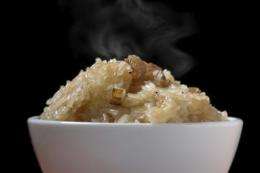
Revealing the ancient Chinese secret of sticky rice mortar
Enlarge

Construction workers in ancient China used sticky rice to make a super-strong mortar for city walls (right) and other structures that even withstood earthquakes. Chemists now have discovered the ingredient in sticky rice that made the mortar so strong.

"Analytical study shows that the ancient masonry mortar is a kind of special organic-inorganic composite material," the scientists explained. "The inorganic component is calcium carbonate, and the organic component is amylopectin, which comes from the sticky rice soup added to the mortar. Moreover, we found that amylopectin in the mortar acted as an inhibitor: The growth of the calcium carbonate crystal was controlled, and a compact microstructure was produced, which should be the cause of the good performance of this kind of organic-organic mortar."

To determine whether sticky rice can aid in building repair, the scientists prepared lime mortars with varying amounts of sticky rice and tested their performance compared to traditional lime mortar.
"The test results of the modeling mortars shows that sticky rice-lime mortar has more stable physical properties, has greater mechanical strength, and is more compatible, which make it a suitable restoration mortar for ancient masonry," the article notes.

More information: Accounts of Chemical Research, "Study of Sticky Rice-Lime Mortar Technology for the Restoration of Historical Masonry Construction".

Provided by American Chemical Society (news : web)

4.9 /5 (23 votes)  

Filter


Move the slider to adjust rank threshold, so that you can hide some of the comments.


Display comments: newest first

Husky
May 30, 2010

Rank: 1 / 5 (1)
maybe todays mortar producers should have a second look at these organic-inorganic composites and experiment with leftover products/sludge from cheap organic waste streams that do not readily convert to biodiesel.
otto1923
May 30, 2010

Rank: 2.3 / 5 (3)
Using food to build buildings- in addition to forced labor and war, another way of curbing pop growth. Villages were decimated and workers sent north to die working on the great wall which did little to keep mongols from invading, but it did help to keep Chinese from reproducing or fighting about it.
billyswong
May 30, 2010

Rank: 4 / 5 (4)
@otto1923:
When the great wall of China was first built (~2200 years ago), the sticky rice mortar has not been invented yet.

When the Mongolians were a threat to China many centuries later, The great wall region were no longer under the control of the Chinese government at that time. That's also one of the important reasons why the military strength of the Chinese government was weak in that era.

So, don't blame the wall.
JoeDuff
May 30, 2010

Rank: 3 / 5 (2)
By Czech legend a chicken eggs were used in mortar during building of Charles bridge in Prague.
Sonhouse
May 30, 2010

Rank: 5 / 5 (1)
I wonder if this could be a home remedy for our own mortar when we build our own walls, it should be cheap enough. I think the commercial uses would concentrate on the active ingredients but for home use, if the walls in China lasted thousands of years just using rice soup, it seems we could do the same everywhere around the world on a local level.
Bloodoflamb
May 30, 2010

Rank: 2 / 5 (1)
China also did not have serious over-population problems until Mao.
otto1923
May 30, 2010

Rank: 3 / 5 (2)
@otto1923:
When the great wall of China was first built (~2200 years ago), the sticky rice mortar has not been invented yet.
Didnt say it was. I know the stories of bodies being used as mortar, or a body buried every 5 ft, are unfortunate myths. But I do blame overpopulation, which is endemic to the human condition in general, for initiating mega- public works projects like the wall and the pyramids (and Mao's 5 year plans), which had very little real purpose other than pop control.
When the Mongolians were a threat to China many centuries later, The great wall region were no longer under the control of the Chinese government at that time. That's also one of the important reasons why the military strength of the Chinese government was weak in that era.

So, don't blame the wall.
So thats why the mongols had no trouble breeching it twice and conquering all of china?
otto1923
May 30, 2010

Rank: 3.2 / 5 (5)
China also did not have serious over-population problems until Mao.
No- rulers were very good at orchestrating internecine wars and rebellions, as well as famine and epidemic. Then outsiders got involved; the brits fought 2 opium wars in attempts to destroy the obsolete cultures, baptists instigated the Taiping rebellion which cost perhaps two hundred million lives, possibly as many as the plague which was purposely spread by the mongols.

Other costly conflicts followed the Taipei Rebellion, such as the Punti-Hakka Clan Wars (1855-67), Nien Rebellion (1851-1868), Muslim Rebellion (1862-77), Panthay Rebellion (1856-1873) and the Miao Rebellion (1854-73). Japan did their share after 1900, followed by the nationalists and THEN the communists took their turn. Chinas history, as in so many other places in the world, is one of constant efforts to mitigate overpopulation. Conflict is the unavoidable result of inevitable human overgrowth.
otto1923
May 30, 2010

Rank: not rated yet
Frajo, would you like to voice your objections to my comments above? Do you actually deny that overpopulation is the root of all evil? Just curious.
dacarls
May 31, 2010

Rank: not rated yet
This organic additive (or others) plus water repellents could be critical to preventing salt (NaCl) damage to modern concrete- that everyone knows is excessively fragile. It might even slow down corrosion of cheap steel rebar, the basis of modern damage to buildings and bridges.
ormondotvos
May 31, 2010

Rank: not rated yet
MY, MY! Why hasn't anyone asked for the exact proportions of rice to mortar mix to water?

All this historicity and population control argument is in the wrong place.

Yes, humans seem driven to have children and grab energy. What a surprise.

I'm for genetic modification of the sex drive through airborne engineered viruses myself...

To paraphrase Philip Wylie's famous comment, "We can all be gay and tea colored."
vkm416
Jun 02, 2010

Rank: not rated yet
Yes, enough of the off-topic stuff. Can we get the exact formula so we can use this in our own homes? I look to see patented versions of this in stores before long, and and inflated prices.
vkm416
Jun 02, 2010

Rank: not rated yet
One question: Would this sticky rice substance not attract pests? Or do the other ingredients act as a repellant? Just something to think about before we go pouring rice syrup on our walls. :-)
david_king
Jun 06, 2010

Rank: not rated yet
Listen, modern mortars when correctly formulated and applied ought to last over a lifetime. That should be plenty. Do we really want to see suburban backyard BBQ chimneys that last 1500 years?

I'd be curious to know if this rice mortar is the mystery mortar used to hold the Cham temple's brickwork together.
Rank 4.9 /5 (23 votes)
Relevant PhysicsForums posts
  • Stoichiometry
    created12 hours ago
  • Boiling and melting point of impure substances
    created13 hours ago
  • Safe nitrogen compound to decompose a 500 deg C in a furnace?
    created20 hours ago
  • [ask]electron inside drinking water
    createdFeb 08, 2012
  • How to avoid formation of Lithium Chromate ???
    createdFeb 08, 2012
  • how to choose a reduced or oxidated form in a redox
    createdFeb 08, 2012
  • More from Physics Forums - Chemistry

More news stories

Fool's gold may prove an unlikely alternative to overexploited catalytic materials

Catalytic materials, which lower the energy barriers for chemical reactions, are used in everything from the commercial production of chemicals to catalytic converters in car engines. However, with current catalytic materials ...

Chemistry / Materials Science

created 4 hours ago | popularity 5 / 5 (2) | comments 1 | with audio podcast

Unpicking HIV’s invisibility cloak

Drug researchers hunting for alternative ways to treat human immunodeficiency virus (HIV) infections may soon have a novel target—its camouflage coat. HIV hides inside a cloak unusually rich in a sugar ...

Chemistry / Biochemistry

created 4 hours ago | popularity 5 / 5 (2) | comments 0

Hydrogen from acidic water: Researchers develop potential low cost alternative to platinum for splitting water

A technique for creating a new molecule that structurally and chemically replicates the active part of the widely used industrial catalyst molybdenite has been developed by researchers with the Lawrence Berkeley ...

Chemistry / Materials Science

created 23 hours ago | popularity 5 / 5 (12) | comments 11 | with audio podcast

Flexible paper robots

(PhysOrg.com) -- These inexpensive robots can stretch, bend and twist under control, and lift objects up to 120 times their own weight. Being soft, they can apply gentle and even pressure, and adapt to varied ...

Chemistry / Materials Science

created 21 hours ago | popularity 5 / 5 (5) | comments 4 | with audio podcast

No entry without protein recycling: Researchers discover new coherence in enzyme transport

The group of Prof. Dr. Ralf Erdmann at the Ruhr-Universität Bochum, Germany, discovered a connection of peroxisomal protein import and receptor export. In the Journal of Biological Chemistry, they disclo ...

Chemistry / Biochemistry

created 4 hours ago | popularity not rated yet | comments 0


Putting the squeeze on planets outside our solar system

(PhysOrg.com) -- Using high-powered lasers, scientists at Lawrence Livermore National Laboratory and collaborators discovered that molten magnesium silicate undergoes a phase change in the liquid state, abruptly ...

Employers feel no love for unscrupulous practice of 'service sweethearting'

A new study led by two Florida State University marketing professors finds that some frontline service employees who are rewarded for hikes in customer loyalty and satisfaction also may engage in "service ...

US issues guidelines to avoid heparin contamination

Four years after US drug-maker Baxter International's blood thinner heparin was contaminated in China, causing dozens of deaths, US regulators on Friday issued draft guidelines for safe production.

Expat French get Internet vote for first time

French citizens will for the first time this year be able to vote in a parliamentary election over the Internet, an experiment that could be extended to other elections if successful.

"Twisted Metal" gamers get shot at real gunplay

Fans of "Twisted Metal" will get to welcome a long-awaited sequel of the car-battle videogame with a real-world bang by blasting an ice cream truck to bits with a machine gun.

The power of estrogen -- male snakes attract other males

A new study has shown that boosting the estrogen levels of male garter snakes causes them to secrete the same pheromones that females use to attract suitors, and turned the males into just about the sexiest ...