From butterflies' wings to bank notes -- how nature's colors could cut bank fraud
May 30, 2010
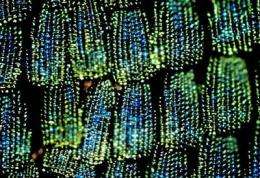
The bright green wings of the P. blumei butterfly result from the mixing of the different colors of light that are reflected from different regions of the scales found on the wings of these butterflies. Credit: Mathias Kolle, University of Cambridge
Scientists have discovered a way of mimicking the stunningly bright and beautiful colours found on the wings of tropical butterflies. The findings could have important applications in the security printing industry, helping to make bank notes and credit cards harder to forge.
The striking iridescent colours displayed on beetles, butterflies and other insects have long fascinated both physicists and biologists, but mimicking nature's most colourful, eye-catching surfaces has proved elusive.
This is partly because rather than relying on pigments, these colours are produced by light bouncing off microscopic structures on the insects' wings.
Mathias Kolle, working with Professor Ullrich Steiner and Professor Jeremy Baumberg of the University of Cambridge, studied the Indonesian Peacock or Swallowtail butterfly (Papilio blumei), whose wing scales are composed of intricate, microscopic structures that resemble the inside of an egg carton.
Because of their shape and the fact that they are made up of alternate layers of cuticle and air, these structures produce intense colours.
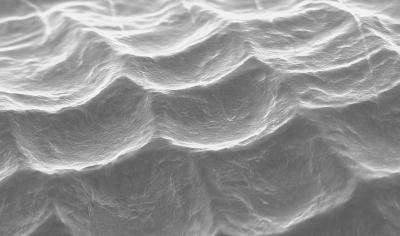
This scanning electron micrograph shows that the surface of a wing scale is covered with concavities. Credit: Mathias Kolle, University of Cambridge
Using a combination of nanofabrication procedures - including self-assembly and atomic layer deposition - Kolle and his colleagues made structurally identical copies of the butterfly scales, and these copies produced the same vivid colours as the butterflies' wings.According to Kolle: "We have unlocked one of nature's secrets and combined this knowledge with state-of-the-art nanofabrication to mimic the intricate optical designs found in nature."
"Although nature is better at self-assembly than we are, we have the advantage that we can use a wider variety of artificial, custom-made materials to optimise our optical structures."
As well as helping scientists gain a deeper understanding of the physics behind these butterflies' colours, being able to mimic them has promising applications in security printing.
"These artificial structures could be used to encrypt information in optical signatures on banknotes or other valuable items to protect them against forgery. We still need to refine our system but in future we could see structures based on butterflies wings shining from a £10 note or even our passports," he says.
Intriguingly, the butterfly may also be using its colours to encrypt itself - appearing one colour to potential mates but another colour to predators.
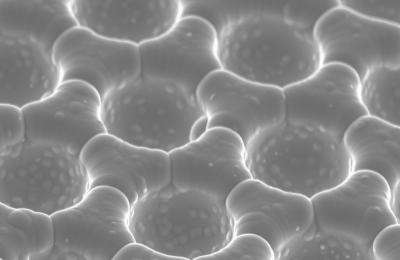
This SEM image of concavities is covered by a conformal multilayer stack of 11 alternating layers of titania and alumina. Credit: Mathias Kolle, University of Cambridge
Kolle explains: "The shiny green patches on this tropical butterfly's wing scales are a stunning example of nature's ingenuity in optical design. Seen with the right optical equipment these patches appear bright blue, but with the naked eye they appear green."This could explain why the butterfly has evolved this way of producing colour. If its eyes see fellow butterflies as bright blue, while predators only see green patches in a green tropical environment, then it can hide from predators at the same time as remaining visible to members of its own species."
The results are published today in Nature Nanotechnology.
More information: Mathias Kolle et al, 'Mimicking the colourful wing scale structure of the Papilio blumei butterfly' is published in Nature Nanotechnology on 30 May 2010.
-
Painting by numbers
Sep 29, 2006 |
not rated yet |
0
-
Hind wings help butterflies make swift turns to evade predators, study finds
Jan 07, 2009 |
not rated yet |
0
-
Natural solar collectors on butterfly wings inspire more powerful solar cells
Feb 05, 2009 |
not rated yet |
0
-
How the butterflies got their spots
Feb 05, 2010 |
not rated yet |
0
-
Nanometric butterfly wings created
Oct 08, 2009 |
not rated yet |
0
-
Engineers build first sub-10-nm carbon nanotube transistor
Feb 01, 2012 |
4.9 / 5 (31) |
30
-
Something old, something new: Evolution and the structural divergence of duplicate genes
Jan 31, 2012 |
4.6 / 5 (7) |
1
-
The hidden nanoworld of ice crystals: Revealing the dynamic behavior of quasi-liquid layers
Jan 30, 2012 |
5 / 5 (3) |
1
-
Stock market network reveals investor clustering
Jan 27, 2012 |
3.9 / 5 (23) |
8
-
Of microchemistry and molecules: Electronic microfluidic device synthesizes biocompatible probes
Jan 26, 2012 |
5 / 5 (1) |
0
-
polymer nanocomposites
16 hours ago
-
Corrosion Tests on Magnesium
Feb 09, 2012
-
polyethylene copper nanocomposite
Feb 09, 2012
-
Output of xrd analysis
Feb 08, 2012
-
Transport phenomena problem based on problems 18.B11 and 19B.6 from Bird, stewart, lw
Feb 06, 2012
-
Help with material selection - Car Piston
Feb 05, 2012
- More from Physics Forums - Materials & Chemical Engineering
More news stories
What lies beneath: Mapping hidden nanostructures
The ability to diagnose and predict the properties of materials is vital, particularly in the expanding field of nanotechnology. Electron and atom-probe microscopy can categorize atoms in thin sheets of material, ...
8 hours ago |
5 / 5 (1) |
1
New kind of solar cell could capture significantly more energy than current cells
New solar cells could increase the maximum efficiency of solar panels by over 25%, according to scientists from the University of Cambridge.
Feb 08, 2012 |
4.5 / 5 (12) |
14
|
'Dark plasmons' transmit energy
Microscopic channels of gold nanoparticles have the ability to transmit electromagnetic energy that starts as light and propagates via "dark plasmons," according to researchers at Rice University.
Feb 09, 2012 |
5 / 5 (6) |
1
|
Nanoshell whispering galleries improve thin solar panels
Visitors to Statuary Hall in the U.S. Capitol Building may have experienced a curious acoustic feature that allows a person to whisper softly at one side of the cavernous, half-domed room and for another on ...
Nanotechnology / Nanomaterials
Feb 07, 2012 |
4.3 / 5 (6) |
6
|
Nanotube therapy takes aim at breast cancer stem cells
Wake Forest Baptist Medical Center researchers have again proven that injecting multiwalled carbon nanotubes (MWCNTs) into tumors and heating them with a quick, 30-second laser treatment can kill them.
Nanotechnology / Bio & Medicine
Feb 09, 2012 |
5 / 5 (1) |
0
|
Google users warned of threat to smartphone wallets
Users of Google smartphone wallets were being warned on Friday that there is a way to crack pass codes intended to thwart thieves from going on illicit shopping sprees.
CIA website offline, Anonymous takes credit
The website of the Central Intelligence Agency was unresponsive on Friday after the hacker group Anonymous claimed to have knocked it offline.
NASA sees wide-eyed cyclone Jasmine
Cyclone Jasmine's eye has opened wider on NASA satellite imagery, as it moves through the Southern Pacific Ocean.
Complex wiring of the nervous system may rely on a just a handful of genes and proteins
Researchers at the Salk Institute have discovered a startling feature of early brain development that helps to explain how complex neuron wiring patterns are programmed using just a handful of critical genes. ...
NASA sees Giovanna reach cyclone strength, threaten Madagascar
Tropical Storm 12S built up steam and became a cyclone on February 10, 2012 as NASA's Terra satellite passed overhead. Residents of east-central Madagascar should prepare for this cyclone to make landfall ...
Putting the squeeze on planets outside our solar system
(PhysOrg.com) -- Using high-powered lasers, scientists at Lawrence Livermore National Laboratory and collaborators discovered that molten magnesium silicate undergoes a phase change in the liquid state, abruptly ...
May 30, 2010
Rank: not rated yet
Jun 01, 2010
Rank: 5 / 5 (1)
My only quibble with the article is the way these guys want to attribute this all to evolution. It doesn't make sense.
Here you have a bunch of scientists, pooling their ideas and intelligence, purposefully trying to figure out and copy the admittedly very amazing design they observe in the butterfly. They used intelligence, purpose, physics, design detection and imitation. The idea that this butterfly somehow evolved this amazing ability by accident even though human inventors pooling their intelligence cannot even begin to replicate it, is hard to fathom! Yet, this is what evolutionists want us to muster up the faith to believe sans evidence!
Jun 02, 2010
Rank: not rated yet
"sans evidence"?
*sigh*
Another home-schooled ignoramus, admonishing those silly scientists for all the things they know but shouldn't.
Yaaaawn...
Jun 02, 2010
Rank: 5 / 5 (1)
I didn't see any evidence given in the article to support the claim that this evolved. None. Did you? It seems they only assume that it did. They don't know how it evolved. They don't know when it evolved. They only speculate as to why it might have evolved, but that is not evidence. Anyone can make up a story to try and justify a belief. You've gotten so used to evolutionists empty claims that you don't even notice anymore. You just fall at their feet in awe and believe whatever they conjure up.
The unintelligent, directionless, uncaring, blind forces of nature used physics and designed this state of the art self-replicating technology? Congratulations on your faith! I need more than bold claims of evolutionists to bow at Charlie's feet along with you.
Of course, I have no problem with the great work these men are doing, just their interpretation of where this technology came from. Where's the evidence?
Jun 02, 2010
Rank: not rated yet
Here's a nice, concise, ignoramus-friendly introduction to evolution and some of the more easily-digestible evidence behind it:
http://evolution....e/evo_01
(Thanks be to the University of California at Berkeley, hallowed be its name.) The truth shall set you free. Or at least, make you a little smarter. Or at least, a little less naive. Or at a minimum, a little less delusional...