Liquid method: pure graphene production
May 30, 2010
Graphene
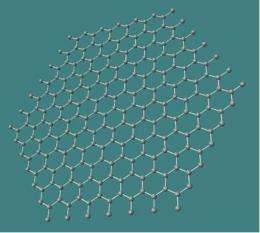
In a development that could lead to novel carbon composites and touch-screen displays, researchers from Rice University and the Technion-Israel Institute of Technology today unveiled a new method for producing bulk quantities of one-atom-thick sheets of carbon called graphene.
The research is available online in the journal Nature Nanotechnology.
When stacked together, graphene sheets make graphite, which has been commonly used as pencil lead for hundreds of years. It wasn't until 2004 that stand-alone sheets of graphene were first characterized with modern nanotechnological instruments. Since then, graphene has come under intense scrutiny from materials scientists, in part because it is both ultrastrong and highly conductive.
"There are high-throughput methods for making graphene oxide, which is not as conductive as graphene, and there are low-throughput methods for making pure graphene," said lead co-author Matteo Pasquali, professor of chemical and biomolecular engineering and chemistry at Rice. "Our method yields very pure material, and it is based on bulk fluid-processing techniques that have long been used by the chemical industry."
Pasquali said the research team found it could dissolve graphite in chlorosulphonic acid, a common industrial solvent. The researchers had to devise new methods to measure the aggregation of the dissolved graphene flakes, but at the end the team was pleasantly surprised to find that the individual graphene layers in the graphite peeled apart spontaneously. The team was able to dissolve as much as two grams of graphene per liter of acid to produce solutions at least 10 times more concentrated than existing methods.
The researchers took advantage of novel cryogenic techniques for electron microscopy that allowed them to directly image the graphene sheets in the chlorosulfonic acid.
"We applied new methods that we had developed to directly image carbon nanotubes in acid," said co-author Yeshayahu "Ishi" Talmon, professor of chemical engineering at the Technion-Israel Institute of Technology. "This was no small feat considering the nature of the acid and the difficulty of specimen preparation and imaging."
Using the concentrated solutions of dissolved graphene, the scientists made transparent films that were electrically conductive. Such films could be useful in making touch screens that are less expensive than those used in today's smart phones. In addition, the researchers also produced liquid crystals.
"If you can make liquid crystals, you can spin fibers," said study co-author James Tour, Rice's T.T. and W.F. Chao Professor of Chemistry. "In liquid crystals, the individual sheets align themselves into domains, and having some measure of alignment allows you to flow the material through narrow openings to create fibers."
If the method proves useful for making graphene fibers in bulk, it could drive down the cost of the ultrastrong carbon composites used in the aerospace, automotive and construction industries.
-
Researchers invent new method for graphene growth
Nov 10, 2009 |
not rated yet |
0
-
Unzipping Carbon Nanotubes Can Make Graphene Ribbons
Apr 20, 2009 |
not rated yet |
0
-
Seeing Moire in Graphene
Apr 27, 2010 |
not rated yet |
0
-
Engineers develop method to disperse chemically modified graphene in organic solvents
Mar 31, 2009 |
not rated yet |
0
-
Producing graphene layers using crystallization
Mar 02, 2010 |
not rated yet |
0
-
Engineers build first sub-10-nm carbon nanotube transistor
Feb 01, 2012 |
4.9 / 5 (31) |
30
-
Something old, something new: Evolution and the structural divergence of duplicate genes
Jan 31, 2012 |
4.6 / 5 (7) |
1
-
The hidden nanoworld of ice crystals: Revealing the dynamic behavior of quasi-liquid layers
Jan 30, 2012 |
5 / 5 (3) |
1
-
Stock market network reveals investor clustering
Jan 27, 2012 |
3.9 / 5 (23) |
8
-
Of microchemistry and molecules: Electronic microfluidic device synthesizes biocompatible probes
Jan 26, 2012 |
5 / 5 (1) |
0
-
polymer nanocomposites
Feb 10, 2012
-
Corrosion Tests on Magnesium
Feb 09, 2012
-
polyethylene copper nanocomposite
Feb 09, 2012
-
Output of xrd analysis
Feb 08, 2012
-
Transport phenomena problem based on problems 18.B11 and 19B.6 from Bird, stewart, lw
Feb 06, 2012
-
Help with material selection - Car Piston
Feb 05, 2012
- More from Physics Forums - Materials & Chemical Engineering
More news stories
What lies beneath: Mapping hidden nanostructures
The ability to diagnose and predict the properties of materials is vital, particularly in the expanding field of nanotechnology. Electron and atom-probe microscopy can categorize atoms in thin sheets of material, ...
20 hours ago |
5 / 5 (3) |
1
New kind of solar cell could capture significantly more energy than current cells
New solar cells could increase the maximum efficiency of solar panels by over 25%, according to scientists from the University of Cambridge.
Feb 08, 2012 |
4.5 / 5 (12) |
14
|
Nanoshell whispering galleries improve thin solar panels
Visitors to Statuary Hall in the U.S. Capitol Building may have experienced a curious acoustic feature that allows a person to whisper softly at one side of the cavernous, half-domed room and for another on ...
Nanotechnology / Nanomaterials
Feb 07, 2012 |
4.3 / 5 (6) |
6
|
'Dark plasmons' transmit energy
Microscopic channels of gold nanoparticles have the ability to transmit electromagnetic energy that starts as light and propagates via "dark plasmons," according to researchers at Rice University.
Feb 09, 2012 |
4.8 / 5 (9) |
1
|
Revealing how a battery material works
Since its discovery 15 years ago, lithium iron phosphate (LiFePO4) has become one of the most promising materials for rechargeable batteries because of its stability, durability, safety and ability to deliver ...
Nanotechnology / Nanomaterials
Feb 08, 2012 |
5 / 5 (5) |
0
|
Anonymous knocks CIA website offline (Update)
The website of the Central Intelligence Agency was inaccessible on Friday after the hacker group Anonymous claimed to have knocked it offline.
New error-correcting codes guarantee the fastest possible rate of data transmission
Error-correcting codes are one of the triumphs of the digital age. Theyre a way of encoding information so that it can be transmitted across a communication channel such as an optical fiber o ...
Small modular reactor design could be a 'SUPERSTAR'
(PhysOrg.com) -- Though most of today's nuclear reactors are cooled by water, we've long known that there are alternatives; in fact, the world's first nuclear-powered electricity in 1951 came from a reactor ...
New power source discovered
(PhysOrg.com) -- Researchers at the Massachusetts Institute of Technology (MIT) and RMIT University have made a breakthrough in energy storage and power generation.
The power of estrogen -- male snakes attract other males
A new study has shown that boosting the estrogen levels of male garter snakes causes them to secrete the same pheromones that females use to attract suitors, and turned the males into just about the sexiest ...
Advanced power-grid model finds low-cost, low-carbon future in West
(PhysOrg.com) -- The least expensive way for the Western U.S. to reduce greenhouse gas emissions enough to help prevent the worst consequences of global warming is to replace coal with renewable and other ...
May 30, 2010
Rank: not rated yet
http://www.youtub...5If2VU3Q
With respect to electronic industry the properties of resulting product of such method are nothing special, because only tiny graphite flakes similar to particles of soot would remain after such drastical treatment. The chlorosulfonic superacid will ripe them all.
May 30, 2010
Rank: not rated yet
http://findarticl...6520720/
May 30, 2010
Rank: 2.3 / 5 (3)
However, just a few days ago I read an article in which researchers used a method similar to that used by the typical cotton candy machine to produce large quantities of carbon nanotubes in a highly controlled and much cheaper fashion.
Here's the link to the article:
http://www.physor...542.html
And here is a short snippet from the article to "whet your appetite".
"Hailed as a "cross between a high-speed centrifuge and a cotton candy machine," bioengineers at Harvard have developed a new, practical technology for fabricating tiny nanofibers."
Enjoy!
Jun 08, 2010
Rank: not rated yet
If you had actually read the article, you would have noticed that the machine produced polymer-based threads, not carbon nanotubes. This has nothing to do with producing carbon nanotubes. I suggest that in the future if you claim to have read something that you actually do read it.
Jun 08, 2010
Rank: not rated yet
The same research group, which developed the method for casting of graphene sheets developed the method for dissolving of nanotubes from simple reason: both materials are composed of graphite sheets, so they're sharing the very same chemistry. Just the nanotube research has become popular earlier. Because you don't know about these connections, it seems for you, my comments are chaotic and mutually inconsistent.
In fact we differ in number of causal dimensions or causal facts, which we are using for consideration of these experiments in wider context. Because my causal structures are larger, they will attract & dissolve those of yours in similar way, like heavier planet attracts the smaller one.
The collision our our stances was a real physical process from certain perspective.