Scientists breed goats that produce spider silk
May 31, 2010 by Lisa Zyga
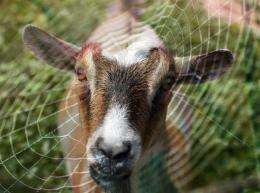
Goats that produce spider silk protein in their milk could enable researchers to collect large quantities of the silk. Image credit: National Science Foundation.
(PhysOrg.com) -- Researchers from the University of Wyoming have developed a way to incorporate spiders' silk-spinning genes into goats, allowing the researchers to harvest the silk protein from the goats’ milk for a variety of applications. For instance, due to its strength and elasticity, spider silk fiber could have several medical uses, such as for making artificial ligaments and tendons, for eye sutures, and for jaw repair. The silk could also have applications in bulletproof vests and improved car airbags.
Normally, getting enough spider silk for these applications requires large numbers of spiders. However, spiders tend to be territorial, so when the researchers tried to set up spider farms, the spiders killed each other.
To solve this problem, Randy Lewis, a professor of molecular biology at the University of Wyoming, and other researchers decided to put the spiders’ dragline silk gene into goats in such a way that the goats would only make the protein in their milk. Like any other genetic factor, only a certain percentage of the goats end up with the gene. For instance, of seven goat kids born in February 2010, three have tested positive for having the silk protein gene. When these transgenic goats have kids and start lactating, the researchers will collect the milk and purify the spider silk protein into “much, much higher quantities,” Lewis said.
Other than their ability to produce the spider silk protein, the goats do not seem to have any other differences in health, appearance, or behavior compared to goats without the gene, the researchers said.
In the future, the scientists plan to incorporate the silk genes into alfalfa plants, which they say could produce even larger quantities of silk. They explain that not only is alfalfa widely distributed, it also has a high (20-25%) protein content, making it an ideal crop to produce silk protein.
More information: via: National Science Foundation
© 2010 PhysOrg.com
-
Scientist Will Examine Spider Silk Use for Sutures
Jun 27, 2006 |
not rated yet |
0
-
Fascinating Spider Silk
Apr 04, 2007 |
not rated yet |
0
-
Stretchy spider silks can be springs or rubber
May 31, 2008 |
not rated yet |
0
-
Artificial bee silk a big step closer to reality
Feb 03, 2010 |
not rated yet |
0
-
Investigating how spiders spin their silk, researchers unravel a key step
May 12, 2010 |
not rated yet |
0
-
Engineers build first sub-10-nm carbon nanotube transistor
Feb 01, 2012 |
4.9 / 5 (29) |
30
-
Something old, something new: Evolution and the structural divergence of duplicate genes
Jan 31, 2012 |
4.6 / 5 (7) |
1
-
The hidden nanoworld of ice crystals: Revealing the dynamic behavior of quasi-liquid layers
Jan 30, 2012 |
5 / 5 (3) |
1
-
Stock market network reveals investor clustering
Jan 27, 2012 |
4 / 5 (22) |
8
-
Of microchemistry and molecules: Electronic microfluidic device synthesizes biocompatible probes
Jan 26, 2012 |
5 / 5 (1) |
0
-
a single mRNA strand is attached to sevaral ribosomes?
14 hours ago
-
Oestrogen and FSH
Feb 07, 2012
-
Linear Blood Vessel Network Examples in Animals or Plants
Feb 07, 2012
-
Neuroscientists: What is a Principal Cell Layer?
Feb 06, 2012
-
How does slime mould grow?
Feb 04, 2012
-
Why are mosquitoes and bedbugs successful?
Feb 04, 2012
- More from Physics Forums - Biology
More news stories
Study shows how DNA finds its match
It's been more than 50 years since James Watson and Francis Crick showed that DNA is a double helix of two strands that complement each other. But how does a short piece of DNA find its match, out of the millions ...
1 hour ago |
5 / 5 (1) |
0
|
Obstacles no barrier to higher speeds for worms, researchers find
Obstacles in an organism's path can help it to move faster, not slower, researchers from New York University's Applied Math Lab at the Courant Institute of Mathematical Sciences have found through a series ...
3 hours ago |
3 / 5 (1) |
3
|
Transformational fruit fly genome catalog completed
Scientists searching for the genomics version of the holy grail more insight into predicting how an animal's genes affect physical or behavioral traits now have a reference manual that should ...
1 hour ago |
5 / 5 (1) |
0
|
Tiny primate 'talks' in ultrasound
One of the world's smallest primates, the Philippine tarsier, communicates in a range of ultrasound inaudible to predator and prey alike, according to a study published on Wednesday.
10 hours ago |
4.8 / 5 (5) |
0
Scared of a younger rival? Not for some male songbirds
When mature male white-crowned sparrows duel to win a mate or a nesting territory, a young bird just doesn't get much respect.
11 hours ago |
4 / 5 (2) |
0
|
Short fasting cycles work as well as chemotherapy in mice
Man may not live by bread alone, but cancer in animals appears less resilient, judging by a study that found chemotherapy drugs work better when combined with cycles of short, severe fasting.
Gene therapy for inherited blindness succeeds in patients' other eye
Gene therapy for congenital blindness has taken another step forward, as researchers further improved vision in three adult patients previously treated in one eye. After receiving the same treatment in their ...
Physicists build highly efficient 'no-waste' laser
A team of University of California, San Diego researchers has built the smallest room-temperature nanolaser to date, as well as an even more startling device: a highly efficient, "thresholdless" laser that ...
Transparent iron? For the first time, an experiment shows that atomic nuclei can become transparent
At the high-brilliance synchrotron light source PETRA III, a team of DESY scientists headed by Dr. Ralf Röhlsberger has succeeded in making atomic nuclei transparent with the help of X-ray light. At the ...
'Explorers,' who embrace the uncertainty of choices, use specific part of cortex
Life shrouds most choices in mystery. Some people inch toward a comfortable enough spot and stick close to that rewarding status quo. Out to dinner, they order the usual. Others consider their options systematically ...
Scientists delve into the brain roots of hunger and eating
Synaptic plasticity the ability of the synaptic connections between the brain's neurons to change and modify over time -- has been shown to be a key to memory formation and the acquisition of new learning behaviors. ...
May 31, 2010
Rank: 5 / 5 (2)
http://en.wikiped...der_silk
May 31, 2010
Rank: 5 / 5 (4)
May 31, 2010
Rank: 3.4 / 5 (9)
May 31, 2010
Rank: 1.7 / 5 (13)
Do you realize how completely INSANE it is to grow a plant with transgenic arthropod DNA?
If the Pollen gets out it could completely destroy the environment by contaminating the regular stock. Not to mention the possibility of exotic bacteria or viruses capable of bridging between completely different Kingdoms of life...
This is a NIGHTMARE, and is exactly what should not be allowed...
May 31, 2010
Rank: 4.4 / 5 (7)
I really don't understand why people with your world view even bother to come to a site such as this, you're only going to give yourself a heart-attack.
May 31, 2010
Rank: 5 / 5 (4)
May 31, 2010
Rank: 1.2 / 5 (9)
This is a SERIOUS matter, you moron.
Hybrid flus and things like that exist, and if they keep screwing around with genetics like this you are gonna get something SICK eventually...
Do you know how fast PLANTS can reproduce in the wild? That's why we call them "weeds" when they are a pest plant, and there is an entire industry based on trying to contain and control them...
May 31, 2010
Rank: 2 / 5 (4)
Well, that certainly isn't me, because I want to put a man on Gliese pronto...
May 31, 2010
Rank: 5 / 5 (6)
Spidergoat,
Does whatever a Spidergoat does."
What commenters so far have failed to appreciate are the new crime-fighting possibilities of this development.
May 31, 2010
Rank: not rated yet
Bats will hang in webs, and hunt humans.
Goats will learn to trap and eat chickens.
Scrapie virus will travel the jet streams in huge invisible webs, descending on towns 'in masse', and we'll all forget our passwords, and develop Narcolepsy or terminal insomnia.
All from a little 'splice',
How do these baby goats digest spider proteins in the milk? What happens when the activating chemistry gets into the feeding baby goats?
Jun 01, 2010
Rank: 4.3 / 5 (3)
Jun 01, 2010
Rank: 5 / 5 (4)
Jun 01, 2010
Rank: 1.5 / 5 (4)
Witness BP....
Jun 01, 2010
Rank: not rated yet
If they can do this with bt corn- to produse bt toxin only in the stem and leaves, and not in the polen and the grains then all the haters of this tehnology will have less to feed themselves.
And this is actually a very weird thinking, to produse it by the milk, why not to make the silkworm to produse it?
Jun 01, 2010
Rank: not rated yet
And another great posibility to make a plant food with proteins whhich are good digestible and contains all the aminoasids the human needs, and all the other thing the meat gives you and the plants are just poor to contain them, then I will cut meat eating without problems, or just I will reduse the amount.But I just can imagine how sceptic the gm haters will be, I think I will never live enough to see this.....
Jun 01, 2010
Rank: 4 / 5 (1)
Jun 01, 2010
Rank: 3 / 5 (2)
Jun 01, 2010
Rank: 5 / 5 (1)
You can go to scare the little children with your sh*ts!
Jun 01, 2010
Rank: 3.8 / 5 (4)
Jun 01, 2010
Rank: 3 / 5 (3)
You have to cut off the movies man!
"lack of intelligent foresight" - people like you have it already....
Jun 01, 2010
Rank: 4.6 / 5 (5)
Well, that'll certainly solve the population problem.
Those of you who want to play Pollyanna with this and pretend that serious problems are unlikely must carry ostrich genes.
Jun 01, 2010
Rank: 5 / 5 (1)
Jun 01, 2010
Rank: 5 / 5 (2)
Alfalfa plants with the Roundup gene and the silk gene. Next splice in the root system of a fast spreading bamboo plant. Throw in some thorns and the urushiol oil produced by the poison ivy plant
and you'd a have real serious weed on your hands.
Of course, the creator of this toxic nuisance will then provide us with the 'environmentally' friendly chemicals to kill it off... maybe.
Jun 01, 2010
Rank: 5 / 5 (1)
Eerily similar to the Sci-fi channel super heroine movie "Ultra Violet".
Although this does give us a way to win the war on drugs.
Take some poppies, Marijauna, and Coca plants and splice in some DNA from Australian Irochongi Jellyfish Venom. Then grow loads and loads of the pollen and spread to Afghanistan, Mexico, and Central America respectively..
Now anyone who tries to grow that poison will get what they deserve: poison...
Jun 01, 2010
Rank: 4 / 5 (1)
You mean Irukandji...^^ (sorry couldn't help it the spelling made me shudder)
Jun 02, 2010
Rank: 4 / 5 (1)
Jun 02, 2010
Rank: not rated yet
Jun 04, 2010
Rank: not rated yet
@Quantum, before you call someone a "moron" you really should read your posts before you send them. You have been watching too many bad sci-fi movies.
Genetic engineering is a powerful tool that will allow humanity to control it's future, yet people like yourself can only imagine the mad scientist playing god. I'm sure you believe that life came to be by fairy dust or some such nonsense.
Jun 04, 2010
Rank: not rated yet
Currently, for laboratory experiments, silk is extracted from silk worm cocoons. This is a VERY tedious and low yield process, but silk is needed to advance fields such as tissue engineering. It's true genetic engineering is a powerful tool, but until groups of genes allow cross-breading, 99.9% of your fears are unsubstantiated.
Jun 04, 2010
Rank: not rated yet
Jun 04, 2010
Rank: not rated yet
There [probably] is no god you neanderthal.
Jun 04, 2010
Rank: not rated yet
Yes, they would if they were in a place with no native wolf packs. wild dogs roam places all over the world and do just fine.
Jun 04, 2010
Rank: not rated yet
with the crops it is the same story....
Jun 04, 2010
Rank: not rated yet
Jun 07, 2010
Rank: not rated yet
Expression of transgenes is usually controlled by choosing specific promoters for other genes that are expressed in very few tissues.
The problem with expressing something only in the stem is that most of the genes in the stem are also active in most other parts of the plant as well. The stem is, to oversimplify, a more primitive part than the flowers or fruit. However, the genes it expresses, due to their "primitiveness" tend to be expressed throughout the plant.
So unless a promoter specific to stems and leaves is found, expression cannot be controlled.
Jun 07, 2010
Rank: not rated yet
Your criticism, then, is not in the methods or dangers, but in your gut feeling?
Jun 07, 2010
Rank: not rated yet
Yes I know that, but in the case of the goat how do they put it in the right place, was it intentionally or by chance after lots of trials, have they used a tehnology to put the DNA where they want....
In the corn I think it wont be that hard this to be done, the difference between the stem and leaves and the grains and polen(the polen is not that important actually in spite of what some critisist say it will destroy the nature) is significant. Lots of work have to be done if we wont to know how so called junk DNA(actually it is not a junk at all) operates, then the posibilities of this tehnology will be endless...