'Neutrino oscillation': Particle chameleon caught in the act of changing
May 31, 2010
(PhysOrg.com) -- Researchers on the OPERA experiment at the INFN's Gran Sasso laboratory in Italy today announced the first direct observation of a tau particle in a muon neutrino beam sent through the Earth from CERN, 730km away. This is a significant result, providing the final missing piece of a puzzle that has been challenging science since the 1960s, and giving tantalizing hints of new physics to come.
The neutrino puzzle began with a pioneering and ultimately Nobel Prize winning experiment conducted by US scientist Ray Davis beginning in the 1960s. He observed far fewer neutrinos arriving at the Earth from the Sun than solar models predicted: either solar models were wrong, or something was happening to the neutrinos on their way. A possible solution to the puzzle was provided in 1969 by the theorists Bruno Pontecorvo and Vladimir Gribov, who first suggested that chameleon-like oscillatory changes between different types of neutrinos could be responsible for the apparent neutrino deficit.
Several experiments since have observed the disappearance of muon-neutrinos, confirming the oscillation hypothesis, but until now no observations of the appearance of a tau-neutrino in a pure muon-neutrino beam have been observed: this is the first time that the neutrino chameleon has been caught in the act of changing from muon-type to tau-type.
Antonio Ereditato, Spokesperson of the OPERA collaboration described the development as: "an important result which rewards the entire OPERA collaboration for its years of commitment and which confirms that we have made sound experimental choices. We are confident that this first event will be followed by others that will fully demonstrate the appearance of neutrino oscillation".
"The OPERA experiment has reached its first goal: the detection of a tau neutrino obtained from the transformation of a muon neutrino, which occurred during the journey from Geneva to the Gran Sasso Laboratory," added Lucia Votano, Director Gran Sasso laboratories. "This important result comes after a decade of intense work performed by the Collaboration, with the support of the Laboratory, and it again confirms that LNGS is a leading laboratory in Astroparticle Physics".
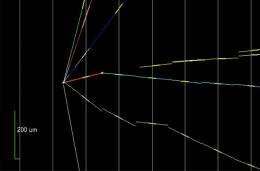
The computer display of the first tau-neutrino candidate event is shown above. One can see a detail of the region around the point of interaction of the neutrino (coming from the left of the figure) producing several particles identified by their tracks in the brick. The detection of the track with a "kink" is the likely signature of a tau-neutrino interaction, with a probability of about 98%. The picture describes a volume of only a few cubic millimetres, but rich of valuable information for the OPERA physicists.
The OPERA result follows seven years of preparation and over three years of beam provided by CERN. During that time, billions of billions of muon-neutrinos have been sent from CERN to Gran Sasso, taking just 2.4 milliseconds to make the trip. The rarity of neutrino oscillation, coupled with the fact that neutrinos interact very weakly with matter makes this kind of experiment extremely subtle to conduct. CERN's neutrino beam was first switched on in 2006, and since then researchers on the OPERA experiment have been carefully sifting their data for evidence of the appearance of tau particles, the telltale sign that a muon-neutrino has oscillated into a tau-neutrino. Patience of this kind is a virtue in particle physics research, as INFN President Roberto Petronzio explained:
"This success is due to the tenacity and inventiveness of the physicists of the international community, who designed a particle beam especially for this experiment," said Petronzio. "In this way, the original design of Gran Sasso has been crowned with success. In fact, when constructed, the laboratories were oriented so that they could receive particle beams from CERN".
At CERN, neutrinos are generated from collisions of an accelerated beam of protons with a target. When protons hit the target, particles called pions and kaons are produced. They quickly decay, giving rise to neutrinos. Unlike charged particles, neutrinos are not sensitive to the electromagnetic fields usually used by physicists to change the trajectories of particle beams. Neutrinos can pass through matter without interacting with it; they keep the same direction of motion they have from their birth. Hence, as soon as they are produced, they maintain a straight path, passing through the Earth's crust. For this reason, it is extremely important that from the very beginning the beam points exactly towards the laboratories at Gran Sasso.
'This is an important step for neutrino physics," said CERN Director General Rolf Heuer. "My congratulations go to the OPERA experiment and the Gran Sasso Laboratories, as well as the accelerator departments at CERN. We're all looking forward to unveiling the new physics this result presages."
While closing a chapter on understanding the nature of neutrinos, the observation of neutrino oscillations is strong evidence for new physics. In the theories that physicists use to explain the behaviour of fundamental particles, which is known as the Standard Model, neutrinos have no mass. For neutrinos to be able to oscillate, however, they must have mass: something must be missing from the Standard Model. Despite its success in describing the particles that make up the visible Universe and their interactions, physicists have long known that there is much the Standard Model does not explain. One possibility is the existence of other, so-far unobserved types of neutrinos that could shed light on Dark Matter, which is believed to make up about a quarter of the Universe's mass.
The OPERA Collaboration presently includes about 170 researchers from 33 institutions and 12 countries.
More information: The OPERA experiment - http://operaweb.ln … p?rubrique39
Please see a related AFP story below
Physicists solve mystery of missing neutrinos
Scientists in Europe announced Monday they had likely solved the case of the missing neutrinos, one of the enduring mysteries in the subatomic universe of particle physics.
If confirmed in subsequent experiments, the findings challenge core precepts of the so-called Standard Model of physics, and could have major implications for our understanding of matter in the universe, the researchers said.
For decades physicists had observed that fewer neutrinos -- electrically neutral particles that travel close to the speed of light -- arrived at Earth from the Sun than solar models predicted.
That meant one of two things: either the models were wrong, or something was happening to the neutrinos along the way.
At least one variety called a muon-neutrino was actually seen to disappear, lending credence to a Nobel-winning 1969 hypothesis that the miniscule particles were shape-shifting into a new and unseen form.
Now scientists at Italy's National Institute for Nuclear Physics have for the first time observed -- with 98 percent certainty -- what they change into during a process called neutrino oscillation: another type of particle known as tau.
"This will be the long-awaited proof of this process. It was a missing piece of the puzzle," said Antonio Ereditato, a researcher at the Institute and spokesman for the OPERA group that carried out the study.
"If true, it means that new physics will be required to explain this fact," he said by phone.
Under the prevailing Standard Model, neutrinos cannot have mass. But the new experiments prove that they do.
One implication is the existence of other, as yet unobserved types of neutrinos that could help clarify the nature of Dark Matter, which is believed to make up about 25 percent of the universe.
"Whatever exists in the infinitely small always has repercussions in the infinitely big," Ereditato said.
"A model which could explain why the neutrino is so small without vanishing will have profound implications for the understanding of our universe -- how it was, how it evolved, and how it will eventually die."
The transformation of the neutrino occurred during a programmed journey from Geneva to the Gran Sasso Laboratory near L'Aquila in central Italy.
The European Organization for Nuclear Research (CERN) provided a laser-like beam composed of billions upon billions of muon neutrinos that took only 2.4 milliseconds to make the 730-kilometer (453-mile) trip.
The rarity of neutrino oscillation, coupled with the fact that the particles interact only weakly with matter, bedeviled the scientists.
Unlike charged particles, neutrinos are not sensitive to the electromagnetic field normally used by physicists to bend the trajectory of particle beams.
They can also pass through matter, and thus keep the same direction of motion from their inception.
It took nearly four years from the time the beam was switched on to witness the muon-to-tau metamorphosis.
Provided by CERN
-
Green light for the neutrino beam from Cern to Gran Sasso
Sep 12, 2006 |
not rated yet |
0
-
CERN neutrino project on target
Aug 16, 2005 |
not rated yet |
0
-
New results confirm standard neutrino theory
Feb 16, 2010 |
not rated yet |
0
-
Discovery of Neutrino Oscillation, Mass Upends Standard Model of Fundamental Forces and Particles
Jul 08, 2004 |
not rated yet |
0
-
The First T2K Neutrino Event Observed At Super-Kamiokande
Feb 25, 2010 |
not rated yet |
0
-
Engineers build first sub-10-nm carbon nanotube transistor
Feb 01, 2012 |
4.9 / 5 (31) |
30
-
Something old, something new: Evolution and the structural divergence of duplicate genes
Jan 31, 2012 |
4.6 / 5 (7) |
1
-
The hidden nanoworld of ice crystals: Revealing the dynamic behavior of quasi-liquid layers
Jan 30, 2012 |
5 / 5 (3) |
1
-
Stock market network reveals investor clustering
Jan 27, 2012 |
3.9 / 5 (23) |
8
-
Of microchemistry and molecules: Electronic microfluidic device synthesizes biocompatible probes
Jan 26, 2012 |
5 / 5 (1) |
0
-
Question about Gravity?
1 hour ago
-
Wearing black in a desert
2 hours ago
-
Did space exist before mass?
2 hours ago
-
How can E&M Waves be polarized?
2 hours ago
-
Does light travel for ever?
3 hours ago
-
Infinity by Particles
4 hours ago
- More from Physics Forums - General Physics
More news stories
Putting the squeeze on planets outside our solar system
(PhysOrg.com) -- Using high-powered lasers, scientists at Lawrence Livermore National Laboratory and collaborators discovered that molten magnesium silicate undergoes a phase change in the liquid state, abruptly ...
9 hours ago |
4.4 / 5 (5) |
0
|
Hovering not hard if you're top-heavy, researchers find
Top-heavy structures are more likely to maintain their balance while hovering in the air than are those that bear a lower center of gravity, researchers at New York University's Courant Institute of Mathematical Sciences ...
10 hours ago |
5 / 5 (1) |
1
|
SLAC, Stanford team focuses on high-energy electrons to treat cancer
Accelerator physicists at SLAC and cancer specialists from Stanford are working on a new technology that could dramatically reduce the time needed for cancer radiation treatments. The team ran an initial experiment ...
13 hours ago |
5 / 5 (1) |
0
Measurements from high-energy collisions lead to better understanding of why meson particles disappear
For several years, physicists at the Relativistic Heavy Ion Collider (RHIC) at Brookhaven National Laboratory (BNL), USA, have studied an unusual state of matter called the quarkgluon plasma, which they ...
13 hours ago |
4.5 / 5 (2) |
0
Explained: Sigma
It's a question that arises with virtually every major new finding in science or medicine: What makes a result reliable enough to be taken seriously? The answer has to do with statistical significance -- but ...
Feb 09, 2012 |
5 / 5 (16) |
53
Google users warned of threat to smartphone wallets
Users of Google smartphone wallets were being warned on Friday that there is a way to crack pass codes intended to thwart thieves from going on illicit shopping sprees.
Anonymous knocks CIA website offline (Update)
The website of the Central Intelligence Agency was inaccessible on Friday after the hacker group Anonymous claimed to have knocked it offline.
New error-correcting codes guarantee the fastest possible rate of data transmission
Error-correcting codes are one of the triumphs of the digital age. Theyre a way of encoding information so that it can be transmitted across a communication channel such as an optical fiber o ...
Complex wiring of the nervous system may rely on a just a handful of genes and proteins
Researchers at the Salk Institute have discovered a startling feature of early brain development that helps to explain how complex neuron wiring patterns are programmed using just a handful of critical genes. ...
The power of estrogen -- male snakes attract other males
A new study has shown that boosting the estrogen levels of male garter snakes causes them to secrete the same pheromones that females use to attract suitors, and turned the males into just about the sexiest ...
Humans may have helped the decline of African rainforests 3000 years ago
(PhysOrg.com) -- Large areas of rainforests in Central Africa mysteriously disappeared over three thousand years ago, to be replaced by savannas. The prevailing theory has been that the cause was a change ...
May 31, 2010
Rank: 5 / 5 (1)
May 31, 2010
Rank: 5 / 5 (3)
http://en.wikiped...ervatory
May 31, 2010
Rank: 5 / 5 (4)
May 31, 2010
Rank: 1 / 5 (3)
http://dnp.nscl.m...snd.html
http://physicswor...ws/16555
http://physicswor...ews/5344
http://www.nature...64a.html
Jun 01, 2010
Rank: 5 / 5 (4)
Perhaps you should familiarize yourself a bit with neutrino physics? Pontecorvo's theoretical predictions fall outside of the Standard Model. What is meant by "new physics" is a theory of particle physics that makes all of the correct predictions of the Standard Model, but no longer comes with the hindrance of the prediction of zero-mass neutrinos.
Jun 01, 2010
Rank: 5 / 5 (1)
From the linked article:
Jun 01, 2010
Rank: 4.8 / 5 (5)
Also, again, Pontecorvo's theory of neutrino oscillation has not been successfully wed to the Standard Model, and thus our current understanding of particle physics is incomplete. String Theory is fine and dandy, but until someone can find the right vacuum, it's not really a theory of this universe; it's an untestable hypothesis.
Jun 01, 2010
Rank: 5 / 5 (3)
I've read that primordial neutrinos, those created during creation, are the most plentiful particle in the Universe. I've also read that a small star, such as the sun, has a neutrino flux density of 5x10^6/cm3.
If there are so many neutrinos, then even a tiny mass will have a large impact on cosmology. How large is an interesting question.
Jun 01, 2010
Rank: 1.8 / 5 (5)
"We are confident that this first event will be followed by others that will fully demonstrate the appearance of neutrino oscillation".
My interpretation: "This one-time event, after years of fruitless searching, needs to be confirmed."
I have not seen their experimental data, but I am equally confident that neutrinos do not oscillate away.
The Sun makes and discharges Hydrogen (H) as a neutron-decay product to interstellar spaces. H-fusion generates ~ 35 % of solar luminosity and all of the solar neutrinos that are observed.
Oliver K. Manuel
Jun 01, 2010
Rank: 5 / 5 (3)
Well, that's the question everyone is asking. Since there are on the order of a trillion neutrinos for every proton out there even a tiny mass could shift the balance substantially (and shed some light on where all that 'dark matter' is.
Wikipedia has a few links on the upper and lowr bounds of neutrino mass.
http://en.wikiped...Neutrino
Jun 01, 2010
Rank: 5 / 5 (1)
That article is quite old, some upper limit rest mass estimates for tau (heaviest neutrino) are in the 0.1EV range. And the density you mention are only the relic neutrinos, and doesn't include those created since.
It just occurred to me. If the mass of these particles fluctuates as the flavor changes, then the aggregate mass of the Universe fluctuates as well. We've already seen parity violation, why not entropy as well? Or am I missing something really really basic?
Jun 01, 2010
Rank: not rated yet
Jun 01, 2010
Rank: not rated yet
Jun 01, 2010
Rank: not rated yet
http://crio.mib.i...UORE.php
However, it should be noted that even if a neutrino is its own antiparticle, it is still possible for neutrino oscillation to occur.
The difference between tau and muon neutrinos is their mass. Given that one must conserve energy in any interaction, it follows that in any decay event, any neutrino that comes out must be in some energy eigenstate, which will almost always involve a superposition of mass eigenstates (different neutrino flavors). Since different masses with the same energy will move at different speeds, the heavier flavors will propagate more slowly than the lighter ones.
Jun 01, 2010
Rank: 5 / 5 (3)
Jun 01, 2010
Rank: not rated yet
Do you have any sources for the above statement claiming antineutrinos making positrons and visa versa?
Jun 01, 2010
Rank: not rated yet
Even if it averaged out, there could be some rather large swings in aggregate mass. Unless the little devils blink on and off, in time, like a Universal Neon Sign.
Jun 01, 2010
Rank: 2.3 / 5 (3)
We measured half-lives of neutrino-producing processes that occurred over the longest measurable time period, up to 10^24 years for the double beta decay of Te-128 to Xe-128m without seeing evidence of neutrino oscillations ["Double beta-decay of Te-128", Physical Review 11 (1975) 1378-1384; . . . "Double beta-decay of tellurium-128 and tellurium-130", Nuclear Physics A 481 (1988) 484-493].
With kind regards,
Oliver K. Manuel
Jun 01, 2010
Rank: 1 / 5 (1)
http://kamland.st...ion.html
Jun 01, 2010
Rank: not rated yet
I was hoping for a device with finer resolution than a Supernova, but it will do for a start.
Jun 01, 2010
Rank: 2.3 / 5 (3)
No. Neutron decay in the Sun produces low energy neutrinos that have not been measured ["The need to measure low energy, anti-neutrinos (E < 0.782 MeV) from the Sun", Physics of Atomic Nuclei 67, 1959-1962 (2004); "Is there a deficit of solar neutrinos?", in Proceedings Second International Workshop on Neutrino Oscillations, Istituto Veneto di Scienze ed Arti, Venice, Italy, 3-5 Dec 2003].
With kind regards,
Oliver K. Manuel
Jun 02, 2010
Rank: 1 / 5 (2)
Please google and read "Earth's heat source - the Sun."
With kind regards,
Oliver K. Manuel
Emeritus Professor
Nuclear & Space Sciences
Former NASA Proncipal Investigator for Apollo
Jun 02, 2010
Rank: 3 / 5 (2)
You take credit for, but did not contribute to, the first paper. It merely calculates an upper limit for the electron neutrino of 5.6 eV, versus current estimates of less than 2.2 eV. Without eliminating the possibility of a mass, this paper can not eliminate the possibility of neutrino oscillation.
The abstract of the 2nd paper is devoid of relevant information, and the full article costs $36. Perhaps you could impart to us the relevant data.
Jun 02, 2010
Rank: 3.7 / 5 (3)
Jun 02, 2010
Rank: 1.5 / 5 (4)
Neutron repulsion in the solar core triggers a series of reactions that together generate solar luminosity (SL), solar neutrinos (SN), and solar-wind Hydrogen (SW H):
a) Neutron emission; => n + ~12 MeV (~60% SL)
b) Neutron decay; n => H + ~1 MeV (~5% SL)
c) Partial fusion of the neutron decay product
__ 4H => He-4 + 2 v + ~27 MeV (~35% SL), (~100% SN)
d) Escape of excess H from solar surface
__ 3 x 10^43 H/yr => Depart in solar wind (100% SW H)
Oliver K. Manuel
Jun 03, 2010
Rank: 1.7 / 5 (3)
See:
1. "Neutron repulsion confirmed as energy source", J. Fusion Energy 20, 197-201 (2003).
2."The need to measure low energy anti-neutrinos (E < 0.782MeV) from the Sun", Phys.Atom.Nucl. 67 (2004) 1959-1962; Yad.Fiz. 67 (2004) 1983-1986
Jun 03, 2010
Rank: 2.3 / 5 (3)
Jun 03, 2010
Rank: 2.3 / 5 (3)
Thanks for the comment.
No, I do not know why neutrons repel each other.
But neutron repulsion contributes to the rest mass of every nucleus with two or more neutrons.
Thus ~3,000 data points representing every nucleus in the visible universe show neutron repulsion.
I am not a theorist but an experimentalist. If I were trying to explain the data theoretically in terms of Yukawa exchange particles, I would suggest that the exchange of neutral pions causes repulsion. The exchange of charged pions causes attraction.
a.) NN interaction is repulsive
b.) PP interaction is repulsive in addition to Coulomb repulsion between + charges
c.) NP interaction is attractive
With kind regards,
Oliver K. Manuel
Jun 03, 2010
Rank: 2.3 / 5 (3)
You're asking to look for low energy neutrinos, but when such neutrinos account only to 5% of total neutrino flux, then the neutrino oscillations can still explain the remaining 60 - 65% lack of neutrinos comfortably.
Jun 03, 2010
Rank: 2.3 / 5 (3)
But as we know, tiny mercury dropplets tend to stick together due the dipole and casimir forces, which can be considered as a manifestation of strong nuclear interaction between quarks at long distances, which is always attractive.
It means, the nuclear force attracts all nucleons together, not only N-P pairs. It's a residual force of strong nuclear interaction in a simmilar way, like atractive forces between mercury dropplets are attractive forces between mercury atoms.
http://en.wikiped...s#Forces
I presume, under certain circumstances even free neutrons could form a relativelly stable dropplets of neutron fluid, i.e. the strangelets.
Jun 03, 2010
Rank: 2.3 / 5 (3)
Jun 03, 2010
Rank: 2 / 5 (4)
The model year is unimportant, Gene. Rest mass data of nuclei show that the N-N interaction is repulsive. This is probably the source of energy that heats planet Earth ["Earth's heat source - The Sun", Energy and Environment, vol 20, pages 131-144 (2009)] and produces the number of neutrinos observed.
Oliver K. Manuel
Jun 03, 2010
Rank: 1 / 5 (3)
Neutron decay or repulsion, which you're talking about is actually a radioactive decay of unstable elements. As we know, iron nuclei are as stable, as the whole Universe although they contain many neutrons - so that neutron repulsion actually doesn't apply here. You're just confusing different concepts
Jun 03, 2010
Rank: 1 / 5 (3)
If the attraction of proton with neutron would be really the insintric source of stability of atom nuclei, then we could make atom nuclei of arbitrary size just be keeping their N-P ratio close to one. The stability of such atoms would even grow with their mass, because in large atoms the exact proton-neutron ratio can be achived easier, then inside of small atoms.
It means, protons doesn't attract neutrons by itself, but just because the surface tension of the whole droplet - the strong positive curvature of supergravity field is the force, which keeps them together.
When the surface curvature of such droplet drops bellow certain limit, no force will keep these particles together anymore. This insight falsifies the pion model intuitivelly on behalf of this gluon one.
Jun 06, 2010
Rank: not rated yet
No instance of neutrino flavor non-conservation (other than these so called oscillations) has been observed in the various particle interactions. If oscillations can occur in spite of it then why only for neutrinos and no superposition of electrons and positrons. As far as we know neutrino flavor conservation is in no way different from charge conservation. How about the possibility of contamination of the beam at the source through virtual tau production?
Jun 06, 2010
Rank: 5 / 5 (1)
Jun 06, 2010
Rank: 1 / 5 (2)
Answer: It is expedient to report any "evidence" that will support the politically correct but scientifically bankrupt opinions of those distributing research funds:
a.) H-fusion is the energy source of the Sun and the cosmos
b.) The Standard Solar Model of an H(Hydrogen)-filled Sun
c.) Solar neutrinos just oscillate away as needed
d.) Earth's climate is immune to the Sun
With kind regards,
Oliver K. Manuel
Emeritus Professor
Nuclear & Space Studies
Former NASA Principal Investigator for Apollo
Jun 06, 2010
Rank: 5 / 5 (1)
Jun 06, 2010
Rank: 1 / 5 (3)
IMHO, neutrino oscillations represent nothing more than wishful thinking.
In the CERN news report, Antonio Ereditato, spokesperson of the OPERA collaboration said:
"We are confident that this FIRST EVENT (emphasis added) will be followed by others that will fully demonstrate the appearance of neutrino oscillation".
I.e., this ONE-TIME event, after years of searching, has not been confirmed.
With kind regards,
Oliver K. Manuel
Emeritus Professor
Nuclear & Space Studies
Former NASA Principal Investigator for Apollo