Quick-Change Molecules Caught in the Act
June 1, 2010
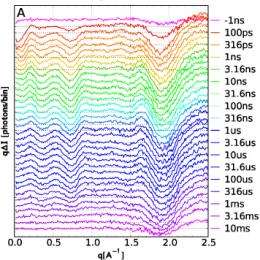
Structure change upon release of CO from myoglobin active site: Intensity of scattered X-rays as a function of distance from the center of the scattering pattern, for increasing intervals between laser and x-ray pulses. The shortest interval is at the top of the graph. The leftmost feature in the graph (SAXS region) is sensitive to the molecule’s overall shape; features to the right of this (WAXS region) provide more detailed information about the protein structure. Colors are associated with proposed intermediate structures that arise in the course of the transition. (Copyright © 2010 by the National Academy of Sciences)
(PhysOrg.com) -- The chemistry of life happens so fast that a millionth of a second is an eternity -- an eternity that is largely invisible to science. In that time, molecules change in ways we cannot see. Now, though, there is a way of looking at molecules in solution -- as they are in life -- that shows both the big-picture shape and smaller-scale details of a molecule in one glance, with each glimpse being captured in one hundred trillionths of a second. With this technique, new chemical landscapes are now open to study.
Working at the BioCARS beamline 14-ID at the U.S. Department of Energy’s Advanced Photon Source at Argonne National Laboratory, researchers from the National Institutes of Health and The University of Chicago have combined simultaneous small-angle and wide-angle x-ray scattering (SAXS and WAXS) with an ultrafast laser to observe the dynamics of a protein in solution with 100-picosecond time resolution and 2.5-Angstrom spatial resolution. The team demonstrated this unprecedented capability in a study of myoglobin.
Myoglobin is the protein that stores oxygen in muscles. The researchers looked at a reversible transition in which a carbon monoxide (CO) molecule binds to and releases from the active site in myoglobin. (The CO molecule is a stand-in for an oxygen molecule: They are chemically similar but the CO reaction is easier to observe with this technique.) The structures with and without CO are known, but are nearly identical. How, then, does the molecule change as CO gets out?
In the experiment, the release of CO was triggered by a pulse of laser light. At a given time delay ranging from 100 picoseconds to 10 milliseconds after the laser pulse, the sample was exposed to an x-ray pulse (see figure). X-rays that scatter at small angles (SAXS), tell about the overall shape of the myoglobin molecule. X-rays scattered at wide angles away from the sample (WAXS) give more detailed information about the structure.
The SAXS data show that the molecule immediately expands, but after 10 nanoseconds have passed, it’s back to nearly normal size. In addition, signatures in the scattering data are consistent with the presence of structures different from the original, and these signatures evolve over time. And because of the high spatial resolution of this technique, it may also be able to track when the CO molecule moves within the myoglobin structure and when it is excreted from the protein.
The method is made possible by a unique laser “pump-probe” setup developed in collaboration with NIH scientists as part of recent upgrade to beamline 14-ID, which is operated by BioCARS, part of the University of Chicago Center for Advanced Radiation Sources. The setup features a high-power, broadly tunable, short pulse laser system combined with sophisticated capabilities for timing the arrival of the laser pulse in relation to the x-ray pulse. In addition, given the design of the scattering diffractometer, the x-ray detector is large enough to capture both small- and wide-angle scattering without the need to reposition the detector.
Because this technique allows researchers to study molecules in solution rather than in single crystals, to collect SAXS and WAXS data simultaneously, to probe at the picosecond time scale, and to use light as a trigger, it is now possible to ask entirely new questions about a wide range of chemical and biological systems.
More information: Hyun Sun Cho, “Protein Structural Dynamics in Solution Unveiled via 100-ps Time-resolved X-ray Scattering,” PNAS, 107 (16), 7281 (20 April 2010). DOI:10.1073/pnas.1002951107
-
The Shapes of Molecules Really Matter for Heat Conduction
Sep 24, 2004 |
not rated yet |
0
-
Molecules in the spotlight
Dec 12, 2008 |
not rated yet |
0
-
Physicists Discover New Way To Visualize Shape Changes In Molecules
Aug 01, 2006 |
not rated yet |
0
-
Watching Electrons with Lasers
Nov 06, 2008 |
not rated yet |
0
-
K-State attosecond research could aid Homeland Security
May 21, 2007 |
not rated yet |
0
-
Engineers build first sub-10-nm carbon nanotube transistor
Feb 01, 2012 |
4.9 / 5 (30) |
30
-
Something old, something new: Evolution and the structural divergence of duplicate genes
Jan 31, 2012 |
4.6 / 5 (7) |
1
-
The hidden nanoworld of ice crystals: Revealing the dynamic behavior of quasi-liquid layers
Jan 30, 2012 |
5 / 5 (3) |
1
-
Stock market network reveals investor clustering
Jan 27, 2012 |
3.9 / 5 (23) |
8
-
Of microchemistry and molecules: Electronic microfluidic device synthesizes biocompatible probes
Jan 26, 2012 |
5 / 5 (1) |
0
-
Light & Sight
58 minutes ago
-
Wind Turbine Power
3 hours ago
-
Steam Table issues
5 hours ago
-
electrostatic induction in a conductor should be immpossible
9 hours ago
-
Help! Physics Momentum/Impulse problem!
12 hours ago
-
Gauss' law cubes, how to prove
13 hours ago
- More from Physics Forums - General Physics
More news stories
Hovering not hard if you're top-heavy, researchers find
Top-heavy structures are more likely to maintain their balance while hovering in the air than are those that bear a lower center of gravity, researchers at New York University's Courant Institute of Mathematical Sciences ...
30 minutes ago |
5 / 5 (1) |
1
|
SLAC, Stanford team focuses on high-energy electrons to treat cancer
Accelerator physicists at SLAC and cancer specialists from Stanford are working on a new technology that could dramatically reduce the time needed for cancer radiation treatments. The team ran an initial experiment ...
3 hours ago |
5 / 5 (1) |
0
Measurements from high-energy collisions lead to better understanding of why meson particles disappear
For several years, physicists at the Relativistic Heavy Ion Collider (RHIC) at Brookhaven National Laboratory (BNL), USA, have studied an unusual state of matter called the quarkgluon plasma, which they ...
4 hours ago |
not rated yet |
0
Quantum physicist explains $100K offer for proof scaled-up quantum computing is impossible
(PhysOrg.com) -- MIT researcher Scott Aaronson has certainly riled the physics community with his offer this past Friday, of $100,000 to anyone who can prove that scaled-up quantum computing is impossible. ...
Explained: Sigma
It's a question that arises with virtually every major new finding in science or medicine: What makes a result reliable enough to be taken seriously? The answer has to do with statistical significance -- but ...
Feb 09, 2012 |
5 / 5 (14) |
31
Grass to gas: Researchers' genome map speeds biofuel development
Researchers at the University of Georgia have taken a major step in the ongoing effort to find sources of cleaner, renewable energy by mapping the genomes of two originator cells of Miscanthus x giganteus, a large perenn ...
Drug halts organ damage in inflammatory genetic disorder
A new study shows that Kineret (anakinra), a medication approved for the treatment of rheumatoid arthritis, is effective in stopping the progression of organ damage in people with neonatal-onset multisystem inflammatory disease ...
Cochlear implants may be safe, effective for organ transplant patients
Cochlear implants may be a safe, effective option for some organ transplant patients who've lost their hearing as an unfortunate consequence of their transplant-related drug regime, researchers report.
Researchers develop new method for creating tissue engineering scaffolds
Researchers at Northwestern University have developed a new method for creating scaffolds for tissue engineering applications, providing an alternative that is more flexible and less time-intensive than current technology.
Molecular profiling reveals differences between primary and recurrent ovarian cancers
There is a need to analyze tumor specimens at the time of ovarian cancer recurrence, according to a new study published in Molecular Cancer Therapeutics. Researchers used a diagnostic technology called molecular profiling to examine ...
C-sections linked to breathing problems in preterm infants
Research conducted at Yale School of Medicine shows that a cesarean (C-section) delivery, which was thought to be harmless, is associated with breathing problems in preterm babies who are small for gestational age.
Jun 01, 2010
Rank: 1 / 5 (1)
Jun 01, 2010
Rank: 5 / 5 (1)
Probably not, that's the fun part.
Jun 01, 2010
Rank: not rated yet