Microbe power as a green means to hydrogen production
June 1, 2010
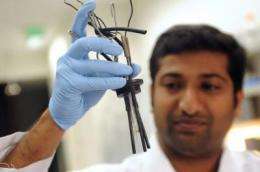
Dr. Prathap Parameswaran showing the electrode used in the microbial electrochemical cell (MEC). When the bacteria are grown in an oxygen-free, or anaerobic environment, they attach to the MXC's anode, forming a sticky matrix of sugar and protein. This living matrix, known as the biofilm anode, is a strong conductor. Credit: The Biodesign Institute at Arizona State University
Scientists have been hard at work harnessing the power of microbes as an attractive source of clean energy. Now, Biodesign Institute at Arizona State University researcher Dr. Prathap Parameswaran and his colleagues have investigated a means for enhancing the efficiency of clean energy production by using specialized bacteria.
Microbial electrochemical cells or MXCs are able to use bacterial respiration as a means of liberating electrons, which can be used to generate current and make clean electricity. With minor reconfiguring such devices can also carry out electrolysis, providing a green path to hydrogen production, reducing reliance on natural gas and other fossil fuels, now used for most hydrogen manufacture.
Dr. Prathap Parameswaran showing the electrode used in the microbial electrochemical cell (MEC).
MXCs resemble a battery, with a Mason jar-sized chamber setup for each terminal. The bacteria are grown in the "positive" chamber (called the anode). The research team, led by Bruce Rittmann, director of Biodesign's Center for Environmental Biotechnology, had previously shown that the bacteria are able to live and thrive on the anode electrode, and can use waste materials as food, (the bacteria's dietary staples include pig manure or other farm waste) to grow while transferring electrons onto the electrode to make electricity.
In a microbial electrolysis cell (MEC), like that used in the current study, the electrons produced at the anode join positiviely charged protons in the negative (cathode) chamber to form hydrogen gas. "The reactions that happen at the MEC anode are the same as for a microbial fuel cell which is used to generate electricity, " Parameswaran says. "The final output is different depending on how we operate it."
When the bacteria are grown in an oxygen-free, or anaerobic environment, they attach to the MXC's anode, forming a sticky matrix of sugar and protein. In such environments, when fed with organic compounds, an efficient partnership of bacteria gets established in the biofilm anode, consisting of fermenters, hydrogen scavengers, and anode respiring bacteria (ARB). This living matrix, known as the biofilm anode, is a strong conductor, able to efficiently transfer electrons to the anode where they follow a current gradient across to the cathode side.
The present study demonstrates that the level of electron flow from the anode to the cathode can be improved by selecting for additional bacteria known as homo-acetogens, in the anode chamber. Homo-acetogens capture the electrons from hydrogen in waste material, producing acetate, which is a very favorable electron donor for the anode bacteria.
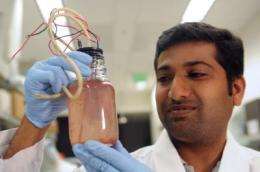
Microbial electrochemical cells or MXCs are able to use bacterial respiration as a means of liberating electrons, which can be used to generate current and make clean electricity. MXCs resemble a battery, with a Mason jar-sized chamber setup for each terminal. The bacteria are grown in the "positive" chamber (called the anode). Credit: The Biodesign Institute at Arizona State University
The study shows that under favorable conditions, the anode bacteria could convert hydrogen to current more efficiently after forming a mutual relationship or syntrophy with homo-acetogens. The team was also able to reduce the negative impact of other hydogen consuming microbes, such as methane-producing methanogens, which otherwise steal some of the available electrons in the system, thereby reducing current. The selective inhibition of methanogens was accomplished by the adding a chemical called 2-bromoethane sulfonic acid to the adode's microbial stew.The group used both chemical and genomic methods to confirm the identify of homo-acetogens. In addition to detection of acetate, formate, an intermediary product, was also discovered. With the aid of quantitative PCR analysis, the team was also able to pick up the genomic signature of acetogens in the form of FTHFS, a gene specifically associated with acetogenesis.
"We were able to establish that these homo-acetogens can prevail and form relationships," Parameswaran says. Future research will explore ways to sustain syntrophic relations between homo-acetogens and anode bacteria, in the absence of the chemical inhibitors.
Further progress could pave the way for eventual large-scale commercialization of systems to simultaneously treat wastewater and generate clean energy. "One of the biggest limitations right now is our lack of knowledge," says Cesar Torres, one of the current study's co-authors, who stresses that there remains much to understand about the interactions of bacterial communities within MXCs.
The field is still very young, Torres points out, noting that work on MXCs only began about 8 years ago. "I think over the next 5-10 years the community will bring a lot of information that will be really helpful and that will lead us to good applications."
More information: The team's results appear in the advanced online issue of the journal Bioresource Technology.
-
Study: cow-powered fuel cells grow smaller, mightier
Aug 21, 2007 |
not rated yet |
0
-
Microbial fuel cells turn on the juice
Dec 05, 2007 |
not rated yet |
0
-
Microbes turn electricity directly to methane
Mar 30, 2009 |
not rated yet |
0
-
Progress Toward a Biological Fuel Cell?
Dec 30, 2008 |
not rated yet |
0
-
Making more efficient fuel cells
Sep 07, 2009 |
not rated yet |
0
-
Engineers build first sub-10-nm carbon nanotube transistor
Feb 01, 2012 |
4.9 / 5 (31) |
30
-
Something old, something new: Evolution and the structural divergence of duplicate genes
Jan 31, 2012 |
4.6 / 5 (7) |
1
-
The hidden nanoworld of ice crystals: Revealing the dynamic behavior of quasi-liquid layers
Jan 30, 2012 |
5 / 5 (3) |
1
-
Stock market network reveals investor clustering
Jan 27, 2012 |
3.9 / 5 (23) |
8
-
Of microchemistry and molecules: Electronic microfluidic device synthesizes biocompatible probes
Jan 26, 2012 |
5 / 5 (1) |
0
-
Calling function with no input argument
13 hours ago
-
Force free body diagram problem on gym equipment
14 hours ago
-
Empirical data regarding shower heads and water
22 hours ago
-
feed hold button on CNC lathe
Feb 09, 2012
-
RFAC in Fortran
Feb 09, 2012
-
dynamics 2/32
Feb 08, 2012
- More from Physics Forums - General Engineering
More news stories
Google users warned of threat to smartphone wallets
Users of Google smartphone wallets were being warned on Friday that there is a way to crack pass codes intended to thwart thieves from going on illicit shopping sprees.
6 hours ago |
5 / 5 (2) |
0
Anonymous knocks CIA website offline (Update)
The website of the Central Intelligence Agency was inaccessible on Friday after the hacker group Anonymous claimed to have knocked it offline.
8 hours ago |
5 / 5 (8) |
13
New error-correcting codes guarantee the fastest possible rate of data transmission
Error-correcting codes are one of the triumphs of the digital age. Theyre a way of encoding information so that it can be transmitted across a communication channel such as an optical fiber o ...
Technology / Computer Sciences
16 hours ago |
4.9 / 5 (8) |
6
|
New power source discovered
(PhysOrg.com) -- Researchers at the Massachusetts Institute of Technology (MIT) and RMIT University have made a breakthrough in energy storage and power generation.
Technology / Energy & Green Tech
15 hours ago |
4.8 / 5 (25) |
8
|
Small modular reactor design could be a 'SUPERSTAR'
(PhysOrg.com) -- Though most of today's nuclear reactors are cooled by water, we've long known that there are alternatives; in fact, the world's first nuclear-powered electricity in 1951 came from a reactor ...
Technology / Energy & Green Tech
16 hours ago |
4.3 / 5 (12) |
22
|
Humans may have helped the decline of African rainforests 3000 years ago
(PhysOrg.com) -- Large areas of rainforests in Central Africa mysteriously disappeared over three thousand years ago, to be replaced by savannas. The prevailing theory has been that the cause was a change ...
Complex wiring of the nervous system may rely on a just a handful of genes and proteins
Researchers at the Salk Institute have discovered a startling feature of early brain development that helps to explain how complex neuron wiring patterns are programmed using just a handful of critical genes. ...
The power of estrogen -- male snakes attract other males
A new study has shown that boosting the estrogen levels of male garter snakes causes them to secrete the same pheromones that females use to attract suitors, and turned the males into just about the sexiest ...
Putting the squeeze on planets outside our solar system
(PhysOrg.com) -- Using high-powered lasers, scientists at Lawrence Livermore National Laboratory and collaborators discovered that molten magnesium silicate undergoes a phase change in the liquid state, abruptly ...
Could Venus be shifting gear?
(PhysOrg.com) -- ESAs Venus Express spacecraft has discovered that our cloud-covered neighbour spins a little slower than previously measured. Peering through the dense atmosphere in the infrared, the ...
Fool's gold may prove an unlikely alternative to overexploited catalytic materials
Catalytic materials, which lower the energy barriers for chemical reactions, are used in everything from the commercial production of chemicals to catalytic converters in car engines. However, with current catalytic materials ...

Jun 01, 2010
Rank: not rated yet
The idea of having a bacterial shit reactor to power our homes and businesses is just too funny.
FBM will hate this one, as it allows recycling of human waste, greatly removing limits on population growth, while simultaneously providing power for said population.
Go microbes.