Japanese firm wants to transform the Moon into a giant solar power plant
June 2, 2010 by Lisa Zyga
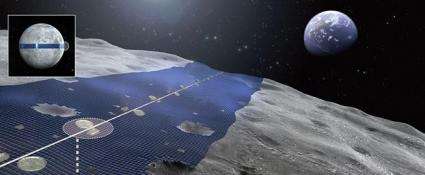
The Luna Ring: Electric power generated by a belt of solar cells around the lunar equator would be transmitted and beamed to the Earth from the near side of the Moon. Image credit: Shimizu Corporation.
(PhysOrg.com) -- The Shimizu Corporation, a Japanese construction firm, has recently proposed a plan to harness solar energy on a larger scale than almost any previously proposed concept. Their ambitious plan involves building a belt of solar cells around the Moon’s 6,800-mile (11,000-kilometer) equator, converting the electricity to powerful microwaves and lasers to be beamed at Earth, and finally converting the beams back to electricity at terrestrial power stations. The Luna Ring concept, the company says, could meet the entire world's energy needs.
Shimizu envisions that robots would play a vital role in building the Luna Ring. Teleoperated 24 hours a day from the Earth, the robots would perform tasks such as ground leveling and assembling machines and equipment, which would be done in space before landing them on the Moon. A team of astronauts would support the robots on-site.
Due to the massive amount of solar panels and other materials needed for the project, Shimizu proposes that lunar resources should be used to the fullest extent possible. The company’s plans call for producing water by reducing lunar soil with hydrogen imported from Earth. Lunar resources could also be used to make cementing material and concrete, while solar-heat treatments could help produce bricks, glass fibers, and other structural materials needed for the project.
The Luna Ring itself would initially have a width of a few kilometers, but could be extended up to 400 kilometers wide. The electric power generated by the solar cells would be transmitted by electric cables to transmission facilities on the near side of the Moon, which is constantly facing Earth. After the electricity is converted into microwave beams and laser beams, 20-kilometer-diameter antennas would beam the power to receivers on Earth. A guidance radio beacon would ensure accurate transmission to the receivers. The energy would then be converted back to electricity and supplied to grids, or possibly converted to hydrogen for fuel or storage.
Shimizu points out that one of the biggest advantages of the Luna Ring is that, since the Moon has virtually no atmosphere, there is no bad weather or clouds that could inhibit the efficiency of the solar panels. As such, the Luna Ring achieves 24/7 continuous clean energy generation, potentially ending our reliance on limited natural resources.
• PhysOrg.com iPhone / iPad Apps
• PhysOrg.com Audio Podcasts / iTunes
• Join PhysOrg.com on Facebook!
• Follow PhysOrg.com on Twitter!
More information: Shimizu Corporation
via: Pink Tentacle
© 2010 PhysOrg.com
-
Japan plans to build robot moon base by 2020
May 28, 2010 |
not rated yet |
0
-
European space company wants solar power plant in space
Jan 21, 2010 |
not rated yet |
0
-
Space-Based Solar Power Coming to California in 2016
Apr 15, 2009 |
not rated yet |
0
-
Lunar Eclipse
Feb 13, 2007 |
not rated yet |
0
-
Concordia University integrates combination of solar heat and power technology into its' new building
Jan 15, 2009 |
not rated yet |
0
-
Engineers build first sub-10-nm carbon nanotube transistor
Feb 01, 2012 |
4.9 / 5 (29) |
30
-
Something old, something new: Evolution and the structural divergence of duplicate genes
Jan 31, 2012 |
4.6 / 5 (7) |
1
-
The hidden nanoworld of ice crystals: Revealing the dynamic behavior of quasi-liquid layers
Jan 30, 2012 |
5 / 5 (3) |
1
-
Stock market network reveals investor clustering
Jan 27, 2012 |
3.9 / 5 (23) |
8
-
Of microchemistry and molecules: Electronic microfluidic device synthesizes biocompatible probes
Jan 26, 2012 |
5 / 5 (1) |
0
-
Real pictures of black hole eating a star?
3 hours ago
-
Hypothetical way to travel faster than light, but not technically exceed lightspeed
Feb 06, 2012
-
How do scientists monitor the Sun's activity?
Feb 05, 2012
-
Search patterns in observational studies
Feb 05, 2012
-
Derivation of Pogson's law
Feb 03, 2012
-
Landing on comet by Rosetta probe in 2014 (YouTube)
Feb 02, 2012
- More from Physics Forums - General Astronomy
More news stories
Astronomy team discovers nearby dwarf galaxy
(PhysOrg.com) -- A team led by UCLA research astronomer Michael Rich has used a unique telescope to discover a previously unknown companion to the nearby galaxy NGC 4449, which is some 12.5 million light years ...
5 hours ago |
5 / 5 (1) |
3
|
Amasia: As next supercontinent forms, Arctic Ocean, Caribbean will vanish first
(PhysOrg.com) -- Geologists at Yale University have proposed a new theory to describe the formation of supercontinents, the epic process by which Earths major continental blocks combine into a single ...
Space & Earth / Earth Sciences
5 hours ago |
4.1 / 5 (7) |
0
|
Chandra finds Milky Way's black hole grazing on asteroids
(PhysOrg.com) -- The giant black hole at the center of the Milky Way may be vaporizing and devouring asteroids, which could explain the frequent flares observed, according to astronomers using data from NASA's ...
6 hours ago |
5 / 5 (1) |
4
|
In scientific coup, Russians reach Antarctic lake
After more than two decades of drilling in Antarctica, Russian scientists have reached a gigantic freshwater lake hidden under miles of ice for some 20 million years - a pristine body of water that may hold ...
Space & Earth / Earth Sciences
6 hours ago |
4.8 / 5 (5) |
4
New images capture 'stealth merger' of dwarf galaxies
New images of a nearby dwarf galaxy have revealed a dense stream of stars in its outer regions, the remains of an even smaller companion galaxy in the process of merging with its host. The host galaxy, known ...
6 hours ago |
not rated yet |
0
|
Why are there so few fish in the Earth's oceans?
(PhysOrg.com) -- A Stony Brook University researcher has found that, contrary to popular belief, there are not plenty of fish in the sea.
Scientists strengthen memory by stimulating key site in brain
Ever gone to the movies and forgotten where you parked the car? New UCLA research may one day help you improve your memory.
Transparent iron? For the first time, an experiment shows that atomic nuclei can become transparent
At the high-brilliance synchrotron light source PETRA III, a team of DESY scientists headed by Dr. Ralf Röhlsberger has succeeded in making atomic nuclei transparent with the help of X-ray light. At the ...
Physicists build highly efficient 'no-waste' laser
A team of University of California, San Diego researchers has built the smallest room-temperature nanolaser to date, as well as an even more startling device: a highly efficient, "thresholdless" laser that ...
Most stretchable spider silk reported
The egg sac silk of the cocoon stalk of the cave spider Meta menardi is the most stretchable egg sac silk yet tested, according to a study published Feb. 8 in the open access journal PLoS ONE.
Study shows how DNA finds its match
It's been more than 50 years since James Watson and Francis Crick showed that DNA is a double helix of two strands that complement each other. But how does a short piece of DNA find its match, out of the millions ...
Jun 02, 2010
Rank: 3.3 / 5 (7)
Jun 02, 2010
Rank: 2.8 / 5 (4)
"The sky calls to us. If we do not destroy ourselves
we will one day venture to the stars" - Carl Sagan
Well, if we do not destroy ourselves....
Jun 02, 2010
Rank: 3 / 5 (2)
Jun 02, 2010
Rank: 4.3 / 5 (6)
Jun 02, 2010
Rank: 1 / 5 (5)
http://www.youtub...=related
Jun 02, 2010
Rank: 3 / 5 (4)
Jun 02, 2010
Rank: 4.2 / 5 (6)
- Japan wanting to shoot up an orbital sattelite in order beam down energy
- Japan wanting to put humanoid robts on the moon
- and now Japan wanting to convert the moon into giant death star
You can't accuse them of 'thinking small'
(but you also can't accuse them of being overly realistic)
Cost. Even if you have to put up 4 solar power plants on the earth's surface to get the performance/reliability of a solar power sattelite it's WAY cheaper (and you are much better able to do maintenance).
Jun 02, 2010
Rank: 1 / 5 (2)
Jun 02, 2010
Rank: 4.1 / 5 (8)
Jun 02, 2010
Rank: 4.1 / 5 (11)
Jun 02, 2010
Rank: 3 / 5 (10)
Say WHAT?!?!?!?!? The moon is a rotating sphere. It has day and night on BOTH sides. Come On!!!
Jun 02, 2010
Rank: 4.2 / 5 (6)
Jun 02, 2010
Rank: 4 / 5 (2)
dark side of the moon - meaning the side of the moon that is never visible to earth
And the fact that a spot on the moon can have darkness -- we never see the dark side of the moon, but that does not mean it is without sunlight - in fact when we have a new moon the dark side of the moon is completly lit up.
it can be a tough concept until you get two soda cans and draw something on one side that represents a face -- then it becomes simple to comprehend
Jun 02, 2010
Rank: 4.6 / 5 (7)
Jun 02, 2010
Rank: 4 / 5 (1)
(and there's that horrid dark side that so many have pointed out - so sunlight will be part time.)
Interesting concept though, possibly doable, but my first thought - beaming all that energy though our atmosphere, would that have any effect on our little world - ozone layer, our weather and so on.
Jun 02, 2010
Rank: 2 / 5 (3)
Half the moon is always illuminated except during a solar eclipse, that's why they wan't to rap it around the entire thing.
Transmission would be darn near impossible. You'd have to do it in really really fast bursts, something like collecting a full days worth of energy, then beaming it to a tiny tiny point on the surface in less than a second, storing it somehow and sending it to the grid. Or you could do it every hour, but that's 24 stations equidistant around the globe.
This is a bit rediculous, probably propaganda distractions to maintain the "we are studying new technologies" attitude to avoid the energy revolution.
I agree the Dyson Sphere is probably more practical, lol.
Jun 02, 2010
Rank: 3 / 5 (1)
Jun 02, 2010
Rank: 3 / 5 (1)
I thought about that too back when that solar satellite was discussed last year to direct solar energy from space to Earth. Think of Earth as an ant and these solar arrays as a big magnifying glass focusing the suns rays on the ant. :)
It may be "clean" energy, but it'll cause Earth to absorb even MORE solar radiation than it already is. A few satellites might not have much of an impact, but redirect all the sunlight that hits a 400 mile swatch across the entire face of the bright side of the moon towards Earth... can't see that helping the fight against global warming... only contributing to global warming.
Jun 02, 2010
Rank: 3 / 5 (1)
Yes, but not the "far side". The far side is the same as the near side... both go through day and night. The text in the article is plain wrong. The far side of the moon does NOT receive constant sunlight. From Earth, when we see a full moon, the "far side" is in complete darkness.
Jun 02, 2010
Rank: 4 / 5 (1)
http://www.acm.or...mar.html
Jun 02, 2010
Rank: 3 / 5 (2)
Jun 02, 2010
Rank: 2 / 5 (2)
Satellites are only cost-efficient if like 99.99% of the materials are mined from asteroids.
Launching them from earth costs more than they would ever be worth at this point.
But the Japanese are at least ambitious and exploring this. American energy companies suck and are only in it for themselves, milking the "fossil fuel" cow for every cent they can.
However, even the Japanese don't get it. You gotta use self-replicating robots. Having people on earth operating ROVs with a 2.5 second delay is a joke.
Jun 02, 2010
Rank: 5 / 5 (1)
A remote controlled earth mover has been seen many times.
Robotic arms assemble cars every day.
Robottic arms can be controlled with human input from earth as if they were your own. 3D also available.
Just launch the rockets already!
Jun 02, 2010
Rank: 2.3 / 5 (9)
Jun 02, 2010
Rank: 3 / 5 (4)
Its a Rock, hell i would send robots up there just to carve a message in the ground.
The moon is useless. Pretty, but useless.
Also, if this will provice our energy, we would have to cut back on everything else. I mean, how much energy can you pump into the earth before we heat up?
Jun 02, 2010
Rank: 3.4 / 5 (5)
Hmm, mindless graffiti on a grand scale. How trite.
Jun 02, 2010
Rank: 4.5 / 5 (4)
The moon is also rich in titanium aluminium etc which could be smelted off planet and reurned to earth.
While it is true no side of the moon is permanently in sun/shade there are supposedly sites at the north/south poles on the moon that are constantly in sun/shade.
But the whole power stations idea is a crock build lots of solar thermal/wind and storage systems and we can have a green grid in less than a generation and pay less for our electricity than we do now.
Jun 02, 2010
Rank: 2.1 / 5 (7)
This might be one of the most ignorant comments I have ever heard. Without the moon the earth wouldn't be able to maintain its orbit and we would be sent far into the cold depths of space. In addition the moon also happens to provide the majority of our tidal action providing the medium for life on this planet. Without the moon we would not exist, so in conclusion the moon is pretty and is very, very useful. You need to think harder before you post garbage.
Jun 02, 2010
Rank: 4.2 / 5 (5)
Jun 02, 2010
Rank: 3.5 / 5 (2)
Jun 02, 2010
Rank: 4.1 / 5 (9)
Which is also the amount of solar cells that would put out power if you place them here on earth (e.g in deserts where the number of overcast days is less than 5 per year).
AND you wouldn't have all the losses from beaming back the energy.
AND you wouldn't need to worry about people turning this thing into a death star.
AND you could easily maintain/upgrade it.
AND it would cost only a small fraction of what putting all that stuff on the moon would cost
AND... (need I go on?)
Summary: The moon-solar-cell-array is cool tech. But it's also an incredibly stupid idea.
Jun 02, 2010
Rank: 2 / 5 (4)
Jun 02, 2010
Rank: 4 / 5 (3)
If Japan can make that many solar cells then stick them on the roof and generate all the power you need right here!
Jun 02, 2010
Rank: 1 / 5 (1)
-Interesting thought experiment
-Shimizu publicity ploy
Jun 02, 2010
Rank: 4.2 / 5 (5)
Jun 02, 2010
Rank: 2 / 5 (3)
Jun 02, 2010
Rank: 1.8 / 5 (5)
If the Japanese want to do this and you don't have to pay for it, why would you care?
Jun 02, 2010
Rank: 1 / 5 (2)
Jun 02, 2010
Rank: 2 / 5 (2)
Jun 02, 2010
Rank: 2 / 5 (2)
Jun 02, 2010
Rank: 1.5 / 5 (2)
Jun 02, 2010
Rank: 4.7 / 5 (3)
I am all for having a robotic program of building infrastructure up there however.
Jun 03, 2010
Rank: 1.5 / 5 (4)
Jun 03, 2010
Rank: 3 / 5 (6)
The Saturn V system delivered a 65000kg payload to the moon. Considering half this payload was the rockets for coming back, how many self-replicating robots do you suppose the proposed ~3 times bigger NOVA rocket launch system could put on the moon?
This stuff isn't as hard as you think if NASA supposedly did it 40 years ago.
The fact is neither the government nor capitalists in the U.S. want anyone to have cheap energy or space-age "type 1" or "type 2" robotics technology.
If they did, the "powers that be" would be out of power.
Jun 03, 2010
Rank: 3.3 / 5 (4)
I am not a physicist but that part seems to me like sci-fi....
Jun 03, 2010
Rank: 1 / 5 (3)
Jun 03, 2010
Rank: 1.5 / 5 (4)
Jun 03, 2010
Rank: 1 / 5 (2)
Jun 03, 2010
Rank: 3 / 5 (2)
Jun 03, 2010
Rank: 3 / 5 (2)
Jun 03, 2010
Rank: 2.2 / 5 (5)
Jun 03, 2010
Rank: 3.3 / 5 (3)
Jun 03, 2010
Rank: 3 / 5 (6)
Jun 03, 2010
Rank: 3 / 5 (3)
Ok I'm done now.
Jun 03, 2010
Rank: 1.7 / 5 (3)
I think all of life on earth would beg to differ, tidewater would simply be the first hit.
Jun 03, 2010
Rank: 5 / 5 (2)
The moon is in synchronous rotation with the earth which means one side is always away from the earth. It does not spin like the Earth !
Since the surface of the moon reflects very little light (about the same reflective quality as coal) what we see as "the dark side of the moon" is really still getting a huge amount of solar radiation, and since we never see the far side, we will not see a solar strip.
The whole idea is ridiculous as a solar power collector in our orbit would much better, cheaper to run and easier to fix.
However the class of idiot comments on a science website are priceless !
Jun 03, 2010
Rank: 3 / 5 (2)
Jun 03, 2010
Rank: 4 / 5 (1)
But since the moon revolves around the earth no point on earth (read none of the base stations that receive power) gets 24/7 coverage. So you'd still be leaving all of the world half of the time 'in the dark'.
Jun 03, 2010
Rank: 3.7 / 5 (3)
Why does this tripe get trough unless the editors agree with killing people?
Jun 03, 2010
Rank: 2 / 5 (1)
The moon also doesn't have a magnetic field to block the solar radiation and flares that can knock out earth based satellites...they would need some massive shielding I'd think....
This is a great concept, but unfortunately, it would cost the world all of its money to do it...
Jun 03, 2010
Rank: 5 / 5 (1)
Who is asking the world to pay?
Jun 03, 2010
Rank: 1 / 5 (1)
I guess it's official, Japan is infected with PRitis. Or most of their corporate execs have been enjoying the benefits of certain medicinal herbs lately.
Jun 03, 2010
Rank: 4 / 5 (1)
Admittedly low cost to earth orbit is necessary.
You appear to forget, the SPS won't be weathering.
You appear to forget, the SPS will be in daylight 24/7.
You appear to forget, the SPS will not be rained on or have cloudy days.
You appear to forget, the SPS will be immune to ground based disaster.
An investment more like Hoover Dam, than those solar farms that will never, ever, pay for themselves.
Jun 03, 2010
Rank: 5 / 5 (1)
Don't invest in SPS.
If you think it is a waste of money, don't invest and don't let politicians give them any tax money.
Jun 03, 2010
Rank: 4 / 5 (1)
Neither will those on earth if you take minimal precautions (a bit of clingwrap protects those from all but UV degradation. And SPS have that problem, too)
Not those on the moon. Those on sattelites: yes. That's the ONLY thing sattelites have going for them.
Plenty of places where the number of rainy days is so low as to be negligible. And if you can build 4-for-1 and space them out at the same cost even that is not a problem (e.g. death valley has no rainy days for years at a stretch)
Such as? Earthquakes don't hurt solar cells. And ground based stuff is not susceptible to micrometeorites (read: how will you do maintenance in space? Especially in GEO? No shuttels go that far)
Jun 03, 2010
Rank: 4.5 / 5 (2)
It's hard to remember when the last power plant (of any type) was struck by 'ground based disaster'. Could you give an example? One that is relevant to a solar power plant?
And SPS will? Have you any idea how much it costs to shoot up 1kg of payload to GEO or even LEO. Look it up and compute how many square meters of solar cells you can build additionally on earth for that.
You talk so off-hand about "we need a cheaper way of launching stuff". Duh.
But I see no such technology even remotely on the horizon (at least not in the timespan we have in order to convert to alternative technologies)
And then you might look up how much damage rocket exhaust does to the ozone layer and then do the math on what would happen if were to put SPSs up there to only cover 1% of our energy need.
Jun 03, 2010
Rank: 2 / 5 (1)
I wonder how many of you "posties" actually have solar power at home. not many is my guess!
Jun 04, 2010
Rank: 5 / 5 (1)
Jun 04, 2010
Rank: 5 / 5 (1)
They've updated the article. Find my first post. I copied and pasted the text as it was.
Jun 04, 2010
Rank: 3.6 / 5 (5)
Y'all are missing the point. No one's talking about REMOVING the moon from orbit!!! NOTHING about this plan would have ANY effect on gravitational tidal forces. The Earth will NOT fly off into empty space. The moon IS a useless piece of rock floating in space. We can't "harm" it because there's nothing to harm. It'd dead. It DOES have plenty of resources that we could use to improve human civilization. Though, this particular solar panel idea is kind of wacko, the moon, as it sits right now, is useless. We can change that though, aesthetics aside.
Jun 04, 2010
Rank: 3 / 5 (1)
I have blueprints drawn up for something that may knock both out of the water though, but still have to build the prototype and measure its output. Its a b*tch to find the parts I need....
Jun 04, 2010
Rank: 5 / 5 (2)
If we have robots capable of construction on the moon, I think the energy gathered would be worth a premium price. Right there! On the moon!
Jun 05, 2010
Rank: 3 / 5 (1)
The only way this could be better than satellites would be if the robots reproduce and get all construction materials from the moon itself. If we had the technology to do that, wouldn't it be a crapload cheaper to put it in the Mojave, Sahara, Gobi and Simpson deserts? The biggest hurdle to solar right now is that it's expensive to build. If solar panels were easy enough for an automated lunar robot to build, then they would be cheap enough to use as roads, roofs, walls and windows.
Then there's the whole 'Death Star' thing. It makes me slightly uncomfortable... And I remember what GDI's Ion Cannon could do in Command and Conquer...
Jun 05, 2010
Rank: 4 / 5 (2)
:) ahah
Jun 05, 2010
Rank: 1 / 5 (5)
This will unbalance earth, and so... all living creatures on earth.
Jun 05, 2010
Rank: 5 / 5 (3)
What? If you weren't told you and most of people who don't own telescopes wouldn't even know this was done.
Jun 05, 2010
Rank: 3 / 5 (1)
By "light side", I'm hoping you mean "the side that faces us always faces us" and not "the side that faces us is always light"?
Jun 05, 2010
Rank: 3 / 5 (2)
Jun 06, 2010
Rank: 5 / 5 (1)
No more nuclear waste on the earth and we get lots of power at probably a fraction of the cost of this solar panel idea on the moon.
[rant]
Or we could just build some god damn nuclear plants here on earth and when someone complains about the waste tell them to stfu.[/rant]
Jun 06, 2010
Rank: 2 / 5 (1)
Obviously, and adding solar panels changes nothing of that. You are a little sidetracked and off topic, but I forgive you.
Jun 06, 2010
Rank: 4 / 5 (1)
Nada. Its just easier to build on something than not.
Jun 06, 2010
Rank: 4 / 5 (1)
It seems natural to me that our houses be made of Solar panels or at the very least the roofs.
Nature's been doing it for billions of years and it hasn't changed and still works like a charm.
Though this is an interesting idea and i like the technology involved.
Jun 06, 2010
Rank: 5 / 5 (1)
Jun 06, 2010
Rank: 3 / 5 (1)
Our solar cells are way too expensive to be efficient. How if new very cheap substances are discovered after all solar arrays are set up? You got to change all of them right from the start, right?
Jun 06, 2010
Rank: not rated yet
One problem would be the low orbit these things would be in, if they were at the altitude of the space station, drag would accumulate requiring periodic boosting. If they were in geosych altitude, some 36,000 km up there would be much less needed in the way of boosting but you might as well be on the moon as far as maintenance goes. The best of all worlds would be a space elevator with solar panels there.
Jun 06, 2010
Rank: not rated yet
Jun 06, 2010
Rank: not rated yet
Jun 06, 2010
Rank: not rated yet
Jun 06, 2010
Rank: not rated yet
The beam would be spread out over several square kilometers so the average power would not fry anything but maybe birds in the beam. They can fix that with a high fence around the receiving antenna.
It would be designed in such a way as to be near impossible to weaponize.
Jun 07, 2010
Rank: not rated yet
Jun 07, 2010
Rank: not rated yet
Jun 07, 2010
Rank: 5 / 5 (1)
OK, I'm not the only one:
Luke: "Look at him. He's headed for that small moon."
Han: "I think I can get him before he gets there. He's almost in range."
Obi-Wan: "That's no moon. It's a space station."
Luke: "I have a very bad feeling about this."
Jun 07, 2010
Rank: 5 / 5 (1)
I say that quote without context all the time. Nice to be able to say it in context for once.
Jun 08, 2010
Rank: not rated yet
There might be something to this, the moon is a bit bigger than the ISS, might pull in more meteorites?
Jun 08, 2010
Rank: not rated yet
Except there's no such thing as nuclear waste. Just radioactive material that we're unable to harvest further energy from.
Stick it in a salt pan and pick the reactables and precious metals out of it later, or even better, stick it in a traveling wave or fast breeder reactor. Zero waste, all energy.
Jun 08, 2010
Rank: not rated yet