Arctic ice at low point compared to recent geologic history
June 2, 2010 by Pam Frost Gorder
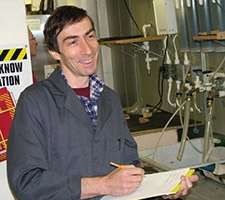
Leonid Polyak
Less ice covers the Arctic today than at any time in recent geologic history. That's the conclusion of an international group of researchers, who have compiled the first comprehensive history of Arctic ice.
For decades, scientists have strived to collect sediment cores from the difficult-to-access Arctic Ocean floor, to discover what the Arctic was like in the past. Their most recent goal: to bring a long-term perspective to the ice loss we see today.
Now, in an upcoming issue of Quarternary Science Reviews, a team led by Ohio State University has re-examined the data from past and ongoing studies -- nearly 300 in all -- and combined them to form a big-picture view of the pole's climate history stretching back millions of years.
"The ice loss that we see today -- the ice loss that started in the early 20th Century and sped up during the last 30 years -- appears to be unmatched over at least the last few thousand years," said Leonid Polyak, a research scientist at Byrd Polar Research Center at Ohio State University. Polyak is lead author of the paper and a preceding report that he and his coauthors prepared for the U.S. Climate Change Science Program.
Satellites can provide detailed measures of how much ice is covering the pole right now, but sediment cores are like fossils of the ocean's history, he explained.
"Sediment cores are essentially a record of sediments that settled at the sea floor, layer by layer, and they record the conditions of the ocean system during the time they settled. When we look carefully at various chemical and biological components of the sediment, and how the sediment is distributed -- then, with certain skills and luck, we can reconstruct the conditions at the time the sediment was deposited."
For example, scientists can search for a biochemical marker that is tied to certain species of algae that live only in ice. If that marker is present in the sediment, then that location was likely covered in ice at the time. Scientists call such markers "proxies" for the thing they actually want to measure -- in this case, the geographic extent of the ice in the past.
While knowing the loss of surface area of the ice is important, Polyak says that this work can't yet reveal an even more important fact: how the total volume of ice -- thickness as well as surface area -- has changed over time.
"Underneath the surface, the ice can be thick or thin. The newest satellite techniques and field observations allow us to see that the volume of ice is shrinking much faster than its area today. The picture is very troubling. We are losing ice very fast," he said.
"Maybe sometime down the road we'll develop proxies for the ice thickness. Right now, just looking at ice extent is very difficult."
To review and combine the data from hundreds of studies, he and his cohorts had to combine information on many different proxies as well as modern observations. They searched for patterns in the proxy data that fit together like pieces of a puzzle.
Their conclusion: the current extent of Arctic ice is at its lowest point for at least the last few thousand years.
As scientists pull more sediment cores from the Arctic, Polyak and his collaborators want to understand more details of the past ice extent and to push this knowledge further back in time.
During the summer of 2011, they hope to draw cores from beneath the Chukchi Sea, just north of the Bering Strait between Alaska and Siberia. The currents emanating from the northern Pacific Ocean bring heat that may play an important role in melting the ice across the Arctic, so Polyak expects that the history of this location will prove very important. He hopes to drill cores that date back thousands of years at the Chukchi Sea margin, providing a detailed history of interaction between oceanic currents and ice.
"Later on in this cruise, when we venture into the more central Arctic Ocean, we will aim at harvesting cores that go back even farther," he said. "If we could go as far back as a million years, that would be perfect."
More information: Quarternary Science Reviews - http://www.elsevie … #description
-
Arctic expeditions find giant mud waves, glacier tracks
Dec 12, 2007 |
not rated yet |
0
-
Arctic sea ice may be at 'tipping point'
Sep 16, 2005 |
not rated yet |
0
-
Winter Sea Ice Fails to Recover, Down to Record Low
Apr 06, 2006 |
not rated yet |
0
-
New method to estimate sea ice thickness
Mar 05, 2008 |
not rated yet |
0
-
Arctic sea ice thinning at record rate
Oct 28, 2008 |
not rated yet |
0
-
Engineers build first sub-10-nm carbon nanotube transistor
Feb 01, 2012 |
4.9 / 5 (31) |
30
-
Something old, something new: Evolution and the structural divergence of duplicate genes
Jan 31, 2012 |
4.6 / 5 (7) |
1
-
The hidden nanoworld of ice crystals: Revealing the dynamic behavior of quasi-liquid layers
Jan 30, 2012 |
5 / 5 (3) |
1
-
Stock market network reveals investor clustering
Jan 27, 2012 |
3.9 / 5 (23) |
8
-
Of microchemistry and molecules: Electronic microfluidic device synthesizes biocompatible probes
Jan 26, 2012 |
5 / 5 (1) |
0
-
Discrepancy between oxygen and carbon-dioxide levels
Feb 09, 2012
-
where gems are found in the world
Feb 09, 2012
-
Wind Waves in Reservoir ~ Wind run-up and Wind set-up
Feb 08, 2012
-
Balance of oxygen in the atmosphere
Feb 01, 2012
-
The case for a methanol-based economy
Jan 30, 2012
-
Weather in a rotating cylinder
Jan 25, 2012
- More from Physics Forums - Earth
More news stories
Humans may have helped the decline of African rainforests 3000 years ago
(PhysOrg.com) -- Large areas of rainforests in Central Africa mysteriously disappeared over three thousand years ago, to be replaced by savannas. The prevailing theory has been that the cause was a change ...
Could Venus be shifting gear?
(PhysOrg.com) -- ESAs Venus Express spacecraft has discovered that our cloud-covered neighbour spins a little slower than previously measured. Peering through the dense atmosphere in the infrared, the ...
Space & Earth / Space Exploration
13 hours ago |
5 / 5 (7) |
7
|
NASA sees wide-eyed cyclone Jasmine
Cyclone Jasmine's eye has opened wider on NASA satellite imagery, as it moves through the Southern Pacific Ocean.
Space & Earth / Earth Sciences
5 hours ago |
3.5 / 5 (2) |
1
NASA budget will axe Mars deal with Europe: scientists
US President Barack Obama's budget proposal to be submitted next week for 2013 will cut NASA's budget by 20 percent and eliminate a major partnership with Europe on Mars exploration, scientists said Thursday.
Space & Earth / Space Exploration
16 hours ago |
5 / 5 (2) |
18
Mars Science Laboratory computer issue resolved
(PhysOrg.com) -- Engineers have found the root cause of a computer reset that occurred two months ago on NASA's Mars Science Laboratory and have determined how to correct it.
Space & Earth / Space Exploration
14 hours ago |
4.7 / 5 (6) |
3
|
Google users warned of threat to smartphone wallets
Users of Google smartphone wallets were being warned on Friday that there is a way to crack pass codes intended to thwart thieves from going on illicit shopping sprees.
Anonymous knocks CIA website offline (Update)
The website of the Central Intelligence Agency was inaccessible on Friday after the hacker group Anonymous claimed to have knocked it offline.
Complex wiring of the nervous system may rely on a just a handful of genes and proteins
Researchers at the Salk Institute have discovered a startling feature of early brain development that helps to explain how complex neuron wiring patterns are programmed using just a handful of critical genes. ...
New error-correcting codes guarantee the fastest possible rate of data transmission
Error-correcting codes are one of the triumphs of the digital age. Theyre a way of encoding information so that it can be transmitted across a communication channel such as an optical fiber o ...
The power of estrogen -- male snakes attract other males
A new study has shown that boosting the estrogen levels of male garter snakes causes them to secrete the same pheromones that females use to attract suitors, and turned the males into just about the sexiest ...
New power source discovered
(PhysOrg.com) -- Researchers at the Massachusetts Institute of Technology (MIT) and RMIT University have made a breakthrough in energy storage and power generation.
Jun 02, 2010
Rank: 3.3 / 5 (7)
Jun 02, 2010
Rank: 3 / 5 (10)
huh? You and other deniers have been trying to cast doubt for years on human based climate change by claiming that events in the last 1000 years have been more extreme.
Using scientific notation to make people think you have a single dollop of scientific knowledge is not only lame, but transparent. Not only that, but 50,000 years (50x10^4) encompasses quite a few extreme events, and I think that having the climate record of last 30-50 years being unreproducible in that time period is pretty scary.
You guys keep screaming for more data, looks like you starting to get buried under a mountain of it.
Jun 03, 2010
Rank: 3.4 / 5 (5)
Jun 03, 2010
Rank: 3 / 5 (2)
Jun 03, 2010
Rank: 2 / 5 (4)
It also amazes me that people think the warming trend we are experiencing is a bad thing. There is no proof that it is bad thing, just a couple of politicians spewing garbage.
Also what happens if we over do it and go into a cooling trend, do we then start putting carbon back into the air.
Heck we can barely forecast simple weather patterns, yet we are able to forcast the entire world for centuries.
Jun 03, 2010
Rank: 1 / 5 (2)
or fat flippin' fingers, and yeah its support to be .5My, 500,000. Geologic Time, not the Sunday before last.
Jun 03, 2010
Rank: 1 / 5 (3)
yada yada.
30 years is 5 minutes ago, geologically speaking, 300, an hour.
Got milk? Where are the dairy farms in Greenland? They were present 1000 years ago. Today, it is too cold. However, I do understand the Greenlanders were able to start growing Cabbages about 40 years ago.
Jun 04, 2010
Rank: 4 / 5 (4)
Shootist, where were the Humans 400,000 years ago? Today it's just perfect for them, but 400k is a geological blink, why weren't they there before?
Just drop this line of argument, gents. It's utterly retarded.