Hubble Images Suggest Rogue Asteroid Smacked Jupiter
June 3, 2010
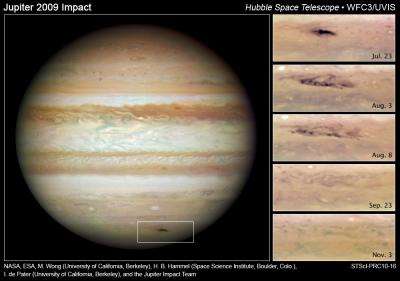
These NASA Hubble Space Telescope snapshots reveal an impact scar on Jupiter fading from view over several months between July 2009 and November 2009. Credit: NASA, ESA,
(PhysOrg.com) -- Without warning, a mystery object struck Jupiter on July 19, 2009, leaving a dark bruise the size of the Pacific Ocean. The spot first caught the eye of an amateur astronomer in Australia, and soon, observatories around the world, including NASA's Hubble Space Telescope, were zeroing in on the unexpected blemish.
Astronomers had witnessed this kind of cosmic event before. Similar scars had been left behind during the course of a week in July 1994, when more than 20 pieces of Comet P/Shoemaker-Levy 9 (SL9) plunged into Jupiter's atmosphere. The 2009 impact occurred during the same week, 15 years later.
Astronomers who compared Hubble images of both collisions say the culprit may have been an asteroid about 1,600 feet (500 meters) wide. The images, therefore, may show for the first time the immediate aftermath of an asteroid, rather than a comet, striking another planet.
The Jupiter bombardments reveal that the solar system is a rambunctious place, where unpredictable events may occur more frequently than first thought. Jupiter impacts were expected to occur every few hundred to few thousand years. Although there are surveys to catalogue asteroids, many small bodies may still go unnoticed and show up anytime to wreak havoc.
"This solitary event caught us by surprise, and we can only see the aftermath of the impact, but fortunately we do have the 1994 Hubble observations that captured the full range of impact phenomena, including the nature of the objects from pre-impact observations" says astronomer Heidi Hammel of the Space Science Institute in Boulder, Colo., leader of the Jupiter impact study.
In 2009 Hammel's team snapped images of the debris field with Hubble's recently installed Wide Field Camera 3 and newly repaired Advanced Camera for Surveys.
The analysis revealed key differences between the two collisions (in 1994 and 2009), providing clues to the 2009 event. Astronomers saw a distinct halo around the 1994 impact sites in Hubble ultraviolet (UV) images, evidence of fine dust arising from a comet-fragment strike. The UV images also showed a strong contrast between impact-generated debris and Jupiter's clouds.
Hubble ultraviolet images of the 2009 impact showed no halo and also revealed that the site's contrast faded rapidly. Both clues suggest a lack of lightweight particles, providing circumstantial evidence for an impact by a solid asteroid rather than a dusty comet.
The elongated shape of the recent impact site also differs from the 1994 strike, indicating that the 2009 object descended from a shallower angle than the SL9 fragments. The 2009 body also came from a different direction than the SL9 pieces.
Team member Agustin Sanchez-Lavega of the University of the Basque Country in Bilbao, Spain, and colleagues performed an analysis of possible orbits that the 2009 impacting body could have taken to collide with Jupiter. Their work indicates the object probably came from the Hilda family of bodies, a secondary asteroid belt consisting of more than 1,100 asteroids orbiting near Jupiter.
The 2009 strike was equal to a few thousand standard nuclear bombs exploding, comparable to the blasts from the medium-sized fragments of SL9. The largest of those fragments created explosions that were many times more powerful than the world's entire nuclear arsenal blowing up at once.
The recent impact underscores the important work performed by amateur astronomers. "This event beautifully illustrates how amateur and professional astronomers can work together," notes Hammel.
Occasional dark spots have appeared on Jupiter throughout the history of sky watching. Observing records of the planet are filled with references to spots, including "white spots," "peculiar spots," and "well-defined spots." Only a handful may have described possible Jupiter strikes.
In 1686, the Italian astronomer Giovanni Cassini reported a dark spot on Jupiter that was roughly the size of the largest SL9 impact. Nearly 150 years later, in 1834, British astronomer George Airy independently reported a dark feature in Jupiter's southern belts that looked nearly four times as large as shadows cast on the planet by the Galilean moons. Crude telescopes prevented sky watchers from probing the nature of those spots.
The study by Hammel's team appeared in the June 1 issue of The Astrophysical Journal Letters.
You can now listen to all PhysOrg.com podcasts at http://www.physorg … dcasts-news/
-
Hubble captures rare Jupiter collision
Jul 25, 2009 |
not rated yet |
0
-
Jupiter, solar system's 'big bully,' takes a punch
Jul 30, 2009 |
not rated yet |
0
-
What Hit Jupiter?
Aug 03, 2009 |
not rated yet |
0
-
Surprise Collision on Jupiter Captured by Gemini Telescope
Jul 23, 2009 |
not rated yet |
0
-
First results dealing with the impact of a celestial body on the planet Jupiter
May 20, 2010 |
not rated yet |
0
-
Engineers build first sub-10-nm carbon nanotube transistor
Feb 01, 2012 |
4.9 / 5 (31) |
30
-
Something old, something new: Evolution and the structural divergence of duplicate genes
Jan 31, 2012 |
4.6 / 5 (7) |
1
-
The hidden nanoworld of ice crystals: Revealing the dynamic behavior of quasi-liquid layers
Jan 30, 2012 |
5 / 5 (3) |
1
-
Stock market network reveals investor clustering
Jan 27, 2012 |
3.9 / 5 (23) |
8
-
Of microchemistry and molecules: Electronic microfluidic device synthesizes biocompatible probes
Jan 26, 2012 |
5 / 5 (1) |
0
-
Scale of the Universe
13 hours ago
-
Titan's lack of impact craters
Feb 09, 2012
-
Real pictures of black hole eating a star?
Feb 08, 2012
-
Hypothetical way to travel faster than light, but not technically exceed lightspeed
Feb 06, 2012
-
How do scientists monitor the Sun's activity?
Feb 05, 2012
-
Search patterns in observational studies
Feb 05, 2012
- More from Physics Forums - General Astronomy
More news stories
Humans may have helped the decline of African rainforests 3000 years ago
(PhysOrg.com) -- Large areas of rainforests in Central Africa mysteriously disappeared over three thousand years ago, to be replaced by savannas. The prevailing theory has been that the cause was a change ...
Could Venus be shifting gear?
(PhysOrg.com) -- ESAs Venus Express spacecraft has discovered that our cloud-covered neighbour spins a little slower than previously measured. Peering through the dense atmosphere in the infrared, the ...
Space & Earth / Space Exploration
20 hours ago |
5 / 5 (7) |
8
|
NASA budget will axe Mars deal with Europe: scientists
US President Barack Obama's budget proposal to be submitted next week for 2013 will cut NASA's budget by 20 percent and eliminate a major partnership with Europe on Mars exploration, scientists said Thursday.
Space & Earth / Space Exploration
23 hours ago |
5 / 5 (2) |
20
Mars Science Laboratory computer issue resolved
(PhysOrg.com) -- Engineers have found the root cause of a computer reset that occurred two months ago on NASA's Mars Science Laboratory and have determined how to correct it.
Space & Earth / Space Exploration
21 hours ago |
4.7 / 5 (6) |
4
|
Two new moons for Jupiter
Advances in technology have lead to the discovery of new planets outside of our Solar System, and now even new moons in our own backyard.
Space & Earth / Space Exploration
20 hours ago |
4 / 5 (1) |
7
Anonymous knocks CIA website offline (Update)
The website of the Central Intelligence Agency was inaccessible on Friday after the hacker group Anonymous claimed to have knocked it offline.
New error-correcting codes guarantee the fastest possible rate of data transmission
Error-correcting codes are one of the triumphs of the digital age. Theyre a way of encoding information so that it can be transmitted across a communication channel such as an optical fiber o ...
Small modular reactor design could be a 'SUPERSTAR'
(PhysOrg.com) -- Though most of today's nuclear reactors are cooled by water, we've long known that there are alternatives; in fact, the world's first nuclear-powered electricity in 1951 came from a reactor ...
New power source discovered
(PhysOrg.com) -- Researchers at the Massachusetts Institute of Technology (MIT) and RMIT University have made a breakthrough in energy storage and power generation.
The power of estrogen -- male snakes attract other males
A new study has shown that boosting the estrogen levels of male garter snakes causes them to secrete the same pheromones that females use to attract suitors, and turned the males into just about the sexiest ...
Google users warned of threat to smartphone wallets
Users of Google smartphone wallets were being warned on Friday that there is a way to crack pass codes intended to thwart thieves from going on illicit shopping sprees.
Jun 03, 2010
Rank: 1 / 5 (1)
I would hazard a guess that there are Knieper Belt and Oort Cloud objects that are made primarily of Rock. If these fell into the Asteroid Belt they would be indistinguishable from a Main Belt Asteroid.
Wouldn't it be more consistent to say that, "the object that struck Jove wasn't neither icy or dusty and that, by inference, it is believed that the object was a the Main Belt planetesimal, not an Oort Cloud or Knieper Belt object?
Jun 03, 2010
Rank: 5 / 5 (1)
Jun 03, 2010
Rank: 4 / 5 (2)
We need some serious space-based radar probes and a plan to deal with asteroids of this size. This isn't a global killer, but man, this would be maybe equivalent to a VEI 7 or 8 eruption if it hit land. If it hit water, it'd be even worse.
Jun 03, 2010
Rank: not rated yet
Jun 03, 2010
Rank: not rated yet
Jun 03, 2010
Rank: 1 / 5 (1)
We can also use the metal ores found in these same celestial objects to refine them and redeposit them bit by bit into hulls using ion beams and other forms of epitaxy. It sure is a lot easier than trying to lift all that mass into orbit from earth.
Jun 03, 2010
Rank: not rated yet
Jun 03, 2010
Rank: not rated yet
11,000 megatons or thereabouts.
http://www.lpi.us...-954.pdf