Scientists create artificial mini 'black hole'
June 3, 2010 by Lisa Zyga report
Microwave absorber

Enlarge

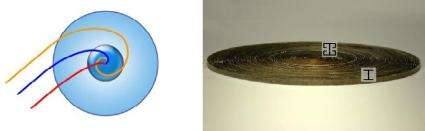
(Left) A model of the electromagnetic omnidirectional absorber, in which electromagnetic waves hitting the cylinder bend spirally in the shell region, and become trapped and absorbed by the lossy core. (Right) A photograph of the device, which is composed of 60 concentric layers of copper-coated metamaterials. Image credit: Institute of Physics.

(PhysOrg.com) -- Scientists from China have built a device that can trap and absorb microwaves coming from all directions with a 99% absorption rate - a property that makes the device simulate, to some extent, an astrophysical black hole.

The scientists, who are from Southeast University in Nanjing, China, explain in their study published in the that this is the first experimental demonstration of an omnidirectional electromagnetic absorber in the microwave frequency region. To build the absorber, the researchers used the unique properties of to manipulate light waves and achieve the wave trapping and absorbing properties.

The device itself is composed of a thin cylinder containing 60 concentric rings of copper-coated metamaterials arranged in layers. Each layer is imprinted with alternating patterns of resonant and non-resonant metamaterial structures. The design traps and absorbs coming from all directions by spiraling the radiation inward and converting its energy into heat. As with a black hole, cannot escape from the device.

Although the electromagnetic absorber currently works only with microwaves, the researchers plan to develop a device that works with visible light. The device demonstrated here could have applications such as collecting microwaves and energies in free space, or as a source of thermal emission, since the device transfers electromagnetic energy into heat energy.

You can now listen to all PhysOrg.com podcasts at http://www.physorg … dcasts-news/

More information: Qiang Cheng, et al. “An omnidirectional electromagnetic absorber made of metamaterials” 2010 New Journal of Physics 12 063006. DOI:10.1088/1367-2630/12/6/063006.

© 2010 PhysOrg.com

3.9 /5 (16 votes)  

Filter


Move the slider to adjust rank threshold, so that you can hide some of the comments.


Display comments: newest first

Tepp
Jun 03, 2010

Rank: 1.3 / 5 (4)
This has good potential as said in the article, but is it actually possible to create a "real" black-hole which could start sucking matter?
OregonWind
Jun 03, 2010

Rank: not rated yet
Tepp,

"... a property that makes the device simulate, to some extent, an astrophysical black hole." The author of the article is just comparing it to a real black hole behavior.

"As with a black hole, electromagnetic radiation cannot escape from the device.". The words "black hole" are very catchy.
Djincs
Jun 03, 2010

Rank: 3.7 / 5 (3)
I have a mini sun...my flashlight!
CouchP
Jun 03, 2010

Rank: 5 / 5 (3)
This is a repeat from over a year ago.
daywalk3r
Jun 03, 2010

Rank: 4.3 / 5 (3)
Although the electromagnetic absorber currently works only with microwaves, the researchers plan to develop a device that works with visible light.
So basicaly, what they are planing is, to re-invent black paint? o_O

Not saying it's bad.. Development of metamaterial based high-absorbtion black pigment could be quite usefull in many areas :)
psimulus
Jun 04, 2010

Rank: not rated yet
Considering a disk is utilized, what would be effects of utilizing cylindrical hyperparaboloid? Hyperparaboloid base unit = saddle surface.light may essentially vanish as it transits around the corner at the 180 degree coordinate
From the circular side one would observe the Yin/Yang geometry. From the rectangular side one would observe a waveform geometry, double helix, if wall of cylinder were transparent.
hudres
Jun 05, 2010

Rank: not rated yet
Who are you kidding. This was reported months ago here! Does anyone know what the term "Fact-checking" means"
Doug_Huffman
Jun 06, 2010

Rank: 1 / 5 (2)
Fact checking? We don' need no stinkin' fact checking!

It's someone's not so subtle way of urging/convincing of the Chinese drive to weaponize anything they can steal.
Skeptic_Heretic
Jun 06, 2010

Rank: 5 / 5 (1)
It's someone's not so subtle way of urging/convincing of the Chinese drive to weaponize anything they can steal.
No, if that was the case it would be a Chinese State Secret, and as such we wouldn't be seeing it.

The Chinese aren't really up on that "Kill the US and Dominate the World with Maoism" philosophy. They don't want to be stuck with an archaeic infrastructure and are attempting to gain more power on the world stage in order to get a piece of the technological action rather than being everyone's manufacturing bitch like India.
inko1nsiderate
Jun 06, 2010

Rank: 5 / 5 (1)
Shame on you physorg editors. Why did you even use the black hole analogy? Black holes are perfect black-bodies, and the idea is to create a near perfect black body. Using the term black hole brings up loads of misconceptions in the general public.

@daywalk3r

It is actually much better than black paint, as black paint doesn't absorb all that much of the visible spectrum.
Gene_H
Jun 07, 2010

Rank: 3 / 5 (2)
..why did you even use the black hole analogy?..
Because the metamaterial foam is really an analogy of quantum foam, forming the vacuum and light of certain frequency is spreading through it like light wave in vacuum. With compare to metamaterials, vacuum foam is a little bit "clever" - it works for wide range of wavelength, but the general principle remains.
Gene_H
Jun 07, 2010

Rank: 3 / 5 (2)
Actually, we can met with black hole analogy even in common life during observation of rainbows in heavy rain. The dense droplets are similar to foam, because they contain surfaces with both positive, both negative surfaces. Between primary and secondary rainbow we can see the dispersionless Alexander's dark band, which roughly correspond to vacuum foam, through light is spreading without dispersion.

http://en.wikiped...'s_band

This model renders physical surface of material objects as a massive case of light dispersion. It can explain symmetry breaking inside of our Universe from Kramers–Kronig relations.
Gene_H
Jun 07, 2010

Rank: 3 / 5 (2)
This asymmetry can be understood easily, if we realize, every object with positive rest mass (like we are) can observe / interact / collide only with objects with positive rest mass too, i.e. with particles with positive surface curvature, too. The places with negative surface curvature will be perceived like bubbles of hollow space, instead.

t means, even if we can consider vacuum as a quite symmetric quantum foam with both positive both negative curvatures, due the positive curvature of ours the positive curvature of fluctuations inside of vacuum will be still preferred.

The Kramers-Kroning equations are making this asymmetry more explicit, because they're describing the dependence of metamaterial foam refraction index and absorbance to wavelength of light. The requirement for minimal absorbance and refraction index of foam leads to asymmetric point, denoted by circle on the graph linked bellow, where both function, both its derivation remains minimal.

http://www.tinyurl.cz/r9n
Rank 3.9 /5 (16 votes)
Related Stories
Relevant PhysicsForums posts
  • A grandfather pulls his granddaughter, whose mass is 20.5 kg
    created2 hours ago
  • what is significance of torque
    created2 hours ago
  • Difference between volume displaced fluid and volume of the object
    created3 hours ago
  • Questions about Galileo statement?
    created3 hours ago
  • Question on Kirchoff's Laws
    created7 hours ago
  • Changes in Water Weight
    created9 hours ago
  • More from Physics Forums - General Physics

More news stories

Borexino Collaboration succeeds in spotting pep neutrinos emitted from the sun

(PhysOrg.com) -- To learn more about how the sun works, scientists study particles that are emitted from it into space due to thermonuclear reactions that occur inside; by applying known physics principles, ...

Physics / General Physics

created 16 hours ago | popularity 4.6 / 5 (7) | comments 0 | with audio podcast report

Explained: Sigma

It's a question that arises with virtually every major new finding in science or medicine: What makes a result reliable enough to be taken seriously? The answer has to do with statistical significance -- but ...

Physics / General Physics

created 16 hours ago | popularity 5 / 5 (10) | comments 29

Physics research suggests new pathways for cancer progression

Observing that certain cancer cells may exhibit greater flexibility than normal cells, some scientists believe that this capability promotes rapid tumor growth. Now computer simulations developed by Boston University Biomedical ...

Physics / General Physics

created 14 hours ago | popularity 5 / 5 (1) | comments 0

Quantum physicist explains $100K offer for proof scaled-up quantum computing is impossible

(PhysOrg.com) -- MIT researcher Scott Aaronson has certainly riled the physics community with his offer this past Friday, of $100,000 to anyone who can prove that scaled-up quantum computing is impossible. ...

Physics / Quantum Physics

created Feb 08, 2012 | popularity 4.1 / 5 (11) | comments 31 | with audio podcast weblog

Physicists 'record' magnetic breakthrough

An international team of scientists has demonstrated a revolutionary new way of magnetic recording which will allow information to be processed hundreds of times faster than by current hard drive technology.

Physics / General Physics

created Feb 07, 2012 | popularity 4.5 / 5 (39) | comments 14 | with audio podcast


'Dark plasmons' transmit energy

Microscopic channels of gold nanoparticles have the ability to transmit electromagnetic energy that starts as light and propagates via "dark plasmons," according to researchers at Rice University.

FDA-approved drug rapidly clears amyloid from the brain, reverses Alzheimer's symptoms in mice

Neuroscientists at Case Western Reserve University School of Medicine have made a dramatic breakthrough in their efforts to find a cure for Alzheimer's disease. The researchers' findings, published in the journal Science, show t ...

Hydrogen from acidic water: Researchers develop potential low cost alternative to platinum for splitting water

A technique for creating a new molecule that structurally and chemically replicates the active part of the widely used industrial catalyst molybdenite has been developed by researchers with the Lawrence Berkeley ...

Ultraviolet protection molecule in plants yields its secrets

Lying around in the sun all day is hazardous not just for humans but also for plants, which have no means of escape. Ultraviolet (UV) radiation from the sun can damage proteins and DNA inside cells, leading ...

Anyone can learn to be more inventive, cognitive researcher says

There will always be a wild and unpredictable quality to creativity and invention, says Anthony McCaffrey, a cognitive psychology researcher at the University of Massachusetts Amherst, because an "Aha moment" is rare and ...

New method makes culture of complex tissue possible in any lab

Scientists at the University of California, San Diego have developed a new method for making scaffolds for culturing tissue in three-dimensional arrangements that mimic those in the body. This advance, published online in ...