Astronomers solve Walt Whitman meteor mystery
(PhysOrg.com) -- In his landmark collection Leaves of Grass, famed poet Walt Whitman wrote of a "strange huge meteor-procession" in such vivid detail that scholars have debated the possible inspiration for decades.
Now, a team of astronomers from Texas State University-San Marcos has applied its unique brand of forensic astronomy to the question, rediscovering one of the most famous celestial events of Whitman's day--one that inspired both Whitman and famed landscape painter Frederic Church--yet became inexplicably forgotten by modern times.
Texas State physics professors Donald Olson and Russell Doescher, English professor Marilynn S. Olson and Honors Program student Ava G. Pope publish their findings in the July 2010 edition of Sky & Telescope magazine, on newsstands now.
"This is the 150th anniversary of the event that inspired both Whitman and Church," Donald Olson said. "It was an Earth-grazing meteor procession."
Fires in the sky
Whitman, known as a keen observer of the sky, included significant references to contemporary as well as cosmic events in his poem "Year of Meteors. (1859-60.)" published in Leaves of Grass. A "great comet" in the poem that appeared unexpectedly in the northern sky is readily identified as the Great Comet of 1860, which follows the path Whitman described and was seen by most of the world.
From Whitman's description, the Texas State research team immediately suspected the other celestial event he wrote about was the rare phenomenon known as an Earth-grazing meteor procession.
"Meteor processions are so rare most people have never heard of them," Olson said. "There was one in 1783 and a Canadian fireball procession in 1913. Those were all the meteor processions we knew of."
An Earth-grazing meteor is one where the trajectory takes the meteor through the Earth's atmosphere and back out into interplanetary space without ever striking the ground. A meteor procession occurs when a meteor breaks up upon entering the atmosphere, creating multiple meteors traveling in nearly identical paths.
The rarity of meteor processions, however, has proven problematic to scholars. Whitman's description has alternately been ascribed to the 1833 Leonid meteor storm, the 1858 Leonids and a widely-observed fireball in 1859. Although Whitman is documented as having observed the 1833 Leonids, the Texas State researchers were able to discount that meteor storm because the timeframe conflicts with the poem's, and Whitman's descriptions of the two events are very different. The 1858 Leonids were also discounted after the research team discovered a dating error misattributing some of Whitman's observations of the 1833 Leonids to the latter year.
By contrast, the 1859 fireball was well-documented and happened during the timeframe of the poem. The fireball, however, was a single meteor, not a procession. Compounding the problem, the 1859 fireball was a daylight meteor, whereas Whitman describes the procession as happening at night.
The art of rediscovery
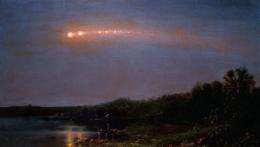
A chance clue from the 19th century artist Frederic Church proved key to unraveling the mystery. A decade ago, Olson saw a painting on the back cover of an exhibition catalog which showed the scene Whitman had described. Church's painting, titled "The Meteor of 1860," clearly depicted a meteor procession. Not only that, but the catalog gave the date of Church's observance: July 20, 1860, well within the timeframe of Whitman's poem. An accomplished landscape painter, Church was a member of the Hudson River School, living beneath the same skies as Whitman.
"We went to Church's house, and the people who know him and his art well, who've studied him, say, 'Oh, he wouldn't have painted it like that based on somebody's say-so. He must have seen it,'" Olson said. "The artist and his wife, who were honeymooning that summer, kept the painting in their bedroom for many years."
"We went to a small research library and found old diaries of Theodore Cole, a friend of Church's, from July of 1860," Pope said. "They tell us Church was, in fact, in Catskill, New York, so he wasn't off in some far distant land."
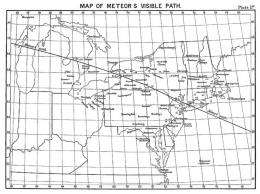
Armed with this intriguing new date, the Texas State researchers began poring through newspapers of the time for verification. What they found surprised even them. A large Earth-grazing meteor broke apart on the evening of July 20, 1860, creating a spectacular procession of multiple fireballs visible from the Great Lakes to New York State as it burned through the atmosphere and continued out over the Atlantic Ocean.
"Any town that had a newspaper within all those states is going have a story on this," Olson said. "We have hundreds of eyewitness accounts, but there are probably hundreds more we don't even have.
"From all the observations in towns up and down the Hudson River Valley, we're able to determine the meteor's appearance down to the hour and minute," Olson said. "Church observed it at 9:49 p.m. when the meteor passed overhead, and Walt Whitman would've seen it at the same time, give or take one minute."
Some of the most influential publications in the U.S.--including the New York Times, Smithsonian and Harper's Weekly--devoted major coverage to the event, and countless letters about it were published. Scientific American went so far as to declare it "the largest meteor that has ever been seen."
"They describe it just as Church painted it. It was visible for about 30 seconds, and passing horizontally, so it was, in fact, an Earth-grazer," Pope said. "A really cool part is that the Catskill newspaper describes it as dividing into two parts with scintillations, exactly like the painting."
This broad public attention, as well as study by many professional astronomers of the day, made the meteor procession of 1860 one of the single most famous celestial events of its day, and quite possibly the most documented meteor appearance in history. Despite this, memory of the dazzling event faded so much that by the middle of the 20th century scholars were left puzzled over what Whitman had actually seen.
"Its appearance, right before the Civil War, at a time growth and anxiety for America, made it a metaphor and portent in the public imagination," Marilynn Olson said.
Provided by Texas State University


