Novel technique informs drug delivery research
June 3, 2010
University College Dublin researchers led by Conway Fellow, Professor David Brayden have shown that a candidate drug delivery polymer may have potential for oral or topical use. These findings were recently published in the Journal of Controlled Release.
The team of scientists, who are part of the Science Foundation Ireland- funded Irish Drug Delivery Network, set out to investigate if an antibacterial synthetic polymer called pDMAEMA [poly(2-(dimethylamino ethyl)methacrylate] is as damaging to normal human cells as it is to bacteria.
This sticky polymer binds membranes and previous research by the team demonstrated that it has a novel bactericidal action against a range of bacteria. This finding has led to pDMAEMA being proposed as a surface-coating for medical devices in an effort to reduce the number of hospital-acquired infections.
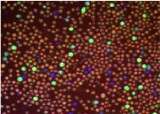
This study, which formed part of the doctoral research by lead author Lee-Anne Rawlinson, used high content analysis, a non-invasive imaging technique that can monitor a number of parameters over a time period using up to eight fluorescent dyes. It has an unique advantage over other techniques in that it does not interfere with cells during the analysis.
The findings showed that pDMAEMA was cytotoxic to white blood cells, but not to intestinal epithelial cells, and that it did not damage intestinal mucosae in the model used even in high concentrations. This would suggest that the polymer might have potential for oral or topical use, rather than by systemic injection.
More information: High content analysis of cytotxic effects of pDMAEMA on human intestinal epithelial and monocyte cultures. Lee-Anne B Rawlinson, Peter J. O’Brien, David J. Brayden. Journal of Controlled Release. May 7. [Epub ahead of print] PMID: 20457190.
Provided by University College Dublin
-
Researchers develop better membranes for water treatment, drug delivery
Nov 29, 2007 |
not rated yet |
0
-
Penicillin-coated biomaterial created
Jan 17, 2007 |
not rated yet |
0
-
Friend or Foe? Scientists Determine How the Intestine Keeps Us Safe From Microbial Invaders
Feb 21, 2007 |
not rated yet |
0
-
Making Better Magnetic Nanoparticles
Dec 18, 2006 |
not rated yet |
0
-
Cancer-causing gut bacteria exposed
Sep 22, 2008 |
not rated yet |
0
-
Engineers build first sub-10-nm carbon nanotube transistor
Feb 01, 2012 |
4.9 / 5 (30) |
30
-
Something old, something new: Evolution and the structural divergence of duplicate genes
Jan 31, 2012 |
4.6 / 5 (7) |
1
-
The hidden nanoworld of ice crystals: Revealing the dynamic behavior of quasi-liquid layers
Jan 30, 2012 |
5 / 5 (3) |
1
-
Stock market network reveals investor clustering
Jan 27, 2012 |
3.9 / 5 (23) |
8
-
Of microchemistry and molecules: Electronic microfluidic device synthesizes biocompatible probes
Jan 26, 2012 |
5 / 5 (1) |
0
-
Membrane Beam Transition Modelling Transition
1 hour ago
-
second law of thermodynamics
14 hours ago
-
Static Electric Orbiting of H2O Droplet to Knitting Needle
15 hours ago
-
Acousto optical modulators
16 hours ago
-
Jerk during Gravitation
17 hours ago
-
2 springs attached by a rigid massless bar
18 hours ago
- More from Physics Forums - Classical Physics
More news stories
Under the microscope #7
In this video Dr Ingrid Graz shows us a thin layer of gold on top of rubber. Cracks in the gold allow it to stretch and we can use this for stretchable electronics.
33 minutes ago |
not rated yet |
0
Hydrogen from acidic water: Researchers develop potential low cost alternative to platinum for splitting water
A technique for creating a new molecule that structurally and chemically replicates the active part of the widely used industrial catalyst molybdenite has been developed by researchers with the Lawrence Berkeley ...
18 hours ago |
5 / 5 (11) |
11
|
Flexible paper robots
(PhysOrg.com) -- These inexpensive robots can stretch, bend and twist under control, and lift objects up to 120 times their own weight. Being soft, they can apply gentle and even pressure, and adapt to varied ...
16 hours ago |
5 / 5 (5) |
3
|
New method makes culture of complex tissue possible in any lab
Scientists at the University of California, San Diego have developed a new method for making scaffolds for culturing tissue in three-dimensional arrangements that mimic those in the body. This advance, published online in ...
15 hours ago |
5 / 5 (4) |
0
|
Materials that shrink when heated
One common reason that people with fillings experience toothache is that their fillings expand at a different rate to the original tooth when, for example, drinking a hot drink. Contrary to intuition, however, ...
17 hours ago |
5 / 5 (2) |
1
New error-correcting codes guarantee the fastest possible rate of data transmission
Error-correcting codes are one of the triumphs of the digital age. Theyre a way of encoding information so that it can be transmitted across a communication channel such as an optical fiber o ...
A frank discussion of the power law and linking correlation to causation
(PhysOrg.com) -- Michael Stumpf a mathematics professor at Imperial College in London, and Mason Porter a lecturer at Oxford have teamed together to write and publish a perspective piece in Science regarding the in ...
Mars Science Laboratory computer issue resolved
(PhysOrg.com) -- Engineers have found the root cause of a computer reset that occurred two months ago on NASA's Mars Science Laboratory and have determined how to correct it.
Advanced power-grid model finds low-cost, low-carbon future in West
(PhysOrg.com) -- The least expensive way for the Western U.S. to reduce greenhouse gas emissions enough to help prevent the worst consequences of global warming is to replace coal with renewable and other ...
Small modular reactor design could be a 'SUPERSTAR'
(PhysOrg.com) -- Though most of today's nuclear reactors are cooled by water, we've long known that there are alternatives; in fact, the world's first nuclear-powered electricity in 1951 came from a reactor ...
Clam fields found at deep, low-temperature Mariana vents
(PhysOrg.com) -- Scientists have marveled at the unusual life forms thriving at high temperature hydrothermal vents of the deep ocean.