Wind-powered car goes down wind faster than the wind
June 4, 2010 by Lin Edwards report
Wind-powered car goes down wind faster than the wind

Enlarge

Image credit: Thin Air Designs

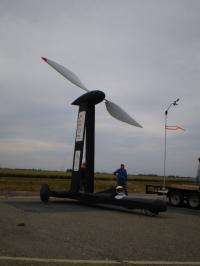
(PhysOrg.com) -- A wind-powered car has been clocked in the US traveling down wind faster than the wind. In a recent run at New Jerusalem in Tracy, California, the car reached a top speed of more than 2.85 times faster than the wind blowing at the time (13.5 mph) powered by the wind itself. The run should now settle the DWFTTW (down wind faster than the wind) debate that has been raging for some time on the Internet about whether or not such a feat was possible.

The Thin Air Designs car, called the Blackbird, was built by Rick Cavallaro, an aerodynamicist, paraglider and kitesurfer, who was alerted to the DWFTTW debate by his employer at Sportvision Inc., Stan Honey, a world-class sailing navigator. Cavallaro is chief scientist with the company. He made some calculations that convinced him the feat was possible and then built a model to prove it. When skeptics remained unconvinced, Cavallaro and a friend decided to build a full-size version.

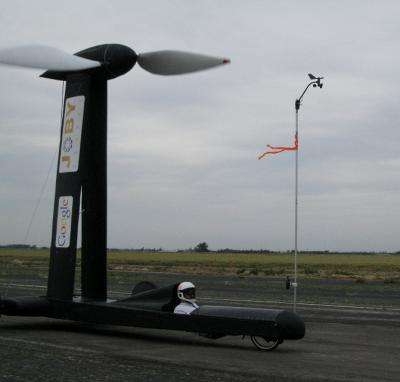
The “Faster than the Wind” team was able to attract sponsorship from wind turbine company Joby Energy and Google, and worked in collaboration with the aero department of the San Jose State University to build their ultra-light vehicle, which is made largely of foam. The car has a passing resemblance to a Formula 1 , except for the five meter high mounted on the back, and it is this propeller that holds the key to how it is possible for the car to travel down wind faster than the wind. An earlier version known as the BUFC for Big Ugly Cart (fill in the blank), also achieved speeds greater than the down wind speed at the North American Land Sailing Association (NALSA) meeting on a dry lakebed in Nevada in March.
Wind-powered car goes down wind faster than the wind
Enlarge


Cavallaro explained the car is able to move faster than the wind because the propeller is not turned by the wind. The wind pushes the vehicle forward, and once moving the wheels turn the propeller. The propeller spins in the opposite direction to that expected, pushing the backwards, which in turn pushes the forwards, turning the wheels, and thus turning the propeller faster still.

The vehicle was built after over a year of trials. Building a transmission able to transfer power from the wheels to the propeller was the most difficult part of the design. The next stage in development will be to have trials confirmed by NALSA.

More information: Thin Air Designs blog: http://www.fastert … thewind.org/
via Autopia

© 2010 PhysOrg.com

4.4 /5 (36 votes)  

Filter


Move the slider to adjust rank threshold, so that you can hide some of the comments.


Display comments: newest first

Quantum_Conundrum
Jun 04, 2010

Rank: 4.2 / 5 (6)
Weird. This almost seems to be some sort of violation of conservation laws.
DGBEACH
Jun 04, 2010

Rank: 5 / 5 (4)
Weird. This almost seems to be some sort of violation of conservation laws.

Indeed. But Ole Wile E coyote was doing this before anyone lol
CreepyD
Jun 04, 2010

Rank: 3 / 5 (2)
What a really clever idea.
I agree Quantum, it doesn't sound possible on paper..
Doug_Huffman
Jun 04, 2010

Rank: 5 / 5 (3)
The propeller spins in the opposite direction to [b]that expected[/b], pushing the wind backwards, which in turn pushes the car forwards, turning the wheels, and thus turning the propeller faster still.
This is a Wiley Coyote explanation.
TAz00
Jun 04, 2010

Rank: 4.5 / 5 (2)
Sounds like a job for the MYTHBUSTERS.... you know, to get more people thinking ^^
yyz
Jun 04, 2010

Rank: 3 / 5 (2)
Have they considered using Coke/Mentos propulsion for a speed boost? ( http://www.univer...sts-off/ ) Inquiring minds....
gwrede
Jun 04, 2010

Rank: not rated yet
Well I'll be...

Took me an hour to figure it out for good. But I have to admit, had someone come to me asking for sponsorship, I would've dissed them out of the room.
Skepticus
Jun 04, 2010

Rank: 5 / 5 (1)
Ingenious! It's a pity this can only be done going downwind. I guess this feat can also be done with sea going vessels. Imagine a big propeller turned by the water in place of the wheels... or perhaps a paddle wheel at the back (?), and a bigger propeller on top!
kasen
Jun 04, 2010

Rank: 1 / 5 (1)
Once it goes faster than the wind, how can it receive further positive acceleration from it? What about drag?

I think this is a misunderstood measurement(there's wind speed, vehicle land speed and vehicle air speed) coupled with short running times(which leads to inertia playing a bigger role).

Either way, they haven't shown any videos yet.
baudrunner
Jun 04, 2010

Rank: 1.8 / 5 (15)
There is no reason to be incredulous. There is no violation of conservation of energy laws. You could just as easily say that the origin, evolution, and maintenance of life on Earth is a violation of those very laws.

Examples like this abound throughout the Universe. On the basis of my first example alone, I think it yet possible to get more energy out of a system than that which is required to maintain the system. Sounds foolish to say, but I believe that. There are any number of ways that energy can be translated or converted in ways that might lead to conclusions that violations of the laws have occurred. I suspect that energy generating plants in space could return more energy than required to operate them, but that they might not work in a gravity environment, for one thing. Those energy conservation laws are not etched in stone. I've dismissed them altogether since creation would never have happened if they were true.
ThinAirDesigns
Jun 04, 2010

Rank: 5 / 5 (12)
Hi. I'm one of the two primary designer/builders of the vehicle in the OP.

It's operates perfectly steady state (no stored momentum involved in acceleration), and when the wind stops, it stops (no PMM bs).

I'll also happily post links to plenty of video if ths site allows such links -- perhaps someone can let me know if this is OK.

JB

SteveL
Jun 04, 2010

Rank: 4.8 / 5 (4)
Makes perfect sense to me, though I am suprised at the 1:2.85 ratio, which is more than I would have expected. Good engineering! Sail boats have long been able to go faster than the wind, but certainly not at this ratio. Likely the lesser rolling resistance vs. water resistance accounts for much of the difference.
CarolinaScotsman
Jun 04, 2010

Rank: not rated yet
Now if they can figure out how to make it tack into the wind.
BigTone
Jun 04, 2010

Rank: not rated yet
@thinairdesigns people like you make this world a better place and thank you for coming on this science site to comment on the actual project...
kasen
Jun 04, 2010

Rank: not rated yet
I'll also happily post links to plenty of video if ths site allows such links


There's the link to your blog and it has a link to a coverage by Discovery. I missed it the first time I looked. Would be helpful to have a media section, or something.

At any rate, after a bit of reading on the subject, I get it. The reason it seems off at first is because the vehicle is presented as something that is "sailing" downwind faster than the wind, when it is in fact "sailing and rolling".

It's still impossible to just sail dead downwind faster than the wind. Your design is roughly the wind-power equivalent of a supercharger/turbine in a petrol engine, if I understand correctly.

You could probably achieve the same effect with a pair of electric motors, or really anything that can convert the motion of the propeller into forward acceleration, within some efficiency threshold.
altino
Jun 04, 2010

Rank: 1 / 5 (1)
"car goes down" says it all.
Temple
Jun 04, 2010

Rank: not rated yet
I admit I had real trouble seeing how this could work, but I think I've got a handle on it. Here's how I visualize this, please correct me if I'm wrong.

There's a certain speed at which the wind will push the car downwind which factors all the aerodynamics, rolling efficiency, etc. Let's call that the downwind equilibrium. Some rolling inefficiency is added in order to use power from the wheels to turn the propeller (ignore the propeller's effects for a moment), but that can be compensated for by simply scaling the sail area.

Ultimately you can tweak the sail area and the rolling resistance to a point where the downwind equilibrium is very, very close to the downwind speed.

At that point the net wind acting on the vehicle is close to zero, but the vehicle's wheels are rotating (possibly quite quickly).

At this point we remember the propeller. It is adding thrust to the vehicle, which will increase it beyond the downwind equilibrium speed.
bg1
Jun 04, 2010

Rank: not rated yet
Clever. The wind moves the propeller, which moves the wheels and vehicle forward. The wheels have traction which resists backward force from wind. Acceleration will proceed until wind resistance on assembly rises to balance force on wheels from propeller. The other limit on speed is traction force, which is simply the friction force between the wheels and the road, which in turn is proportional to the weight. This vehicle will definitely have problems on an incline, because the normal force on the surface is reduced.
ThinAirDesigns
Jun 04, 2010

Rank: 5 / 5 (4)
@CarolinaScotsman:
"Now if they can figure out how to make it tack into the wind"
********************

It only takes a minor gearing change (or smaller drive wheels) and it drives directly upwind no problem. To do this very efficiently however, different blades would need to be installed -- turbine blades rather then the currenly installed prop blades.
ThinAirDesigns
Jun 04, 2010

Rank: 5 / 5 (1)
@BigTone:

Thanks for the kind words -- the science forums are the most fun.
ubavontuba
Jun 04, 2010

Rank: not rated yet
Fascinating.

Land yachts have long been able to substantially beat wind speeds, but not directly downwind. The record is approximately 126mph in a 40mph wind.

Credit: http://en.wikiped...d_Record

I would speculate, the canted angle of the propeller probably acts similarly to a sale moving across the wind. Is that correct?
bottomlesssoul
Jun 04, 2010

Rank: not rated yet
@thinair

Thanks for taking the time to debunk this issue. The solution is obvious if you have a world class education (I do) and there is no way in hell I would have considered investing my time in something like this; because I don't have anything to prove.

I'm wrong and you're right. I guess it has to be proved for the 99.9% of other people who don't know these things can be predicted.

Now that you've done this it opens a question I can't predict and I'm too lazy to model. Can this be hybridized to a solar / wind racer? It adds a lot of weight so has a negative effect on the wind power system but is it less than what can be collected from solar?

Would a wind / solar car be faster than a pure wind or pure solar car? I think this may lead to something beautiful, a super funky annual race across Australia.
kerry
Jun 04, 2010

Rank: 1 / 5 (1)
I have to admit, I am still skeptical. Even if your mass was ~0 (you were a air molecule), the fastest you'd go is the velocity of the wind, itself.

I think what is happening here is a play on words. Yes, the car's top speed (speed, not velocity) may be faster than the wind in the direction that the car was travelling, but it cannot exceed the speed of the wind in the direction of the wind's maximum velocity. I think the article is just playing with vectors and relative velocities.

The same effect is at play when people say boats/yachts sail "faster than the wind". Here is an article titled, "Physicists Explain How To Sail Faster Than The Wind". It gives a good explanation for boats.
http://www.scienc...ling.htm

If a boat/car moves faster than the wind in the direction of the wind's maximum velocity, then I think (I THINK) that would be breaking conservation of energy..
ThinAirDesigns
Jun 05, 2010

Rank: 5 / 5 (2)
@kasen:
"the vehicle is presented as something that is "sailing" downwind faster than the wind, when it is in fact "sailing and rolling".
************

I'm not really understanding you here --

A: Land sailors use wheels and thus are "sailing and rolling" -- this certainly doesn't mean they aren't sailing.

B: You will find that *we* tend to avoid the term "sailing" just because it creates definitional situations just like this one. In fact a search of this page will show that not once in the OP article was it referred to as sailing -- in this case it was you who brought it up.
ThinAirDesigns
Jun 05, 2010

Rank: 5 / 5 (2)
@kasen: "It's still impossible to just sail dead downwind faster than the wind."
***************

Here is our claim: "A vehicle that travels directly downwind, faster than the wind, powered only by the wind, steady state".

By commonly accepted land sailing standards, we are *sailing*, but it accomplishes nothing for us to debate that point as the term itself has too many meanings. That's precisely why we leave the word "sailing" out of our claim - we prefer to discuss the physics rather than the semantics.
ThinAirDesigns
Jun 05, 2010

Rank: 5 / 5 (2)
kasen: " Your design is roughly the wind-power equivalent of a supercharger/turbine in a petrol engine, if I understand correctly."
***********

It appears to me that perhaps you don't understand it correctly -- a supercharger/turbine uses waste gasses from a combustion process to compress intake air. Our device is nothing of the sort.

This device merely reduces the motion of the air relative to the ground (like any other wind powered device) and expends the harvested energy to propel itself.
ThinAirDesigns
Jun 05, 2010

Rank: 5 / 5 (2)
@Temple:

You've done a pretty good job with your description.

The key thing to remember is that due to the tailwind, the wheels are traveling over the ground much further than the propeller is traveling through the air -- thus using the force x distance calculations for work and power it's easy to see that when we are traveling the speed of the wind, we can gain more power from the wheels (faster moving ground) than we have to expend in the air (slower moving air).
ThinAirDesigns
Jun 05, 2010

Rank: 5 / 5 (2)
@bq1: "Clever. The wind moves the propeller, which moves the wheels and vehicle forward."
**********

Actually, it works pretty much just the opposite -- the moving wheels turn the propeller which thrusts the veihcle foward. At no speed (above or below windspeed) does the propeller turn the wheels.
ThinAirDesigns
Jun 05, 2010

Rank: 5 / 5 (3)
@ubavontuba: " would speculate, the canted angle of the propeller probably acts similarly to a sale moving across the wind. Is that correct?"
*******

Very, very close to correct -- it's not just the canted angle of the propeller, but also the helical path that the propeller is taking through the air.

Adjusting the pitch of the prop is the same as adjusting the sail angle on a boat, and altering the angle of the helical path of the prop (via gear ratio changes) is the same as altering the path of the boat.

It really is that simple once you get the 3D visualization handled in your mind (which admittedly took me a while)

ThinAirDesigns
Jun 05, 2010

Rank: not rated yet
@bottomlesssoul: "Would a wind / solar car be faster than a pure wind or pure solar car? I think this may lead to something beautiful, a super funky annual race across Australia."

That would be a very fun question to answer -- I sure don't have the answer myself.
ThinAirDesigns
Jun 05, 2010

Rank: 5 / 5 (1)
@kerry: "If a boat/car moves faster than the wind in the direction of the wind's maximum velocity, then I think (I THINK) that would be breaking conservation of energy.."

Kerry, there's is no play on words. Even the cheapest ice boats and land yachts can beat the wind to the downwind end of a course by large margins (>2x) while higher performance versions beat it by 3-4x.

Now, they do this by zig-zagging, but even though they are taking the long route as compared to the true wind, they are going 6-8x the windspeed (on the angle) so in the end thats how they end up 3-4x faster in the downwind direction.

For a good primer on this, Google "iceboat sailing performance" and the first link will take you to a .pdf on the nalsa.org site (North American Land Sailing Association). The article was writting by Bob Dill (Nalsa technical guru) and will show recorded GPS data plot demonstrating what I've just said. Additionally, the raw data behind the plots is available from nalsa.org
ThinAirDesigns
Jun 05, 2010

Rank: 5 / 5 (4)
Sorry for all the posts in a row -- I tried to get to everyone's comments and questions before going to bed.

Best wishes.
MarkyMark
Jun 05, 2010

Rank: not rated yet
Sorry for all the posts in a row -- I tried to get to everyone's comments and questions before going to bed.

Best wishes.


Its ok its not often we get comments from the those involved in such projects.

Question do you see a use for this in commercial Shipping in a form of a suplimentery form of motive power?

[excuse the spelling]
ubavontuba
Jun 05, 2010

Rank: not rated yet
@ubavontuba
I would speculate, the canted angle of the propeller probably acts similarly to a sail moving across the wind. Is that correct?
Very, very close to correct -- it's not just the canted angle of the propeller, but also the helical path that the propeller is taking through the air.

Adjusting the pitch of the prop is the same as adjusting the sail angle on a boat, and altering the angle of the helical path of the prop (via gear ratio changes) is the same as altering the path of the boat.

It really is that simple once you get the 3D visualization handled in your mind (which admittedly took me a while)
Okay, I think I get it. You're essentially converting the linear motion/momentum that a normal sail vessel collects across the wind, into angular motion/momentum (by putting the sail on a rotor and gearing it to the ground). You can now travel with the wind nearly as efficiently as a fixed sail vessel travels across the wind. Very clever!
ubavontuba
Jun 05, 2010

Rank: not rated yet
...continued:

If I'm understanding this correctly, the friction with the ground is critical. Therefore it wouldn't work for a water borne vessel (the propeller would tend to turn the wrong way - with the wind rather than against).

I think it'd make a heck of a fun (and exceptionally maneuverable) land yacht, but I'm having difficulty considering more "practical" applications. Do you have any other applications in mind?
Skepticus
Jun 05, 2010

Rank: not rated yet
@ThinAirDesigns: This is my take on how it works. Please correct me If I got it wrong:
-The vehicle + propeller presents a certain frontal area A.The wind exerts a pressure on this and moves the whole vehicle. This make the wheels turns on the ground.
-The wheels through gearing turns the propeller of which the blades are pitched to blow the wind back to its source. The propeller thus creates a region of higher air pressure behind the vehicle than in the front, more than the normal pressure difference across a normal sail driven by the wind. In effect, you have increased the "ffective area" of the "sail" as well as the "effective wind speed". The vehicle therefore travels as if it is driven by a 2x+ stronger wind.
Skepticus
Jun 05, 2010

Rank: not rated yet
@ThinAirDesigns: I have some thoughts about the hypothetical case where your vehicle is adapted for travel on water. For the equivalence of the grounded wheels, I wonder if steam-boat type paddle wheels would be more efficient than a propeller turned by water? My instincts tells me that as a paddle wheel blade is pushed by the water, the drag force vector will just contribute to the turning of the wheel, whereas the whole propeller immersed in water will experience hydrodynamic drag as well as Newtonian reaction drag forces while being turned. What do you think?
kasen
Jun 05, 2010

Rank: not rated yet
a supercharger/turbine uses waste gasses from a combustion process to compress intake air. Our device is nothing of the sort.


I meant it provides a performance boost, a mechanical advantage. Like a lever, screw, pulley, those sort of things.

powered only by the wind, steady state


If this is the accepted definition of sailing, then you're semantically fine, I guess. Most people only think of the sails, hence the initial negative reactions. And you have to admit, it does look a little ACMEish.

Say you have a field of wind turbines generating electricity and sending it wireless to an electric car, no power stored anywhere. The car moves downwind, faster than the wind and it's powered by the wind, steady state.

Just saying, when it comes to settling debates, which I understand was the original purpose, semantics can be quite a female dog.
Kedas
Jun 05, 2010

Rank: not rated yet
I guess it is simple:
simplefied, if the wind direction is 90° turned to your movement then the downwind speed is 0 m/s but with a propeller or a sail you can turn this side wind in a constant force in your moving direction so it doesn't matter how fast your going the wind force is a constant.
(from the point if view of the wind you are standing still)
When the drag force is equal to that force the max speed is reached, the rotating propeller is a clever way to reduce the drag of the element that puches you.
ThinAirDesigns
Jun 05, 2010

Rank: 3 / 5 (2)
@Kasen:"Most people only think of the sails, hence the initial negative reactions."

Kasen, the two spinning airfoils *are* sails -- operating in a perfectly traditional manner aerodymanically. Yes, the form looks different, but that appearence difference isn't even skin deep.

The only aerodynamic difference between the spinning airfoil on this vehicle and the spinning (yes spinning) airfoil of the new America's Cup winner is the diameter of the cirle.

When on a downwind reach, the airfoil on the BMW Oracle sailboat is spinning around the diameter of the earth, we merely have reduced that diameter to 17ft.

Here is an animation that might help in visualizing this:

http://www.youtub...=channel
kasen
Jun 05, 2010

Rank: not rated yet
I get it. The propeller blades, as airfoils, are always facing the wind at an optimal(presumably), non-zero angle. The parallel force vector component is exploited conventionally, while the perpendicular one is exploited via spinning, which is converted to forward motion by the transmission to the wheels.

So the "sailing", in traditional terms that first come to mind when wind-powered transportation is mentioned, is actually done at an angle, but a bit of engineering makes all the wind energy to be used for forward motion alone.
ThinAirDesigns
Jun 05, 2010

Rank: 5 / 5 (1)
@kasen: "... bit of engineering makes all the wind energy to be used for forward motion alone.:

That's correct, the prop sails on the vehicle are functioning as a traditional sails at an angle to the wind while their dynamic connection to the chassis allows it to go DDW.
brentrobot
Jun 06, 2010

Rank: 2 / 5 (1)
Jesus F Christ, Look at the second photo people!

The car is going directly into the wind, not downwind. The guy writing this article obviously got almost all of his facts wrong. The car is also very streamlined, so that it can slip through the air with little resistance. The car is not being pushed by the wind at all. It is traveling up wind faster than the wind. It is the turbine rotation that causing the car to move forward directly into the wind. And yes the slight angle of the blades is mathematically equivalent to a sail that is tacking into the wind.

The way the article explains it is impossible.

Look at the photo! Jesus!

vanderMerwe
Jun 06, 2010

Rank: not rated yet
I saw a paper presented at an energy conservation conference by a guy who came up with this idea for cars and boats way back in the mid-1970's. It's fun to see the idea revived. He'd built one of these, too, though he didn't get the speed multiplier that this guy has. Great stuff! :-D

Jehochman
Jun 06, 2010

Rank: 5 / 5 (2)
The telltales stream backwards in photo 2 because the car is going downwind faster than the wind. They show the "apparent wind" which is the wind's speed vector minus the vehicle's speed vector.

If the propeller blade angle is sufficiently steep air can be accelerated faster than the vehicle's forward speed relative to the wind. This creates thrust, pushing the vehicle forward, and slowing the wind a little bit.

Energy is conserved because the increased kinetic energy of the vehicle is necessarily less than the decreased kinetic energy of the wind.
ThinAirDesigns
Jun 06, 2010

Rank: 5 / 5 (3)
@Brentrobot:
You're wrong on quite a number of points here.

I'm going to post a link to a video of the vehicle operating from a standstill to a speed well above windpspeed *directly downwind*. You'll see that of course the streamers on the vehicle switch directions as it goes above windspeed because the apparent wind is then coming from the front -- that is the reason that second photo above looks the way it does.

http://www.youtub...Wh9J1dk4
vanderMerwe
Jun 06, 2010

Rank: not rated yet
I saw a paper presented at an energy conservation conference by a guy who came up with this idea for cars and boats way back in the mid-1970's. It's fun to see the idea revived. He'd built one of these, too, though he didn't get the speed multiplier that this guy has. Great stuff! :-D

RFC3251
Jun 06, 2010

Rank: not rated yet
The part of the article that confused me was "the propeller spins in the opposite direction to that expected", possibly because I "expected" it to turn in the direction it actually does. Just to confirm, the "propeller" spins in the same direction as an aircraft propeller would, right (when the car goes above the wind speed)?
ThinAirDesigns
Jun 06, 2010

Rank: not rated yet
That's correct RFC, looking from the rear it turns the same direction as an airplan propeller would. It does that at *all speeds*.

But if you look at the pitch of the blades and consider the true wind coming from behind, most folks imagine it working like a windmill and that would require it to turn the other way.
david_king
Jun 06, 2010

Rank: 1 / 5 (1)
Apparently none of the doubters have ever piloted a sailing craft of any type. Anyone who's been on a windsurfer or iceboat would instinctively understand how this is possible. I find that a sad fact. Sailing is a LOT of fun.
tomr
Jun 06, 2010

Rank: not rated yet
Where's the detailed scientific explanation / equations / force diagram from the team? I can't find an official explanation of how it's supposed to work anywhere.

To travel faster than the wind change in K.E of the air must be greater than the change in K.E of the cart. As long as the mass of the air exceeds that of the cart then that's perfectly possible. But how does the wind exert any force once the velocity of the cart exceeds that of the wind?

The only way I can see how this might work is if the wind is able to push against the exhaust?!

I can't quite believe it's anymore than the angular momentum stored in the prop until someone releases a proper explanation! Please do because this is driving me nuts!
ThinAirDesigns
Jun 06, 2010

Rank: 5 / 5 (1)
tomr -- perhaps you'll like this treatment. It's a .zip file with a number of diagrams along with the math. (I know it's not a good idea for folks to downwload stuff offered on a internet board, you can decide if you want to take the chance offered by one of the designers of the craft ... I swear it's perfectly clean)

http://www.mediaf...nnd3dwct
jsa09
Jun 06, 2010

Rank: 5 / 5 (1)
I dislike it when some people keep saying "where is the math", "where are your references." etc. Think for yourself and see for yourself. The cart works and works very well.

I am not an engineer and at times wish I was. I want to build a a cycle powered hydro bike but cant even weld very well so it is not likely to happen.

I too would like to see a modified race of these things across Australia.
ThinAirDesigns
Jun 06, 2010

Rank: not rated yet
@jsa09

It clearly works in practice ... the only question is, can it work in theory. :-)

(the good news here is it works just fine in both)
Moodie_1
Jun 06, 2010

Rank: not rated yet
Sorry, Skeptikus, it would seem your comment that "It's a pity this can only be done going downwind." is wrong. If this vehicle really can go almost 3 times faster (~38 mph) than a 13.5 mph tailwind then it should be able to go almost twice as fast (~26 mph) in a equal strength headwind. After all, the vehicle is being pushed by its wheels, not by the wind. Just reverse the angle of the propellor blades (or shift the transmission into reverse) and the vehicle should be moved forward by a wind coming from the opposite direction.
ThinAirDesigns
Jun 06, 2010

Rank: 5 / 5 (1)
@Moodie:

You are correct on the theory, but off a bit in your numbers. Let's take a 10mph wind for instance:

3x downwind gives us 30mph across the ground and a 20mph headind to overcome.

1x upwind gives us 10mph across the ground and also a 20mph headwind to overcome.

The largest drag in both cases comes from that 20mph headwind -- rolling losses and transmission losses will be slightly but not greatly different overall.

So, you can see rather than 2x upwind being about the same as 3x downwind, it's really about 1x that is the same.

you are correct howiever that it can be modified to go both directions (and any other direction)
quit
Jun 07, 2010

Rank: not rated yet
Now what I want to see is Up Wind faster than Wind!
mrsean2k
Jun 07, 2010

Rank: not rated yet
Jesus F Christ, Look at the second photo people!

The car is going directly into the wind, not downwind. The guy writing this article obviously got almost all of his facts wrong.

{old toot snipped}

The way the article explains it is impossible.

Look at the photo! Jesus!


Easy tiger.

There are no captions on the photos that claim to be a picture of the car in action, being driven downwind.

They're just photographs of the car. In the second photo, the wind happens to against the direction of motion. It can change at any time.

Wind's like that; unpredictable and occasionally drops in to make loud exclamations where it isn't welcome.

You know?
Eikka
Jun 07, 2010

Rank: not rated yet
I visualised the concept as follows:

Imagine a toy car on a table with a nut glued on the roof, and a bolt through the nut protruding backwards. On the front end, the bolt is connected to the wheels of the car via a rubber band.

As the toy car moves forwards, the wheels turn and the rubber band screws the bolt in through the nut so it pushes out from the back.

Now, what happens when you push the end of the bolt from behind to move the car?

The bolt moves forwards at the same speed you're pushing it, but at the same time it is screwing into the nut and the car moves forwards relative to the bolt, in effect moving faster than your finger pushing the bolt.

Replace the bolt with air, and you've got the vehicle that sails downwind faster than the wind.
WeezerMike
Jun 07, 2010

Rank: not rated yet
Here's another attempt to explain this concept.

Basically what this propeller does is create a surface with an effective speed through air that is slower than the car, which allows the wind to push on this surface. Try to think of a rotating propeller as a surface with a different effective speed through air than it's actual speed through air.

For instance, a plane travelling at 400 MPH through air has a rotating prop with an effective speed through air of -400 MPH, thus the propeller is at equilibrium with the still air.

Now imagine the wind driven car going 10 MPH in a wind of 10 MPH. If you spin a prop with an effective speed of -10 MPH, now the prop's effective surface is at 0 MPH and the wind is at 10 MPH, so the wind pushes the prop. You're not generating thrust with your own momentum. You're still being pushed by the wind.

This takes a lot of efficiency because you need to overcome friction/drag/etc.
bcal
Jun 07, 2010

Rank: 5 / 5 (1)
Propeller is not turning based on wind from rear, but instead is powered by the forward turning wheels, this is great. In theory, then, if you just gave it a nudge in a no wind situation, it would take off, never to stop. Riiiiight. I ordered one from ACME.
Subduction_Zone
Jun 08, 2010

Rank: not rated yet
bcal, you are forgetting that the cart runs off of the difference in speed between the ground and the air. When the wind is not blowing there is no energy for the cart to "harvest". In other words it will quickly come to a stop. Have you seen the various treadmill videos the team made before they made the big cart?
Drewdad
Jun 08, 2010

Rank: not rated yet
I'll believe it when it's been independently verified.

First, can we agree that if there is no wind, and the car is at rest with relation to the ground, that the thing will not accelerate? No forces acting on it at all.

Next, can we agree that the best outcome possible is for the drag from the wheels to exactly match the thrust from the propeller? Ignoring all friction losses, with perfect power transfer, drag = thrust.

If we agree on those points, then the case of a stationary car, and a car moving at the same speed as the wind are equivalent. The apparent mostion of the ground is immaterial. Thrust and drag cancel out, and there is no wind relative to the car, so the car cannot accelerate.

Then how did they get those pictures?

1. The car on the treadmill, I believe there is a fan at the back of the treadmill. It is put in place while the narrator is demonstrating the car for us.
2. The car on the salt flat, the string measuring apparent wind is placed in front of the car (and t
Drewdad
Jun 08, 2010

Rank: not rated yet
2. The car on the salt flat, the string measuring apparent wind is placed in front of the car (and thus in front of the propeller), not to the side. To properly measure indicated airspeed, there should be a pitot tube way out to the side. The way they did it would be like having a pitot tube directly in front of the propeller on an airplane; you would get ridiculously high indicated airspeed.
Drewdad
Jun 08, 2010

Rank: not rated yet
I do applaud the name "Thin Air Designs".

It's almost as good as "Fly by Night Enterprises."
Subduction_Zone
Jun 08, 2010

Rank: not rated yet
Drewdad, why do you think that the drag on the wheels must be equal to the thrust from the propellers? The law is conservation of energy, not conservation of force. A very simple machine that shows this is a lever. The forces can be different at either end.

Next there are various treadmill videos, there are no fans in most of them. If you understand the concept of a Galilean Transformation you would see that the cart on the treadmill is a case of the cart traveling faster than the wind.

Last there are four different streamers on the cart on the salt flats. One much higher than the prop. Two at the same height as the center of the prop, but off to the side. And the one that you noticed. The other three are definitely not in the prop wash.
Subduction_Zone
Jun 08, 2010

Rank: not rated yet
I just looked at the photo at the top of the page again and I see that the Blackbird does not have all of the various streamers that the BUFC had when it ran on the lake bed. If you go to Youtube and check out the videos of spork33 you will find some of his lake runs there.
rps
Jun 08, 2010

Rank: not rated yet
@Drewdad - And if the streamer /was/ in the prop wash - and /was/ in an air stream that was faster than the wind - wouldn't that only prove that the propeller was providing thrust?
Drewdad
Jun 08, 2010

Rank: not rated yet
Drewdad, why do you think that the drag on the wheels must be equal to the thrust from the propellers? The law is conservation of energy, not conservation of force. A very simple machine that shows this is a lever. The forces can be different at either end.

Work (energy) is force over distance. Both points in this case are moving the same distance.
Drewdad
Jun 08, 2010

Rank: not rated yet
@Drewdad - And if the streamer /was/ in the prop wash - and /was/ in an air stream that was faster than the wind - wouldn't that only prove that the propeller was providing thrust?

I don't doubt that the big fan is moving air. That's my point.
Subduction_Zone
Jun 08, 2010

Rank: not rated yet
Nope, work is force times distance. And they don't really travel the same distance. The prop is moving through the air that is moving at a different speed than the ground is. Ideally the work done by the propeller at wind speed is zero. It is a bit more complex than that. It still exerts a force, and moves a column of air. Just as a propeller on a stationary plane does "no" work. Ideally when the plane is stationary it does no work, but it still exerts a force that starts the plane moving forward. The concept of work done, just like kinetic energy, is frame dependent.
Drewdad
Jun 08, 2010

Rank: not rated yet
As I said before, I'll be very interested to see if their results can be independently verified.
Drewdad
Jun 08, 2010

Rank: not rated yet
Nope, work is force times distance. And they don't really travel the same distance. The prop is moving through the air that is moving at a different speed than the ground is. Ideally the work done by the propeller at wind speed is zero. It is a bit more complex than that. It still exerts a force, and moves a column of air. Just as a propeller on a stationary plane does "no" work. Ideally when the plane is stationary it does no work, but it still exerts a force that starts the plane moving forward. The concept of work done, just like kinetic energy, is frame dependent.

You've just solved the energy crisis, if you can get more energy out of a system than you put in.
Subduction_Zone
Jun 08, 2010

Rank: not rated yet
No, I haven't, unless you think wind power alone will solve the energy crisis. All you need to understand this is the ability to do fairly simple vector addition.
Subduction_Zone
Jun 08, 2010

Rank: not rated yet
To understand where the energy for the cart comes form all you have to do is to look at what happens to the air it interacts with. You already admitted that the cart can move a substantial volume of air. Look at the kinetic energy of that air before and after the cart interacts with it. The air has far less kinetic energy relative to the ground after the cart passes than it had before. Where did all of that KE go?
TheEyeofTheBeholder
Jun 09, 2010

Rank: not rated yet
I hope you all notice in this piticular picture the vehicle is facing up wind or into the wind, it is not going down wind or with the wind, the picture does not follow along with what the article is talking about. Maybe the people, in the article, do not own sailboats.
ThinAirDesigns
Jun 09, 2010

Rank: not rated yet
@DrewDad:
The independently verified results will come in the form of a NALSA (nalsa.org) ratified DDW record. You can read the NALSA ratification report when it is released on their website.

It will not convince you because nothing will convince you. You turn a blind eye to all evidence presented to you here and on other forums.

You still claim that an ice-boat can't beat a balloon to the downwind end of a lake by tacking in spite of published and verified GPS data showing otherwise (on nalsa.org site). You ignore the very accounts of the NALSA members who do it every time they go out (on the NALSA forum). You ignore the published data from, and crew accounts of, the BMW Oracle boat doing this during the America's Cup race.

You ignore the *three* streamers well to the side and well above (near 30ft in the air) on the vehicle on the Ivanpah lakebed and claim there there is only a streamer in front of the prop.

Nothing will convince you.
ThinAirDesigns
Jun 09, 2010

Rank: not rated yet
@TheEyeofTheBeholder:
The picture is fine -- when the cart exceeds the speed of the wind, the streamer on the vehicle flows to the rear and that's what the pic is of.

Imagine going downwind on the freeway in your car -- if your car is going faster than the wind, when you stick your hand out the window you still feel air from the front of the car and if you held a streamer in your hand it would flutter to the rear. But you're still driving in the downwind direction.

Drewdad
Jun 09, 2010

Rank: not rated yet
@DrewDad:It will not convince you because nothing will convince you. You turn a blind eye to all evidence presented to you here and on other forums.

Not true. I remain somewhat cautious about accepting apparently extraordinary claims without independent verification; there is a long history of tomfoolery on the Internet, after all.

Also, I apologize for the "Fly By Night" crack. It was out of line.
Drewdad
Jun 09, 2010

Rank: not rated yet
@DrewDad:You still claim that an ice-boat can't beat a balloon to the downwind end of a lake by tacking in spite of published and verified GPS data showing otherwise (on nalsa.org site).

This is patently untrue. I have never made such a claim.
ThinAirDesigns
Jun 10, 2010

Rank: 5 / 5 (1)
@DrewDad: "This is patently untrue. I have never made such a claim."
****************

LOL - you have a short memory apparently: Here is your quote from able2know.org

"A sailboat extracts energy from the speed of the wind relative to itself. It cannot have a downwind vector greater than the wind speed for any extended length of time."

I'm always amazed at what people will claim they never said when it's right there in writing.

The internet remembers.

JB
fixer
Jun 12, 2010

Rank: not rated yet
Still, a first class piece of work.
And, responses from the author for the first time in history.
Amazing!
Subduction_Zone
Jun 12, 2010

Rank: not rated yet
Still, a first class piece of work.
And, responses from the author for the first time in history.
Amazing!

I don't think that Thin Air Design was the author of this article, but even better he and Rick built it. This has been Rick's pet debate for years on the internet. Finally he built a small scale model that worked on a treadmill. He and TAD thought that might settle the argument, and it did for anyone that understood Galilean Transformations. But it only made the skeptics more vitriolic. Finally, after many tests of improved smaller scale carts, they decided to make a full scale model. And thus the BUFC was born. The BUFC is the interior of the Blackbird and they ran it at Ivanpah lake bed where they almost got it up to three times the speed of the wind. spork and JB tend to test items to destruction, or until a part fails. They plan to make their officially tested trial around the Fourth of July, I am sure that they will meet Rick's goal of Pi times wind speed.
DaveGee
Jun 12, 2010

Rank: not rated yet
"When skeptics remained unconvinced..."


To steal a line from Terminator... "IT'S WHAT THEY DO!"
phlipper
Jun 12, 2010

Rank: not rated yet
I was sceptical, at first. Now, I'm beginning to see the light on how it extracts energy from the wind. The wind speed slows, somewhat, and higer speed wind trys to comes in which, in turn, is also slowed because of the rear thrust. I can see this mechanism being used to build more efficient windmills. It is counter-intuitive and, if you don't mind the pun, counter-rotating. I rarely see any truely interesting science stories, these days. I have to admit, this one hurt my brain - and that's a good thing! :)
ziploc
Jun 13, 2010

Rank: not rated yet
Howdy folks. I'm the other guy.

>> I rarely see any truely interesting science stories, these days. I have to admit, this one hurt my brain - and that's a good thing! :)

That's one of the best compliments we've had. Thanks.
niio
Jul 05, 2010

Rank: not rated yet
Relative velocity of 'sail' to wind is what makes this work, and it only works because a conventional sail is so inefficient at low relative velocities.

Straight downwind a conventional passive sail provides decreasing thrust to a boat as the boat speeds up because the sail 'slows' in the relative wind. If the sail and the wind are going the same speed there is no thrust at all and the boat must slow down.

This configuration uses a propeller to increase the relative velocity of the 'sail' to the wind. At low relative speeds little power is required to turn the prop because it doesn't think it is going very fast.

Low relative speed occurs at high vehicle speed, where there is some meaningful amount of power available at the wheels. Using some of this power to turn the prop increases the thrust on the vehicle, at least initially.

As the vehicle speeds up, exponentially more power is required to turn the prop than can be recovered from the wheels. It eventually hits its max speed.
ziploc
Jul 08, 2010

Rank: not rated yet
WIRED posted an update on our project: http://www.wired....#respond
It sounds like they plan to publish another article when last weekend's record runs become official.
paul_W
Jul 20, 2010

Rank: not rated yet
It's gone very quiet. Can anyoone say when the record is likely to be ratified. At the moment I'm having to defend the possibility of success against some very disbelieving people and I hate the taste of humble pie.

I doubt they'll believe NALPA anyway, simply saying they are part of the scam, but the continued silence is encouraging their disbelief and is difficult to refute without evidence
Subduction_Zone
Jul 20, 2010

Rank: not rated yet
Some people would not be satisfied with any amount of evidence. If you want to follow the progress of this project you should go to the Talk Rational site. In the Science/Skepticism section it is always one of the top five topics. spork and JB, the makers of the cart, post there regularly. For your skeptical friends, ask them how the cart could drive faster than the cloud of dust created by the chase vehicle in one of their YouTube posts.
Rank 4.4 /5 (36 votes)
Related Stories
Relevant PhysicsForums posts
  • Empirical data regarding shower heads and water
    created1 hour ago
  • feed hold button on CNC lathe
    created20 hours ago
  • Mechanics of Solids ( Final exam question) please help!
    created22 hours ago
  • RFAC in Fortran
    createdFeb 09, 2012
  • dynamics 2/32
    createdFeb 08, 2012
  • dynamics
    createdFeb 08, 2012
  • More from Physics Forums - General Engineering

More news stories

Soraa LED light may dim 50-watt halogen rivals

(PhysOrg.com) -- Soraa, a Fremont, California company founded in 2008, this week launched its first product, a light that uses LEDS (light emitting diodes). The "Soraa LED MR16 lamp" is the "perfect" replacement ...

Technology / Semiconductors

created 21 hours ago | popularity 4.3 / 5 (17) | comments 18 | with audio podcast report

Samsung can continue selling Galaxy tabs in Germany: court

South Korea's Samsung Electronics can continue to sell its Galaxy Tab 10.1N tablet computer in Germany, a German court ruled Thursday, rejecting a bid by arch-rival Apple to have them banned.

Technology / Business

created 19 hours ago | popularity 3.7 / 5 (3) | comments 3

Google launches Chrome browser for Android smartphones

With more and more people connecting to the Internet through a phone or a tablet instead of a PC, Google Inc. is bringing its fast-growing browser, Chrome, to the newest Android-powered mobile devices.

Technology / Software

created 17 hours ago | popularity 5 / 5 (4) | comments 0

Digital photos could put kids at risk

A study published in the International Journal of Electronic Security and Digital Forensics this month suggests that parents and carers could be putting children at risk if they upload digital photos that are automatically "geota ...

Technology / Internet

created 15 hours ago | popularity 5 / 5 (1) | comments 3

First Google hire leaving for online academy

The first person hired by Google's founders is leaving the Internet giant to devote himself to an innovative online education website called Khan Academy.

Technology / Internet

created 9 hours ago | popularity 5 / 5 (1) | comments 0


'Dark plasmons' transmit energy

Microscopic channels of gold nanoparticles have the ability to transmit electromagnetic energy that starts as light and propagates via "dark plasmons," according to researchers at Rice University.

FDA-approved drug rapidly clears amyloid from the brain, reverses Alzheimer's symptoms in mice

Neuroscientists at Case Western Reserve University School of Medicine have made a dramatic breakthrough in their efforts to find a cure for Alzheimer's disease. The researchers' findings, published in the journal Science, show t ...

Hydrogen from acidic water: Researchers develop potential low cost alternative to platinum for splitting water

A technique for creating a new molecule that structurally and chemically replicates the active part of the widely used industrial catalyst molybdenite has been developed by researchers with the Lawrence Berkeley ...

Ultraviolet protection molecule in plants yields its secrets

Lying around in the sun all day is hazardous not just for humans but also for plants, which have no means of escape. Ultraviolet (UV) radiation from the sun can damage proteins and DNA inside cells, leading ...

Anyone can learn to be more inventive, cognitive researcher says

There will always be a wild and unpredictable quality to creativity and invention, says Anthony McCaffrey, a cognitive psychology researcher at the University of Massachusetts Amherst, because an "Aha moment" is rare and ...

Flexible paper robots

(PhysOrg.com) -- These inexpensive robots can stretch, bend and twist under control, and lift objects up to 120 times their own weight. Being soft, they can apply gentle and even pressure, and adapt to varied ...