Airborne wind turbines to generate power from high winds (w/ Video)
June 4, 2010 by Lin Edwards
Image credit: Joby Energy
(PhysOrg.com) -- Airborne wind turbines may soon be generating power from high-altitude winds to provide consistent, clean, cheap, and abundant energy for a power-hungry world.
Mr Bevirt of airborne wind turbine company Joby Energy, said wind power is a great source of energy, with an estimated 870 terawatts being carried in the tropospheric winds. This potential is considerably greater than the 17 terawatts of current global demand.
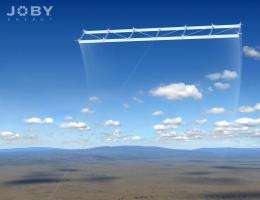
The idea of using winds at high altitudes to generate power was first suggested around four decades ago but at the time was not technically feasible. Now, with new materials and more advanced computers, electronics and sensors, and the development of unmanned aircraft, the concept may be viable, and several companies are investigating the best ways to tap into the resource to generate renewable energy cheaply. Joby Energy is one of these, and its design looks like a multi-winged kite supporting an array of turbines.
This video is not supported by your browser at this time.
Depiction of our 2 MW upper boundary layer system. Video: Joby Energy
The thrust required for the kite's vertical take-off is supplied by motor-generators connected to the turbines, and the orientation of the kite to the wind is controlled by a computer system that differentially adjusts rotor speeds to keep it flying in a circular path. The winds flowing through the turbines spin the generators at high speed, so there is no need for gearboxes. The electricity generated by the turbines is transmitted to the ground via the reinforced composite tether that anchors the kite to the ground.The airborne turbines would initially fly at a height five times higher than conventional wind turbines, and this would increase access to higher wind speeds and better wind consistency, giving more reliable power supplies. If the turbines were flown higher the power generated could be even greater because the wind speed tends to increase at higher altitudes.
The US Federal Aviation Administration has restricted the altitude initially to 600 meters or less, even though the airborne turbines can in theory fly at altitudes over 10,000 meters, and they are designed to operate in the upper troposphere and upper boundary layer.
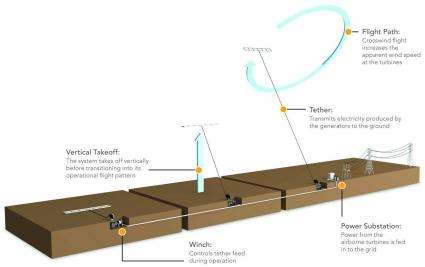
After testing over 20 designs the company has selected a 30 kW system for evaluation and testing. If the tests are successful the company plans to test a 100 kW prototype, and then an initial set of turbine arrays generating 300 kW, enough to supply power to about 150 homes. The generated DC electricity transferred to the ground via the tether would then be converted to AC power to be fed into the power grid.
Bevirt said the system is designed to withstand strong winds, and in gale-force winds or periods of no wind at all the array would be programmed to land itself and take to the air again when the wind conditions are more suitable. The kite is also designed to be landed safely even if the tether is broken, using batteries to power its motors. The design includes a high degree of redundancy in the array, which means it can remain in the air even with multiple points of failure.
This video is not supported by your browser at this time.
The eventual goal of Joby Energy is to develop wind farms with several arrays to develop consistent power, but it will first need to demonstrate the system is safe and the control systems are reliable. Bevirt said the ultimate aim is to deploy the wind turbines around the world to produce an abundant global supply of cheap and clean electricity. More information: Joby Energy: http://www.jobyenergy.com/tech
© 2010 PhysOrg.com
-
Grant aims to reduce cost and expand use of wind turbines for generating electricity
Jan 13, 2010 |
not rated yet |
0
-
Global wind map identifies wind power potential
May 16, 2005 |
not rated yet |
0
-
Recycling wind turbines
Sep 21, 2007 |
not rated yet |
0
-
Smart wind turbines can predict the wind
Jan 05, 2010 |
not rated yet |
0
-
Kites flying in high-altitude winds could provide clean electricity
Jun 24, 2009 |
not rated yet |
0
-
Engineers build first sub-10-nm carbon nanotube transistor
Feb 01, 2012 |
4.9 / 5 (31) |
30
-
Something old, something new: Evolution and the structural divergence of duplicate genes
Jan 31, 2012 |
4.6 / 5 (7) |
1
-
The hidden nanoworld of ice crystals: Revealing the dynamic behavior of quasi-liquid layers
Jan 30, 2012 |
5 / 5 (3) |
1
-
Stock market network reveals investor clustering
Jan 27, 2012 |
3.9 / 5 (23) |
8
-
Of microchemistry and molecules: Electronic microfluidic device synthesizes biocompatible probes
Jan 26, 2012 |
5 / 5 (1) |
0
-
Calling function with no input argument
6 hours ago
-
Force free body diagram problem on gym equipment
7 hours ago
-
Empirical data regarding shower heads and water
15 hours ago
-
feed hold button on CNC lathe
Feb 09, 2012
-
RFAC in Fortran
Feb 09, 2012
-
dynamics 2/32
Feb 08, 2012
- More from Physics Forums - General Engineering
More news stories
CIA website offline, Anonymous takes credit
The website of the Central Intelligence Agency was unresponsive on Friday after the hacker group Anonymous claimed to have knocked it offline.
1 hour ago |
5 / 5 (1) |
6
New error-correcting codes guarantee the fastest possible rate of data transmission
Error-correcting codes are one of the triumphs of the digital age. Theyre a way of encoding information so that it can be transmitted across a communication channel such as an optical fiber o ...
Technology / Computer Sciences
9 hours ago |
5 / 5 (3) |
5
|
Small modular reactor design could be a 'SUPERSTAR'
(PhysOrg.com) -- Though most of today's nuclear reactors are cooled by water, we've long known that there are alternatives; in fact, the world's first nuclear-powered electricity in 1951 came from a reactor ...
Technology / Energy & Green Tech
9 hours ago |
4.2 / 5 (10) |
18
|
Advanced power-grid model finds low-cost, low-carbon future in West
(PhysOrg.com) -- The least expensive way for the Western U.S. to reduce greenhouse gas emissions enough to help prevent the worst consequences of global warming is to replace coal with renewable and other ...
Technology / Energy & Green Tech
9 hours ago |
3.7 / 5 (3) |
7
|
New power source discovered
(PhysOrg.com) -- Researchers at the Massachusetts Institute of Technology (MIT) and RMIT University have made a breakthrough in energy storage and power generation.
Technology / Energy & Green Tech
8 hours ago |
4.9 / 5 (12) |
3
|
NASA sees wide-eyed cyclone Jasmine
Cyclone Jasmine's eye has opened wider on NASA satellite imagery, as it moves through the Southern Pacific Ocean.
NASA sees Giovanna reach cyclone strength, threaten Madagascar
Tropical Storm 12S built up steam and became a cyclone on February 10, 2012 as NASA's Terra satellite passed overhead. Residents of east-central Madagascar should prepare for this cyclone to make landfall ...
Complex wiring of the nervous system may rely on a just a handful of genes and proteins
Researchers at the Salk Institute have discovered a startling feature of early brain development that helps to explain how complex neuron wiring patterns are programmed using just a handful of critical genes. ...
The power of estrogen -- male snakes attract other males
A new study has shown that boosting the estrogen levels of male garter snakes causes them to secrete the same pheromones that females use to attract suitors, and turned the males into just about the sexiest ...
Humans may have helped the decline of African rainforests 3000 years ago
(PhysOrg.com) -- Large areas of rainforests in Central Africa mysteriously disappeared over three thousand years ago, to be replaced by savannas. The prevailing theory has been that the cause was a change ...
Could Venus be shifting gear?
(PhysOrg.com) -- ESAs Venus Express spacecraft has discovered that our cloud-covered neighbour spins a little slower than previously measured. Peering through the dense atmosphere in the infrared, the ...

Jun 04, 2010
Rank: 4 / 5 (6)
Jun 04, 2010
Rank: 1 / 5 (7)
Jun 04, 2010
Rank: 1 / 5 (4)
energy stored somewhere to turn the blades and work like helicopters with perhaps a gyro system to land? I'd like to see the process.
Jun 04, 2010
Rank: 3.7 / 5 (3)
Landing such a contraption is not hard. Here's an awesome video of how stable/manouverable a multi-blade helicopter contraption can be.
http://www.youtub...ujjP5J-k
Jun 04, 2010
Rank: 5 / 5 (4)
Jun 04, 2010
Rank: 5 / 5 (1)
My guess this is going to be another dream energy source that never will be practical, but which governments will spend a lot of money on or if it is successful, just like bio-fuels, will do more harm than good.
Jun 04, 2010
Rank: 4.3 / 5 (3)
Jun 04, 2010
Rank: not rated yet
You could daisy chain them. Have several of these units riding at different altitudes on the same tether. That way they don't get in each other's way.
Don't worry - the amount of units one would have to put up to gather 2% of the wind would be enormous (i.e. completely unrealistic). But I could see it working in particularly windy places.
Like many alterantive energy sources this is a niche product. But that is not to say that it's a bad idea. We have to become less monolithic in our ideas of where our energy comes from. Mix and match where sensible.
Jun 04, 2010
Rank: 4 / 5 (2)
I don't think the engineering for that would work. Remember that they fly in a continuous loop perpendicular to the tether, so you have to have a high strength rotary joint to connect the kite to the tether or you'll twist the tether to failure point quickly. If you daisy chain more than one on the same tether then you multiply the complexity of that connection exponentially, as well as the difficulty of synchronized takeoff/landing and synchronized loop flying, especially when the wind at each kite on the same tether could vary wildly. The wind at different altitudes may not even blow in the same direction, much less the same speed.
Jun 04, 2010
Rank: 5 / 5 (3)
http://www.jobyen...m/impact
"the construction of such a complicated machine with so many moving parts"
So many moving parts? Which, exactly? It is essentially a turbine on a glider on a tether. Very few moving parts compared to, say, a car. Construction costs are much *lower* than tower based turbines because you replace tons of steel in a tower with a relatively cheap tether.
"Ground-based wind turbines are so complicated that they require a permanent professional maintenance staff to keep them running."
Natural gas plants don't? Coal plants don't? What is the disadvantage here exactly?
And what are these "similar ventures" you are talking about?
Jun 04, 2010
Rank: 5 / 5 (1)
Land requirements per kW are comparable or favorable to ground based turbines. Most of what you say is reasonable except the 360 deg requirements. Most good sites will have wind that blows in one direction, and the system can be brought down in adverse conditions. Remember that you are accessing wind power of significantly higher power density per square meter of swept area at higher altitude.
Jun 04, 2010
Rank: 5 / 5 (1)
The best climate models say no, and if they did, it would be a net cooling effect. Besides, you would need just absolutely enormous scale deployment to approach 2% intercept of energy in wind. It is extremely unlikely that you would power the world on wind, due to intermittency and transmissions issues. That figure is just to put a scale on the power available on the wind - it's very large compared to most renewable sources.
Jun 04, 2010
Rank: not rated yet
It's just the reverse of the launch process - they draw power rather than generate it during launch/land, and the turbine blades work like helicopter blades to land it vertically.
Jun 04, 2010
Rank: not rated yet
Then indeed you are right they are very stable, and the system is basically a direct drive unit. Not too much complexity, i suppose the blades will be fixed and the landing controlled precisely by a multi axis gyro system. (If the blades are fixed, complexity is minimum)
This is really interesting, i wish i was involve in anything that has to do with it. And regarding space, windfarms usually are out in the sticks anyway, there should be plenty of space wherever they put it. Of Course if it lands like a heli, (meaning one has precise control over the system) they can programme them to land in close proximity.
Jun 04, 2010
Rank: 5 / 5 (1)
The control systems for this type of device are, as far as I know, unproven. Seemingly feasible, but unproven. Makani Power has done something very similar but they share extremely little about either their successes or failures. They have shown some pictures/video of autonomous tethered flight, but it appeared not to be generating power, but rather free-flying.
Second, I gather that tether drag is an issue that is not entirely solved, and attempting to solve it with aerodynamic fairings creates its own problems. You can see some of Makani's patents in this area, they look pretty sketchy and conceptual to me.
All of this will hinge on what kind of robustness can really be achieved in the autonomous operation of the system, in my opinion. And while I'd love to see it, we'll have to wait and see how far along towards that goal these folks and a few others really are. As for me, I think there is too much potential to ignore.
Jun 04, 2010
Rank: not rated yet
It seem promising to me.
Jun 04, 2010
Rank: not rated yet
1) extreme strength of cable (unlikely to snap)
2) high electrical conductivity (so, tether is also the conductor)
3) small cable cross-section (low wind loads on cable)
4) small cable mass (less sagging, less wind wasted just counteracting cable weight)
Maybe in 10-15 years, when CNT cables are a reality and at a reasonable price, this concept will be viable.
Jun 04, 2010
Rank: 3 / 5 (2)
The overhead power lines currently in use (steel and aluminium for 110 KV) typically have a mass of roughly 1000 kg per 1000 m. Without winter ice.
Jun 04, 2010
Rank: not rated yet
Jun 04, 2010
Rank: not rated yet
I don't know if CNT cables will ever be cost-competitive with steel or aluminum. And I don't know if their bulk conductivity will be competitive either. Individual CNTs can be excellent conductors, but a cable woven from them might not be as good due to the discontinuities involved between molecules. I expect it would still conduct, but perhaps with higher losses than a pure steel cable might...
Jun 04, 2010
Rank: not rated yet
Jun 05, 2010
Rank: not rated yet
Jun 05, 2010
Rank: 5 / 5 (1)
You can watch actual prototypes taking off and landing at the Joby website, so there is no mystery there.
No need for carbon nanotube cables, commercially available dyneema will do the job just fine, even at 10,000ft, so the drag at 600 meters is trivial in comparison.
As for the first part hanging close to the ground, if the landscape requires if is is trivial to run the cable from the top of a 20 meter tower, so the sag happens higher up.
Initially areas like Montana where there is plenty of space would be most suitable, as large areas are indeed needed, but once the concept is got working at megawatt scale then versions for deployment at sea are planned.
The article specifies that there will be batteries aboard to enable landing in the unlikely event the cable breaks.
Jun 05, 2010
Rank: not rated yet
Jun 05, 2010
Rank: 5 / 5 (1)
And if you use a tether you might as well conduct the electricity up/down it.
Yes, that is a problem - though I'm not sure if they actually need to fly in a loop. If you design them more like a kite then they'd be more or less stationary.
As an aside: there are multi-kites (stunt kites) which are effectively daisy-chained single kites and they do seem to fly very well without twisting their tethers to the point of failure.
(example : http://farm3.stat...jpg?v=0)
Jun 05, 2010
Rank: not rated yet
Jun 05, 2010
Rank: 1 / 5 (1)
Balloons as in the Magenn system use helium, which is a really, really bad idea in my view as this is very valuable and essential for many industrial uses.
It is so light that it escapes from the atmosphere so it leaves the earth forever so there is no question of recycling.
Hydrogen is a possibility but safety concerns may well limit it's use.
Jun 05, 2010
Rank: not rated yet
What??? Not unless the weight of the helium + the weight of the balloon material are lighter than empty space (not). A balloon CANNOT float out into space! It can only reach the upper atmosphere until it gets to where the atmosphere equals the combined weight of the balloon + helium per volume. At that point, it's impossible for it to go any higher.
Jun 05, 2010
Rank: not rated yet
Helium molecules are so small that they seep out through the walls of balloons. DaveMart is right: just like hydrogen, helium will tend to rise to the top of the atmosphere, where it will be exposed to ionizing radiation and solar wind, and eventually stripped away into space. Unlike hydrogen, helium is a noble gas, and it won't react with anything else (e.g. oxygen) to form a heavier compound that might keep it in the atmosphere...
@DaveMart,
I think multi-kites would put too much strain on a tether. But I also think there's a way to better utilize the space overhead: instead of flying just one kite in a loop, put several of them in the same loop, evenly spaced apart. Depending on how stable and precise the kites' maneuvering capability is, you could space them let's say 45 degrees apart on the loop, which would let you fly 8 kites in the same space, for example...
Jun 05, 2010
Rank: not rated yet
Jun 06, 2010
Rank: not rated yet
Jun 06, 2010
Rank: 5 / 5 (1)
Yes. I think of it every time I read an article like this, but I am immediately satisfied that no such effect would happen: Think of how much physical matter you'd have to have in air space to significantly effect the wind itself. Look at the videos on this article. Compare how minuscule these things are compared to the whole volume of atmosphere. Back away a little and you can barely see them. Take 10 cubic miles of atmosphere in a 10 mile high column. How much of that volume is occupied by wind energy harvesting devices? It's an infinitesimal amount. But, your intuition is right: To harvest energy from the wind, you do slow it down a bit, but it's so little, it's not worth worrying about until we build solid walls of wind mills tall enough and wide enough to effect actual weather patterns.
Jun 06, 2010
Rank: not rated yet
Jun 06, 2010
Rank: 5 / 5 (1)
Now we can (and do) affect the climate but by harvesting a little bit of wind over a few square meters (or even hundreds of square kilometers) isn't going to do all that much.
With more CO2 in the atmosphere and a heating up of the climate we should expect stronger winds - so if we harvest a _lot_ and actually did manage to change the windflow a little bit then it will be for the better.
Jun 06, 2010
Rank: not rated yet
Jun 07, 2010
Rank: 5 / 5 (1)
But still, all this uses so much area for not very much power. A thorium breeder reactor would consume, including its mine, a small fraction of the space for many many times the power production. And that produces heat which can be often used directly rather than converted to electricity, such as in desalination via boiling.
Jun 07, 2010
Rank: 3.5 / 5 (2)
I'll take something like this kite-generator over a nuclear reactor any time.
Jun 07, 2010
Rank: 5 / 5 (1)
Of course. And the possible effects have been modeled, and found to be trivial with tons of headroom for any realistic deployment scenario. Google "Archer and Caldeira".
Jun 07, 2010
Rank: not rated yet
Flying in a loop is central to these lower boundary layer designs. A dynamic crosswind kite generates about (lift/drag)^2/2 times as much power as a static kite. With realistic L/D about 20, that's 200x more power in the crosswind kite. It's the key to the whole thing.
Jun 11, 2010
Rank: not rated yet
Jun 12, 2010
Rank: 2 / 5 (1)
I think these systems would be most practical on top of skyscrapers where they are unlikely to interfere with surrounding terrain, and get even more elevation boost. (i.e. 600-800meters extra from the newest, tallest skyscrapers.)
Jun 13, 2010
Rank: not rated yet
It'd be interesting to see what the overall footprint of these kites would be (at ~300kW a pop) vs. a nuclear plant (at say ~2400MW). Not that I'm against these wind turbines. They definitely show promise and could do well in some specific areas.
Jun 13, 2010
Rank: not rated yet
That might be a tough sell given that in a worst case scenario falling from a skyscraper would have it landing in the middle of a city.
Jun 14, 2010
Rank: not rated yet