Genetic 'Parts' List Now Available for Key Part of the Mammalian Brain
June 4, 2010
Genetic 'Parts' List Now Available for Key Part of the Mammalian Brain

Enlarge

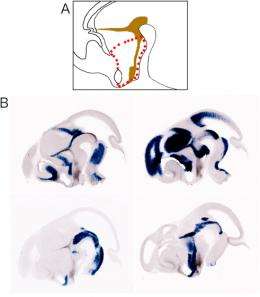
A. A diagram of the developing mouse brain at 12 days gestation. The hypothalamus is outlined in red, while cells that express the Shh gene, which was used as a landmark in this study, are shown in brown. B. Various different genes that are turned on in different parts of the hypothalamus are shown in purple, while Shh is shown in brown.

(PhysOrg.com) -- A Johns Hopkins and Japanese research team has generated the first comprehensive genetic "parts" list of a mouse hypothalamus, an enigmatic region of the brain — roughly cherry-sized, in humans — that controls hunger, thirst, fatigue, body temperature, wake-sleep cycles and links the central nervous system to control of hormone levels.

Flaws in development may underlie both inborn and acquired metabolic balance problems that can lead to obesity, diabetes, mood disorders and , according to a report on the study published May 2 in the advance online publication of .

“Knowing how cells develop in this part of the brain will help us understand how they regulate behavior, mood and metabolism,” says Seth Blackshaw, Ph.D., an assistant professor in the Solomon H. Snyder Department of Neuroscience, Johns Hopkins University School of Medicine.

The hypothalamus is one of the most diverse and complex parts of the brain, and having an index of the genes involved in producing its many cell types is a toolbox that researchers can use to manipulate the activity of by turning them on and off, or tracing their connections. This may ultimately lead to better diagnostic and treatment options for a variety of disorders.

“The study of hypothalamic development, particularly of cell specification, will help us to understand how hypothalamic neurons function to regulate behavior and physiology,” says Blackshaw. “Because of when and where we saw certain genes turn on, we now have identified a set of candidate players that guide the assembly of the different parts of the hypothalamus and that specify the many individual cell types within it.”

The hypothalamus is composed of at least dozens of types of neurons — and more likely hundreds — each of which corresponds to a gene that has remained unidentified until now. Its cellular arrangement is more akin to a bowl of spaghetti than a neatly organized club sandwich, according to Blackshaw. The catalog of molecular markers identified here helps unravel this complexity.

The team’s first challenge was to dissect away, at the very start of neural development, the part of the mouse brain which develops into the hypothalamus, and then cut tiny slices of this region for use in microarray analysis, a technology that reveals multiple gene activity. By analyzing all the roughly 20,000 genes in the mouse genome, the team identified 1200 as strongly activated in developing hypothalamus and characterized the cells within the hypothalamus in which they were activated. The team then characterized the expression of the most interesting 350 genes in detail using another gene called Shh, for sonic hedgehog, as a landmark to identify the precise region of the hypothalamus in which these genes were turned on. This involved processing close to 20,000 tissue sections — painstakingly sliced at one-fiftieth of a millimeter thickness and then individually examined.

“We were able to use this data to find genes whose expression matched every individual hypothalamic nucleus and essentially assemble a jigsaw puzzle of gene expression patterns that completely covered the developing hypothalamus,” Blackshaw says. “Now that we have a complete set of molecular landmarks, along with an extensive molecular parts list, we can begin to learn how all these parts fit together to create this essential and highly complex brain region.”

More information: Nature Neuroscience: http://www.nature. … o/index.html

Provided by Johns Hopkins University (news : web)

Filter


Move the slider to adjust rank threshold, so that you can hide some of the comments.


Display comments: newest first

zevkirsh
Jun 04, 2010

Rank: not rated yet
amazing.
Rank not rated yet
Related Stories
Relevant PhysicsForums posts
  • Is Everyday Technology Killing Us?
    createdFeb 08, 2012
  • Exercise and weight loss
    createdFeb 08, 2012
  • Why do we have head aches? Our brains can't feel anything.
    createdFeb 07, 2012
  • "The end of diseases" by David Agus, interview from Daily Show with Jon Stewart
    createdFeb 04, 2012
  • Oncolytic adenovirus
    createdFeb 04, 2012
  • Nutrition label stuffs and diets
    createdFeb 02, 2012
  • More from Physics Forums - Medical Sciences

More news stories

Complex wiring of the nervous system may rely on a just a handful of genes and proteins

Researchers at the Salk Institute have discovered a startling feature of early brain development that helps to explain how complex neuron wiring patterns are programmed using just a handful of critical genes. ...

Medicine & Health / Research

created 8 hours ago | popularity 4.9 / 5 (9) | comments 0 | with audio podcast

Both maternal and paternal age linked to autism

Older maternal and paternal age are jointly associated with having a child with autism, according to a recently published study led by researchers at The University of Texas Health Science Center at Houston (UTHealth).

Medicine & Health / Psychology & Psychiatry

created 12 hours ago | popularity 4.3 / 5 (3) | comments 0 | with audio podcast

New understanding of DNA repair could eventually lead to cancer therapy

A research group in the Faculty of Medicine & Dentistry at the University of Alberta is hoping its latest discovery could one day be used to develop new therapies that target certain types of cancers.

Medicine & Health / Cancer

created 12 hours ago | popularity 4.8 / 5 (5) | comments 0 | with audio podcast

Curry spice component may help slow prostate tumor growth

Curcumin, an active component of the Indian curry spice turmeric, may help slow down tumor growth in castration-resistant prostate cancer patients on androgen deprivation therapy (ADT), a study from researchers ...

Medicine & Health / Cancer

created 13 hours ago | popularity 4.4 / 5 (8) | comments 0 | with audio podcast

Team isolates nerve cells involved in storing long term memory and gene proteins associated with them

(Medical Xpress) -- A research team in Taiwan has succeeded in isolating two nerve cells in fruit fly brains that are believed to be the major players in allowing for the formation of long term memories. Furthermore, ...

Medicine & Health / Neuroscience

created 14 hours ago | popularity 5 / 5 (4) | comments 1 | with audio podcast report


Google users warned of threat to smartphone wallets

Users of Google smartphone wallets were being warned on Friday that there is a way to crack pass codes intended to thwart thieves from going on illicit shopping sprees.

Anonymous knocks CIA website offline (Update)

The website of the Central Intelligence Agency was inaccessible on Friday after the hacker group Anonymous claimed to have knocked it offline.

New error-correcting codes guarantee the fastest possible rate of data transmission

Error-correcting codes are one of the triumphs of the digital age. They’re a way of encoding information so that it can be transmitted across a communication channel — such as an optical fiber o ...

Humans may have helped the decline of African rainforests 3000 years ago

(PhysOrg.com) -- Large areas of rainforests in Central Africa mysteriously disappeared over three thousand years ago, to be replaced by savannas. The prevailing theory has been that the cause was a change ...

New power source discovered

(PhysOrg.com) -- Researchers at the Massachusetts Institute of Technology (MIT) and RMIT University have made a breakthrough in energy storage and power generation.

The power of estrogen -- male snakes attract other males

A new study has shown that boosting the estrogen levels of male garter snakes causes them to secrete the same pheromones that females use to attract suitors, and turned the males into just about the sexiest ...