Climate change forces major vegetation shifts
June 4, 2010
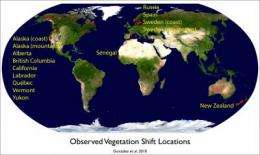
This map shows locations of 15 cases of observed biome shifts due to climate change. Credit: Map by Patrick Gonzalez, et al.
(PhysOrg.com) -- Vegetation around the world is on the move, and climate change is the culprit, according to a new analysis of global vegetation shifts led by a University of California, Berkeley, ecologist in collaboration with researchers from the U.S. Department of Agriculture Forest Service.
n a paper published today (June 4) in the journal Global Ecology and Biogeography, researchers present evidence that over the past century, vegetation has been gradually moving toward the poles and up mountain slopes, where temperatures are cooler, as well as toward the equator, where rainfall is greater.
Moreover, an estimated one-tenth to one-half of the land mass on Earth will be highly vulnerable to climate-related vegetation shifts by the end of this century, depending upon how effectively humans are able to curb greenhouse gas emissions, according to the study.
The results came from a meta-analysis of hundreds of field studies and a spatial analysis of observed 20th century climate and projected 21st century vegetation.
The meta-analysis identified field studies that examined long-term vegetation shifts in which climate, rather than impacts from local human activity such as deforestation, was the dominant influence. The researchers found 15 cases of biome shifts since the 18th century that are attributable to changes in temperature and precipitation.
"This is the first global view of observed biome shifts due to climate change," said the study's lead author Patrick Gonzalez, a visiting scholar at the Center for Forestry at UC Berkeley's College of Natural Resources. "It's not just a case of one or two plant species moving to another area. To change the biome of an ecosystem, a whole suite of plants must change."
The researchers calculated that from 1901 to 2002, mean temperatures significantly increased on 76 percent of global land, with the greatest warming in boreal, or subarctic, regions. The most substantial biome shifts occurred where temperature or precipitation changed by one-half to two standard deviations from 20th century mean values.
Some examples of biome shifts that occurred include woodlands giving way to grasslands in the African Sahel, and shrublands encroaching onto tundra in the Arctic.
"The dieback of trees and shrubs in the Sahel leaves less wood for houses and cooking, while the contraction of Arctic tundra reduces habitat for caribou and other wildlife," said Gonzalez, who has served as a lead author on reports of the Intergovernmental Panel on Climate Change (IPCC). "Globally, vegetation shifts are disrupting ecosystems, reducing habitat for endangered species and altering the forests that supply water and other services to many people."
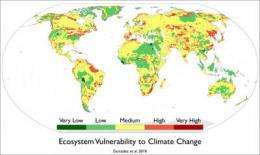
Researchers identify areas of vulnerability to biome shifts, based upon observations of changes from the 20th century and projections of changes in the 21st century. Credit: Map by Patrick Gonzalez, et al
To identify the areas most vulnerable to future vegetation shifts, the researchers combined statistical analyses of observed climate data from the 20th century with models of vegetation change in the 21st century.Based upon nine different combinations of IPCC greenhouse gas emissions scenarios and climate models, the researchers divided the world's land into five classes — from very high to very low — of vulnerability to biome shifts.
"Scientists had not quantified this risk before," said Gonzalez. "We developed a simple classification system that natural resource management agencies can use to identify regions in greatest need of attention and planning. We have worked with the U.S.D.A. Forest Service and the U.S. Fish and Wildlife Service to explore the application of our results to adaptation of natural resource management."
Gonzalez said that because of limited resources, it may be prudent to focus on protecting areas of greater resilience to ecological changes so that they can serve as refuges for plants and animals. "It is also useful to identify places of higher vulnerability, because agencies will need to consider adaptation measures for vulnerable ecosystems," he said. "Some shifts in vegetation could increase fuel for wildfires, for example, so prescribed burning may be necessary to reduce the risk of catastrophic fires."
"Approximately one billion people now live in areas that are highly to very highly vulnerable to future vegetation shifts," said Gonzalez. "Ecosystems provide important services to people, so we must reduce the emissions that cause climate change, then adapt to major changes that might occur."
Provided by University of California - Berkeley (news : web)
-
Climate change and species distributions
Aug 04, 2008 |
not rated yet |
0
-
Region-specific climate modeling studied
Oct 31, 2005 |
not rated yet |
0
-
A changing climate for protected areas
Apr 02, 2007 |
not rated yet |
0
-
Massive California fires consistent with climate change
Oct 24, 2007 |
not rated yet |
0
-
Using satellite observations to study photosynthetic trends
May 18, 2006 |
not rated yet |
0
-
Engineers build first sub-10-nm carbon nanotube transistor
Feb 01, 2012 |
4.9 / 5 (30) |
30
-
Something old, something new: Evolution and the structural divergence of duplicate genes
Jan 31, 2012 |
4.6 / 5 (7) |
1
-
The hidden nanoworld of ice crystals: Revealing the dynamic behavior of quasi-liquid layers
Jan 30, 2012 |
5 / 5 (3) |
1
-
Stock market network reveals investor clustering
Jan 27, 2012 |
3.9 / 5 (23) |
8
-
Of microchemistry and molecules: Electronic microfluidic device synthesizes biocompatible probes
Jan 26, 2012 |
5 / 5 (1) |
0
-
Discrepancy between oxygen and carbon-dioxide levels
6 hours ago
-
where gems are found in the world
9 hours ago
-
Wind Waves in Reservoir ~ Wind run-up and Wind set-up
Feb 08, 2012
-
Balance of oxygen in the atmosphere
Feb 01, 2012
-
The case for a methanol-based economy
Jan 30, 2012
-
Weather in a rotating cylinder
Jan 25, 2012
- More from Physics Forums - Earth
More news stories
New views show old NASA Mars landers
(PhysOrg.com) -- The High Resolution Imaging Science Experiment (HiRISE) camera on NASA's Mars Reconnaissance Orbiter recorded a scene on Jan. 29, 2012, that includes the first color image from orbit showing ...
Space & Earth / Space Exploration
19 hours ago |
4.9 / 5 (7) |
7
|
Deconstructing a mystery: What caused Snowmaggedon?
In the quiet after the storms, streets and cars had all but disappeared under piles of snow. The U.S. Postal Service suspended service for the first time in 30 years. Snow plows struggled to push the evidence ...
Space & Earth / Earth Sciences
11 hours ago |
4.7 / 5 (3) |
1
|
Black holes and star formation
(PhysOrg.com) -- It has long been recognized that galaxy mergers or even close interactions can play a vital role in shaping the morphology of galaxies. One way they can do so, it is thought, is by triggering ...
18 hours ago |
4.1 / 5 (7) |
5
|
Ocean microbe communities changing, but long-term environmental impact is unclear
As oceans warm due to climate change, water layers will mix less and affect the microbes and plankton that pump carbon out of the atmosphere but researchers say it's still unclear whether these processes ...
Space & Earth / Earth Sciences
13 hours ago |
5 / 5 (2) |
2
|
Researchers create 3-D laser maps that show how earthquake changes landscape
Geologists have a new tool to study how earthquakes change the landscape down to a few inches, and it's giving them insight into how earthquake faults behave. In the Feb. 10 issue of the journal Science, a team ...
Space & Earth / Earth Sciences
13 hours ago |
5 / 5 (4) |
0
|
'Dark plasmons' transmit energy
Microscopic channels of gold nanoparticles have the ability to transmit electromagnetic energy that starts as light and propagates via "dark plasmons," according to researchers at Rice University.
FDA-approved drug rapidly clears amyloid from the brain, reverses Alzheimer's symptoms in mice
Neuroscientists at Case Western Reserve University School of Medicine have made a dramatic breakthrough in their efforts to find a cure for Alzheimer's disease. The researchers' findings, published in the journal Science, show t ...
Hydrogen from acidic water: Researchers develop potential low cost alternative to platinum for splitting water
A technique for creating a new molecule that structurally and chemically replicates the active part of the widely used industrial catalyst molybdenite has been developed by researchers with the Lawrence Berkeley ...
Ultraviolet protection molecule in plants yields its secrets
Lying around in the sun all day is hazardous not just for humans but also for plants, which have no means of escape. Ultraviolet (UV) radiation from the sun can damage proteins and DNA inside cells, leading ...
Soraa LED light may dim 50-watt halogen rivals
(PhysOrg.com) -- Soraa, a Fremont, California company founded in 2008, this week launched its first product, a light that uses LEDS (light emitting diodes). The "Soraa LED MR16 lamp" is the "perfect" replacement ...
Anyone can learn to be more inventive, cognitive researcher says
There will always be a wild and unpredictable quality to creativity and invention, says Anthony McCaffrey, a cognitive psychology researcher at the University of Massachusetts Amherst, because an "Aha moment" is rare and ...

Jun 05, 2010
Rank: 2 / 5 (4)
There's no need to demonize climate change by referring to it as a culprit. Is winter a culprit because it (temporarily) ends plant growth? Is rain a culprit because it ruins your picnic?
People need to keep their political opinions out of scientific reports.
Jun 05, 2010
Rank: 1.7 / 5 (6)
If the motive was science they would. The motive is more government control uber alles.
Jun 05, 2010
Rank: 3 / 5 (4)
These links specifically address the problems facing caribou.
http://www.physor...111.html
http://www.physor...608.html
Given time, most species would be able to adapt to a changing environment, unfortunately the change is occuring too fast for some.
Jun 05, 2010
Rank: 3 / 5 (4)
And this is something new?
Jun 05, 2010
Rank: 2.6 / 5 (5)
Earth's climate has changed, is now changing, and will always change because Earth moves in the outer layer (heliosphere) of the Sun - a variable star.
With kind regards,
Oliver K. Manuel
Jun 05, 2010
Rank: 4 / 5 (4)
Jun 05, 2010
Rank: 1 / 5 (2)
Jun 12, 2010
Rank: 5 / 5 (1)
that is bloody climate change.