NIST Demonstrates 'Teleportation' of Atomic States for Quantum Computing
Physicists at the Commerce Department’s National Institute of Standards and Technology (NIST) have demonstrated 'teleportation' by transferring key properties of one atom to another atom without using any physical link, according to results reported in the June 17, 2004, issue of the journal Nature.
Unlike the “beaming” of actual physical objects and people between distant locations popularized in the Star Trek science fiction series, the term “teleportation” is how physicists describe a transfer of “quantum states” between separate atoms. The quantum state of an atom is a description of such things as its energy, motion, magnetic field and other physical properties.
The NIST experiments used laser beam manipulations to transfer quantum states of one beryllium atom to another atom within a set of microscale traps, with a 78 percent success rate. The technique may prove useful for transporting information in quantum computers of the future, which could use central processing elements smaller than a cube of sugar to carry out massively complex computations that are currently impossible.
If they can be built, quantum computers—harnessing the strange behavior of particles at the atomic scale—someday might be used for applications such as code breaking of unprecedented power, optimizing complex systems such as airline schedules, much faster database searching and solving of complex mathematical problems, and even the development of novel products such as fraud-proof digital signatures.
The NIST work and other research by the University of Innsbruck reported in the same issue of Nature mark the first demonstrations of teleportation using atoms. Systems using atoms are arguably the leading candidate for storing and processing data in quantum computers. Teleportation could increase computing speed and efficiency by linking distant zones within a computer so that data could be processed by physically separated quantum bits (or qubits, the quantum form of the digital bits 1 and 0).
Quantum computing with atomic qubits requires manipulation of information contained in the quantum states of the atoms. “It’s hard to quickly move qubits to share or process information. But using teleportation as we’ve reported could allow logic operations to be performed much more quickly,” says NIST physicist David Wineland, leader of the NIST work.
The NIST group previously has demonstrated the building blocks for a quantum computer based on atomic-ion traps. The new experiments, which are computer controlled and perform teleportation in about 4 milliseconds, incorporate most of the features required for large-scale information processing systems using ion traps. In addition, the experiments are relatively simple in design and could be used as part of a series of logical operations needed for practical computing.
The demonstration described in the Nature paper exploited quantum properties that are radically different from the properties observed in the “normal” world. For example, ions can be manipulated into a special state known as a “superposition” in which they literally can be in two places at once. Similarly, they also can hold information representing more than one number at once, a common property of all qubits. Ions also can be “entangled” with each other, so that their behavior is related in predictable ways, as if they were connected by an invisible force. Einstein called this “spooky action at a distance.”
The NIST experiments entangled a set of three ions, then destroyed the quantum state in one ion and teleported it to another one. The properties that were teleported included the “spin state” of the ion (up, down or a superposition of the two), and the “phase” (which has to do with the relative positions of the peaks and troughs of an ion’s wave properties). A clever approach was required because of another unusual feature of the quantum world: measurements always alter quantum states (for example, causing superpositions to collapse). Therefore, the experiment teleported the quantum state without measuring it.
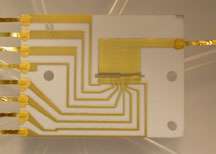
The ions were teleported inside a NIST-developed multi-zone trap, first described in 2002. Lasers are used to manipulate the ion’s spin and motion, and to entangle the ions by linking their internal spin states to their external motion. A key technical advance reported in the current paper is the capability to entangle ions and then separate them in the trap (maintaining entanglement) without generating much heat. This previously led to uncontrolled motions that interfered with operations and required additional cooling operations. The advance was enabled in part by the use of smaller electrodes to generate electric fields that move the ions between trap zones.
The research was supported in part by the Advanced Research and Development Activity and the National Security Agency.
More information about NIST research on quantum computing can be found at qubit.nist.gov.
A non-regulatory agency of the U.S. Department of Commerce, NIST develops and promotes measurement, standards, and technology to enhance productivity, facilitate trade and improve the quality of life.
The original press release can be found here.


