Gently unfolding proteins to watch them refold
June 7, 2010 By Kaspar Mossman
Gently unfolding proteins to watch them refold

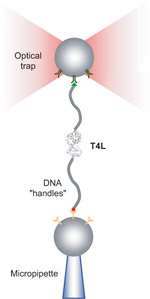
The authors used the “optical tweezers” technique, developed by Carlos Bustamante, to unfold and refold T4L hundreds of times. The ensemble of force-extension curves holds information about the free energy of the folding transition. (Image: Susan Marqusee)

(PhysOrg.com) -- How does a protein chain fold into the same 3-D shape each time and not something disfunctional or dangerous? A new study shows that the first fold is critical. The finding by Susan Marqusee and Carlos Bustamante could help to understand the role of misfolded proteins in Alzheimer's Disease.

Alzheimer’s disease belongs to a family of conditions classified as amyloidoses, in which misfolded proteins clump into plaques or fibrils instead of taking their normal, soluble form. Why this happens and how it might be prevented has been the subject of intense research for decades. Equally of interest is how most proteins have evolved to avoid misfolding.

QB3 researchers Susan Marqusee, a UC Berkeley professor of biochemistry and molecular biology, and Carlos Bustamante, a UC Berkeley professor of physics, show in new research that, in T4 lysozyme—an enzyme related to one responsible for a form of amyloidosis—a subtle detail of topology ensures that the protein either folds all at once or not at all, avoiding dangerous intermediates.

The research was published in the journal Nature. First authorship was shared by Elizabeth Shank, now a postdoctoral fellow at Harvard; Ciro Cecconi, now a researcher at the University of Modena and Reggio Emilia in Italy; and Jesse Dill, a graduate student at UC Berkeley.

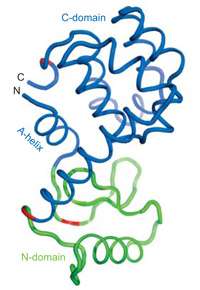
T4L, like all proteins, is a string of amino acid residues. At the “C” end is a carboxylic acid group; at the “N” end, an amino group. When folded, T4L consists of two globular domains. Starting from the N end, the first 12 residues coil into what the authors call the “A-helix.” The next 48 residues comprise the N-domain; the last 104 residues belong to the C-domain. But the initial A-helix folds into the C-domain.

“This ‘re-entrant’ structure is found in many enzyme families where the active site is in the cleft between domains,” Marqusee says.

The researchers used a technique called “” to gently pull single T4L enzymes apart and allow them to refold over and over again. Single molecules are subject to random thermal fluctuations, which induce variations in the curves of force versus extension. From these variations, the scientists used a sophisticated mathematical technique to extract information about the “free energy” difference between folded and unfolded T4L.

What they found was that pulling apart just the N-domain required forces and energies similar to those required to unfold the entire enzyme, implying that the two domains folded “cooperatively”—the C-domain could not fold independently of the N-domain.

T4L’s structure has an unusual quirk: folded, its N end and C end sit next to each other. This enabled the researchers to genetically engineer a version in which the A-helix was cut from the N end and joined to the C end, so that there was only one point at which the two domains made contact. Experiments showed that the domains of this engineered T4L folded independently.

The results are evidence that T4L’s A-helix is a sort of Velcro reinforcing strip holding the protein together. “We speculate that the re-entrant structure in many proteins has been selected over evolutionary time to ensure that different domains fold cooperatively,” Bustamante says. "This prevents misfolding,” known to be a major factor in amyloidosis.

The new results could be useful to scientists designing enzymes from scratch, Marqusee says.

“Our collaboration is a good example of the kind of work that can emerge from the kind of multidisciplinary environment fostered by QB3,” Bustamante says. “By combining molecular biology and physics, we have been able to discover communication between the domains of the proteins that would have been difficult to extract in any other way.”

“This is beautiful work,” says Nancy Forde, an assistant professor of physics at Simon Fraser University in Vancouver, who was not involved in the research. “The Marqusee and Bustamante groups have made seminal contributions in two distinct fields: further demonstrating how optical tweezers can provide unique insight into structure and stability, and illustrating the critical influence of re-entrant structure on the folding pathways of an enzyme.”

More information: Nature paper: http://www.nature. … re09021.html

Provided by University of California - Berkeley (news : web)

Filter


Move the slider to adjust rank threshold, so that you can hide some of the comments.


Display comments: newest first

gunslingor1
Jun 07, 2010

Rank: not rated yet
What? You need 20 ARPS of ramstat polivash for shell lubrication of the schrodinger flux capacitor. Is it clear how confused I am?
zevkirsh
Jun 07, 2010

Rank: not rated yet
amyloidosis sounds like the wrong kink areas begin cooperatively folding to create a wrongly folded protein, rather than a break down of cooperation between the correct areas.
Rank 5 /5 (5 votes)
Relevant PhysicsForums posts
  • Stoichiometry
    created20 hours ago
  • Boiling and melting point of impure substances
    created21 hours ago
  • Safe nitrogen compound to decompose a 500 deg C in a furnace?
    createdFeb 09, 2012
  • [ask]electron inside drinking water
    createdFeb 08, 2012
  • How to avoid formation of Lithium Chromate ???
    createdFeb 08, 2012
  • how to choose a reduced or oxidated form in a redox
    createdFeb 08, 2012
  • More from Physics Forums - Chemistry

More news stories

Fool's gold may prove an unlikely alternative to overexploited catalytic materials

Catalytic materials, which lower the energy barriers for chemical reactions, are used in everything from the commercial production of chemicals to catalytic converters in car engines. However, with current catalytic materials ...

Chemistry / Materials Science

created 11 hours ago | popularity 4.3 / 5 (6) | comments 3 | with audio podcast

Unpicking HIV’s invisibility cloak

Drug researchers hunting for alternative ways to treat human immunodeficiency virus (HIV) infections may soon have a novel target—its camouflage coat. HIV hides inside a cloak unusually rich in a sugar ...

Chemistry / Biochemistry

created 11 hours ago | popularity 5 / 5 (4) | comments 0

No entry without protein recycling: Researchers discover new coherence in enzyme transport

The group of Prof. Dr. Ralf Erdmann at the Ruhr-Universität Bochum, Germany, discovered a connection of peroxisomal protein import and receptor export. In the Journal of Biological Chemistry, they disclo ...

Chemistry / Biochemistry

created 11 hours ago | popularity not rated yet | comments 0

Under the microscope #7

In this video Dr Ingrid Graz shows us a thin layer of gold on top of rubber. Cracks in the gold allow it to stretch and we can use this for stretchable electronics.

Chemistry / Other

created 13 hours ago | popularity not rated yet | comments 0

Hydrogen from acidic water: Researchers develop potential low cost alternative to platinum for splitting water

A technique for creating a new molecule that structurally and chemically replicates the active part of the widely used industrial catalyst molybdenite has been developed by researchers with the Lawrence Berkeley ...

Chemistry / Materials Science

created Feb 09, 2012 | popularity 5 / 5 (12) | comments 13 | with audio podcast


Google users warned of threat to smartphone wallets

Users of Google smartphone wallets were being warned on Friday that there is a way to crack pass codes intended to thwart thieves from going on illicit shopping sprees.

Anonymous knocks CIA website offline (Update)

The website of the Central Intelligence Agency was inaccessible on Friday after the hacker group Anonymous claimed to have knocked it offline.

Complex wiring of the nervous system may rely on a just a handful of genes and proteins

Researchers at the Salk Institute have discovered a startling feature of early brain development that helps to explain how complex neuron wiring patterns are programmed using just a handful of critical genes. ...

New error-correcting codes guarantee the fastest possible rate of data transmission

Error-correcting codes are one of the triumphs of the digital age. They’re a way of encoding information so that it can be transmitted across a communication channel — such as an optical fiber o ...

The power of estrogen -- male snakes attract other males

A new study has shown that boosting the estrogen levels of male garter snakes causes them to secrete the same pheromones that females use to attract suitors, and turned the males into just about the sexiest ...

Putting the squeeze on planets outside our solar system

(PhysOrg.com) -- Using high-powered lasers, scientists at Lawrence Livermore National Laboratory and collaborators discovered that molten magnesium silicate undergoes a phase change in the liquid state, abruptly ...