Explained: Quark gluon plasma
June 9, 2010 by Anne Trafton
Explained: Quark gluon plasma

Enlarge

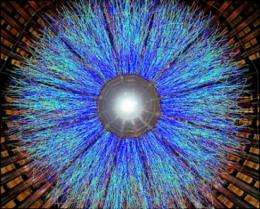
A visualization of one of the first full-energy collisions between gold ions at Brookhaven Lab's Relativistic Heavy Ion Collider, as captured by the Solenoidal Tracker At RHIC (STAR) detector. Image: Brookhaven National Laboratory

For a few millionths of a second after the Big Bang, the universe consisted of a hot soup of elementary particles called quarks and gluons. A few microseconds later, those particles began cooling to form protons and neutrons, the building blocks of matter.

Over the past decade, physicists around the world have been trying to re-create that soup, known as (QGP), by slamming together nuclei of atoms with enough energy to produce trillion-degree temperatures.

“If you’re interested in the properties of the microseconds-old universe, the best way to study it is not by building a telescope, it’s by building an accelerator,” says Krishna Rajagopal, an MIT who studies QGP.

Quarks and gluons, though they make up protons and neutrons, behave very differently from those heavier particles. Their interactions are governed by a theory known as quantum chromodynamics, developed in part by MIT professors Jerome Friedman and Frank Wilczek, who both won Nobel prizes for their work. However, the actual behavior of quarks and gluons is difficult to study because they are confined within heavier particles. The only place in the universe where QGP exists is inside high-speed accelerators, for the briefest flashes of time.

In 2005, scientists at the at Brookhaven National Laboratory reported creating QGP by smashing gold atoms together at nearly the speed of light. These collisions can produce temperatures up to 4 trillion degrees — 250,000 times warmer than the sun’s interior and hot enough to melt protons and neutrons into quarks and gluons.

The resulting super-hot, super-dense blob of matter, about a trillionth of a centimeter across, could give scientists new insights into the properties of the very . So far, they have already made the surprising discovery that QGP is a nearly frictionless liquid, not the gas that physicists had expected.

By doing higher-energy collisions, scientists now hope to find out more about the properties of quark gluon plasma and whether it becomes gas-like at higher temperatures. They also want to delve further into the very surprising similarities that have been seen between QGP and ultracold gases (near absolute zero) that MIT’s Martin Zwierlein and others have created in the laboratory. Both substances are nearly frictionless, and theoretical physicists suspect that string theory may explain both phenomena, says Rajagopal.

At the Large Hadron Collider in Geneva, MIT faculty Gunther Roland, Wit Busza and Boleslaw Wyslouch are among the physicists planning to double the temperature achieved at Brookhaven, offering a glimpse of an even-earlier stage of the universe’s formation.

More information: Other "Explained" stories can be found: http://www.physorg … d&headline=1

Provided by Massachusetts Institute of Technology (news : web)

4.6 /5 (21 votes)  

Rank 4.6 /5 (21 votes)
Related Stories
Relevant PhysicsForums posts
  • Pith balls problem
    created34 minutes ago
  • Electrostatics
    created35 minutes ago
  • what is phase constant
    created47 minutes ago
  • Basics In electromagnetic wave
    created56 minutes ago
  • How to calculate theoretical initial velocity?
    created1 hour ago
  • Question about Gravity?
    created3 hours ago
  • More from Physics Forums - General Physics

More news stories

Putting the squeeze on planets outside our solar system

(PhysOrg.com) -- Using high-powered lasers, scientists at Lawrence Livermore National Laboratory and collaborators discovered that molten magnesium silicate undergoes a phase change in the liquid state, abruptly ...

Physics / Condensed Matter

created 11 hours ago | popularity 4.3 / 5 (7) | comments 0 | with audio podcast

Hovering not hard if you're top-heavy, researchers find

Top-heavy structures are more likely to maintain their balance while hovering in the air than are those that bear a lower center of gravity, researchers at New York University's Courant Institute of Mathematical Sciences ...

Physics / General Physics

created 12 hours ago | popularity 5 / 5 (1) | comments 1 | with audio podcast

SLAC, Stanford team focuses on high-energy electrons to treat cancer

Accelerator physicists at SLAC and cancer specialists from Stanford are working on a new technology that could dramatically reduce the time needed for cancer radiation treatments. The team ran an initial experiment ...

Physics / General Physics

created 15 hours ago | popularity 5 / 5 (2) | comments 0

Measurements from high-energy collisions lead to better understanding of why meson particles disappear

For several years, physicists at the Relativistic Heavy Ion Collider (RHIC) at Brookhaven National Laboratory (BNL), USA, have studied an unusual state of matter called the quark–gluon plasma, which they ...

Physics / General Physics

created 16 hours ago | popularity 4.5 / 5 (4) | comments 0

Explained: Sigma

It's a question that arises with virtually every major new finding in science or medicine: What makes a result reliable enough to be taken seriously? The answer has to do with statistical significance -- but ...

Physics / General Physics

created Feb 09, 2012 | popularity 5 / 5 (16) | comments 53


Anonymous knocks CIA website offline (Update)

The website of the Central Intelligence Agency was inaccessible on Friday after the hacker group Anonymous claimed to have knocked it offline.

Google users warned of threat to smartphone wallets

Users of Google smartphone wallets were being warned on Friday that there is a way to crack pass codes intended to thwart thieves from going on illicit shopping sprees.

New error-correcting codes guarantee the fastest possible rate of data transmission

Error-correcting codes are one of the triumphs of the digital age. They’re a way of encoding information so that it can be transmitted across a communication channel — such as an optical fiber o ...

Humans may have helped the decline of African rainforests 3000 years ago

(PhysOrg.com) -- Large areas of rainforests in Central Africa mysteriously disappeared over three thousand years ago, to be replaced by savannas. The prevailing theory has been that the cause was a change ...

New power source discovered

(PhysOrg.com) -- Researchers at the Massachusetts Institute of Technology (MIT) and RMIT University have made a breakthrough in energy storage and power generation.

The power of estrogen -- male snakes attract other males

A new study has shown that boosting the estrogen levels of male garter snakes causes them to secrete the same pheromones that females use to attract suitors, and turned the males into just about the sexiest ...