New therapy offers hope to spinal muscular atrophy patients
June 9, 2010
New therapy offers hope to spinal muscular atrophy patients

Enlarge

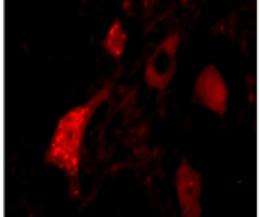
This image shows the results of a new therapy technique for Spinal Muscular Atrophy patients developed by academics at the University of Sheffield. The study has led to the restoration of the SMN protein in motor neurons, as shown in this image. Credit: Professor Mimoun Azzouz, from the University of Sheffield's Department of Neuroscience

Children who suffer from the devastating disease Spinal Muscular Atrophy are set to benefit from a new breakthrough in therapy developments by researchers at the University of Sheffield.

The research, which was published in Science Translational Medicine, has shown that a novel gene transfer system has the potential to provide an effective therapeutic treatment for SMA patients.

SMA is a devastating which affects children. It is caused by an abnormal survival motor neuron (SMN) gene, which leads to a reduction of SMN protein levels. The disease is currently incurable, and patients often require prolonged medical care as no effective treatments to alleviate the condition, currently exist.

The research team at Sheffield, led by Professor Mimoun Azzouz, tested whether a novel gene replacement therapy through a single injection was the most efficient way to treat the disease in a group of mice. They found that the injection, which expressed the SMN gene, successfully restored the SMN protein to normal levels and alleviated symptoms in the SMA model.

The new technique has the potential to develop a simple injection, without any requirement for risky and costly surgical interventions, and has achieved the highest therapeutic effects reported in the field to date. This has significant implications for the future treatment of SMA.

Professor Mimoun Azzouz, from the University's Department of , said: "I am delighted by the outcome of several years of efforts to tackle this devastating disease. These results bring us one step closer to a successful gene therapy treatment for patients with SMA."

More information: The paper, entitled ‘Systemic delivery of scAAV9 expressing SMN prolongs survival in a model of spinal muscular atrophy’ was published in Volume 2, Issue 34 of Science Translational Medicine: Chiara Valori, Ke Ning, Matthew Wyles, Richard J Mead, Andrew J Grierson, Pamela J Shaw, Mimoun Azzouz.

Provided by University of Sheffield

3.7 /5 (3 votes)  

Rank 3.7 /5 (3 votes)
Relevant PhysicsForums posts
  • Is Everyday Technology Killing Us?
    createdFeb 08, 2012
  • Exercise and weight loss
    createdFeb 08, 2012
  • Why do we have head aches? Our brains can't feel anything.
    createdFeb 07, 2012
  • "The end of diseases" by David Agus, interview from Daily Show with Jon Stewart
    createdFeb 04, 2012
  • Oncolytic adenovirus
    createdFeb 04, 2012
  • Nutrition label stuffs and diets
    createdFeb 02, 2012
  • More from Physics Forums - Medical Sciences

More news stories

FDA-approved drug rapidly clears amyloid from the brain, reverses Alzheimer's symptoms in mice

Neuroscientists at Case Western Reserve University School of Medicine have made a dramatic breakthrough in their efforts to find a cure for Alzheimer's disease. The researchers' findings, published in the journal Science, show t ...

Medicine & Health / Neuroscience

created 14 hours ago | popularity 4.9 / 5 (34) | comments 15 | with audio podcast

Anyone can learn to be more inventive, cognitive researcher says

There will always be a wild and unpredictable quality to creativity and invention, says Anthony McCaffrey, a cognitive psychology researcher at the University of Massachusetts Amherst, because an "Aha moment" is rare and ...

Medicine & Health / Psychology & Psychiatry

created 10 hours ago | popularity 4.7 / 5 (7) | comments 1 | with audio podcast

To perform with less effort, practice beyond perfection

Whether you are an athlete, a musician or a stroke patient learning to walk again, practice can make perfect, but more practice may make you more efficient, according to a surprising new University of Colorado Boulder study.

Medicine & Health / Neuroscience

created 13 hours ago | popularity 4.6 / 5 (9) | comments 3 | with audio podcast

Researchers weigh in on ethics of H5N1 research

(Medical Xpress) -- In a commentary on the biosecurity controversy surrounding publication of bird flu research details, a bioethicist and a vaccine expert at Johns Hopkins reaffirm that "all scientists have an affirmativ ...

Medicine & Health / Other

created 13 hours ago | popularity not rated yet | comments 0 | with audio podcast

Scientists identify most lethal known species of prion protein

Scientists from the Florida campus of The Scripps Research Institute have identified a single prion protein that causes neuronal death similar to that seen in "mad cow" disease, but is at least 10 times more ...

Medicine & Health / Research

created 13 hours ago | popularity 5 / 5 (4) | comments 2 | with audio podcast


'Dark plasmons' transmit energy

Microscopic channels of gold nanoparticles have the ability to transmit electromagnetic energy that starts as light and propagates via "dark plasmons," according to researchers at Rice University.

Hydrogen from acidic water: Researchers develop potential low cost alternative to platinum for splitting water

A technique for creating a new molecule that structurally and chemically replicates the active part of the widely used industrial catalyst molybdenite has been developed by researchers with the Lawrence Berkeley ...

Ultraviolet protection molecule in plants yields its secrets

Lying around in the sun all day is hazardous not just for humans but also for plants, which have no means of escape. Ultraviolet (UV) radiation from the sun can damage proteins and DNA inside cells, leading ...

Soraa LED light may dim 50-watt halogen rivals

(PhysOrg.com) -- Soraa, a Fremont, California company founded in 2008, this week launched its first product, a light that uses LEDS (light emitting diodes). The "Soraa LED MR16 lamp" is the "perfect" replacement ...

Engineers find inspiration for new materials in Piranha-proof armor

(PhysOrg.com) -- It’s a matchup worthy of a late-night cable movie: put a school of starving piranha and a 300-pound fish together, and who comes out the winner?

Explained: Sigma

It's a question that arises with virtually every major new finding in science or medicine: What makes a result reliable enough to be taken seriously? The answer has to do with statistical significance -- but ...