Robots designed to inspect power lines

June 10, 2010 by Lin Edwards report
Robots designed to inspect power lines
Enlarge

(PhysOrg.com) -- Overhead transmission lines traverse thousands of kilometers, often crossing remote areas. Inspecting the often ageing lines and the vegetation near them is an important aspect of maintenance, but it can be extremely expensive and is sometimes dangerous. Now a robot has been designed to travel along transmission lines, covering 130 km of line at least twice a year, inspecting the line and checking for high-risk vegetation.

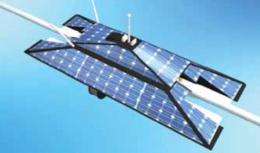
Scientists at the Electric Power Research Institute (EPRI) in the US are developing the , which looks a little like a solar car, is around two meters long and weighs about 65 kilograms. It is designed to clamp onto the shield wire, which is above the main transmission line and protects it from lightning strikes. The robot will “crawl” along the wire on rollers at about five kilometers per hour, powered by energy harvested from the shield wire and with and batteries as backup. The robot can cross obstacles such as cable spacers and suspension clamps and can maneuver around pylons (towers) using cables built in (or retrofitted).

The robot is equipped with sensors and a high-definition camera to detect obstacles such as overgrown trees, and it can analyze the images and compare them with previous images to see if anything has changed. It will also be able to use images taken at two locations and use parallax measurements to calculate clearances between conductors, trees and other objects. Overgrown trees are the major cause of electrical outages, so detecting them early is important to the utility companies and power consumers.

The robot will also contain sensors to detect electromagnetic noise that could indicate problems, and it will check for faulty connections. It could also retrieve data from sensors in the field that is normally retrieved by ground or helicopter visits. In remote regions data collected will be relayed to the utility via satellite link. Images will be transmitted when the robot returns to locations with cell phone coverage.

According to EPRI representative Andrew Phillips, the savings should more than offset the expected price tag of under $500,000 for each robot.

The first prototype of the robot will be tested later this month, and commercial field testing is expected to start in 2014 along the 440 km Potomac-Appalachian Transmission Highline in Ohio. Similar robotic power line inspectors are also being developed by Canada’s Hydro-Québec Research Institute and the Kansai Electric Power Co. in Japan.

More information: EPRI Journal - Spring 2010 (pdf)

© 2010 PhysOrg.com

4.8 /5 (13 votes)  

Filter


Move the slider to adjust rank threshold, so that you can hide some of the comments.


Display comments: newest first

antialias
Jun 10, 2010

Rank: 5 / 5 (1)
Good idea...BUT if the robot travels around cable pylons on retrofitted cables expressly for that purpose he'll be missing the one spot where 99% of all problems with cables occur: at the point where they are attached to the pylons.
GSwift7
Jun 10, 2010

Rank: not rated yet
Railroads already use systems like this and it's been found that there is no substitute for human judgement and perception. You'll still have people doing inspections, so any problems the robot isn't good at finding can still be found the old fashioned way.

The biggest problems with systems like this is that they tend to wear out too fast. The upkeep of the robots themselves is always hard to justify. When one of these thigs gets stuck in some remote area you'll have to send people to retrieve it and find a way to get a 143 lb robot down from the line without getting zapped.
gwrede
Jun 10, 2010

Rank: 5 / 5 (2)
The real savings, of course come from the long stretches of cable that don't have any problems. Having a human do those would be a waste, and boring.

Even if the robot is satisfied with only listing the places with anything dubious, humans could then just go trough them, with their judgement, experience and skills.

But I'm wondering about the price tag. I can't possibly imagine the price being more than $50k a piece. And even that is stretching it. The only way they could cost half a million a piece is if a lavish cost of development is spread between fewer than half a dozen such units. But even then, somebody is getting awful rich awful quick.
magpies
Jun 10, 2010

Rank: 5 / 5 (1)
Look we got lots of unemployment why not train some of these people who are unemployed to do this? It can't be that expensive?
Roj
Jun 10, 2010

Rank: not rated yet
expected price tag of under $500,000 for each

Free toys for rural folks with shotguns.

In rural areas where road signs are fare game, these high-wire clay pigeons would be target-practice magnets.

Doubt the sensors could triangulate the buck shot that knocked them off their perch, causing more damage to the wires than before.

Perhaps less costly & more efficient is tasking a Government surveillance satellite, fees refunded to taxpayers, for visual clearances between conductors, trees and other objects.
Quantum_Conundrum
Jun 10, 2010

Rank: 5 / 5 (1)
magpies:

Actually, I've done tax returns for these jobs before, and it IS that expensive. This is one of the highest paying jobs in the WORLD at around $90,000 to $110,000 per year, DOE and overtime...and not counting benefits.

You have to figure hazard pay and probably an extra-high insurance price for worker compensation, which last I checked was 13% even for "safe" employment, so for stuff like this there's no telling what it costs the employer.
Rank 4.8 /5 (13 votes)
Related Stories
Relevant PhysicsForums posts
  • Calling function with no input argument
    created9 hours ago
  • Force free body diagram problem on gym equipment
    created10 hours ago
  • Empirical data regarding shower heads and water
    created18 hours ago
  • feed hold button on CNC lathe
    createdFeb 09, 2012
  • RFAC in Fortran
    createdFeb 09, 2012
  • dynamics 2/32
    createdFeb 08, 2012
  • More from Physics Forums - General Engineering

More news stories

Japan scientist makes 'Avatar' robot

A Japanese-developed robot that mimics the movements of its human controller is bringing the Hollywood blockbuster "Avatar" one step closer to reality.

Electronics / Robotics

created 14 hours ago | popularity 5 / 5 (5) | comments 5

Intel packs performance and reliability into its latest SSD 520 series

Intel Corporation announced today its fastest, most robust client/consumer solid-state drive (SSD) to date, the Intel Solid-State Drive 520 Series (Intel SSD 520), a 6 gigabit-per-second (gbps) SATA III SSD ...

Electronics / Hardware

created Feb 07, 2012 | popularity 5 / 5 (1) | comments 4

Google rumored to have built Heads-Up-Display glasses prototype

(PhysOrg.com) -- 9to5Google is reporting that they have received a tip from someone they believe to be a reliable source saying that Google is working on a Heads-Up-Display (HUD) pair of eye-glasses. The per ...

Electronics / Consumer & Gadgets

created Feb 08, 2012 | popularity 4.3 / 5 (8) | comments 2 | with audio podcast weblog

Apple to debut 'iPad 3' in March: report

Apple will unveil a new version of its market-ruling iPad table computer in March, according to a report in Dow Jones-owned technology blog All Things D.

Electronics / Consumer & Gadgets

created Feb 09, 2012 | popularity 1.9 / 5 (21) | comments 0

New Kindle Touch is an impressive e-reader

When it comes to reading digital books, tablets are all the rage. But there's a lot to like about simple e-readers, which over the past year have become both a lot cheaper and a lot less clunky.

Electronics / Consumer & Gadgets

created Feb 09, 2012 | popularity 5 / 5 (3) | comments 1


Google users warned of threat to smartphone wallets

Users of Google smartphone wallets were being warned on Friday that there is a way to crack pass codes intended to thwart thieves from going on illicit shopping sprees.

Anonymous knocks CIA website offline (Update)

The website of the Central Intelligence Agency was inaccessible on Friday after the hacker group Anonymous claimed to have knocked it offline.

Complex wiring of the nervous system may rely on a just a handful of genes and proteins

Researchers at the Salk Institute have discovered a startling feature of early brain development that helps to explain how complex neuron wiring patterns are programmed using just a handful of critical genes. ...

Putting the squeeze on planets outside our solar system

(PhysOrg.com) -- Using high-powered lasers, scientists at Lawrence Livermore National Laboratory and collaborators discovered that molten magnesium silicate undergoes a phase change in the liquid state, abruptly ...

NASA sees wide-eyed cyclone Jasmine

Cyclone Jasmine's eye has opened wider on NASA satellite imagery, as it moves through the Southern Pacific Ocean.

New error-correcting codes guarantee the fastest possible rate of data transmission

Error-correcting codes are one of the triumphs of the digital age. They’re a way of encoding information so that it can be transmitted across a communication channel — such as an optical fiber o ...