Scientists Strive to Replace Silicon with Graphene on Nanocircuitry
June 10, 2010
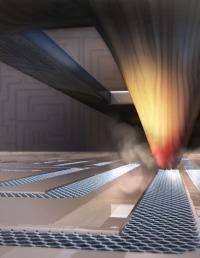
In a technique known as thermochemical nanolithography, the tip of an atomic force microscope uses heat to turn graphene oxide into reduced graphene oxide, a substance that can be used to produce nanocircuits and nanowires with controllable conductivity. Image Credit: University of Illinois at Urbana-Champaign
(PhysOrg.com) -- Scientists have made a breakthrough toward creating nanocircuitry on graphene, widely regarded as the most promising candidate to replace silicon as the building block of transistors. They have devised a simple and quick one-step process for creating nanowires, tuning the electronic properties of reduced graphene oxide and thereby allowing it to switch from being an insulating material to a conducting material.
The technique works with multiple forms of graphene and is poised to become an important finding for the development of graphene electronics. The research appears in the June 11, 2010, issue of the journal Science.
Scientists who work with nanocircuits are enthusiastic about graphene because electrons meet with less resistance when they travel along graphene compared to silicon and because today's silicon transistors are nearly as small as allowed by the laws of physics. Graphene also has the edge due to its thickness - it's a carbon sheet that is a single atom thick. While graphene nanoelectronics could be faster and consume less power than silicon, no one knew how to produce graphene nanostructures on such a reproducible or scalable method. That is until now.
"We've shown that by locally heating insulating graphene oxide, both the flakes and epitaxial varieties, with an atomic force microscope tip, we can write nanowires with dimensions down to 12 nanometers. And we can tune their electronic properties to be up to four orders of magnitude more conductive. We've seen no sign of tip wear or sample tearing," said Elisa Riedo, associate professor in the School of Physics at the Georgia Institute of Technology.
On the macroscale, the conductivity of graphene oxide can be changed from an insulating material to a more conductive graphene-like material using large furnaces. Now, the research team used TCNL to increase the temperature of reduced graphene oxide at the nanoscale, so they can draw graphene-like nanocircuits. They found that when it reached 130 degrees Celsius, the reduced graphene oxide began to become more conductive.
"So the beauty of this is that we've devised a simple, robust and reproducible technique that enables us to change an insulating sample into a conducting nanowire. These properties are the hallmark of a productive technology," said Paul Sheehan, head of the Surface Nanoscience and Sensor Technology Section at the Naval Research Laboratory in Washington, D.C.
The research team tested two types of graphene oxide - one made from silicon carbide, the other with graphite powder.
"I think there are three things about this study that make it stand out," said William P. King, associate professor in the Mechanical Science and Engineering department at the University of Illinois at Urbana-Champaign. "First, is that the entire process happens in one step. You go from insulating graphene oxide to a functional electronic material by simply applying a nano-heater. Second, we think that any type of graphene will behave this way. Third, the writing is an extremely fast technique. These nanostructures can be synthesized at such a high rate that the approach could be very useful for engineers who want to make nanocircuits."
"This project is an excellent example of the new technologies that epitaxial graphene electronics enables," said Walt de Heer, Regent's Professor in Georgia Tech's School of Physics and the original proponent of epitaxial graphene in electronics. His study led to the establishment of the Materials Research Science and Engineering Center two years ago. "The simple conversion from graphene oxide to graphene is an important and fast method to produce conducting wires. This method can be used not only for flexible electronics, but it is possible, sometime in the future, that the bio-compatible graphene wires can be used to measure electrical signals from single biological cells."
Provided by Georgia Institute of Technology
-
A huge step toward mass production of graphene
Mar 10, 2010 |
not rated yet |
0
-
Light-speed nanotech: Controlling the nature of graphene
Jan 21, 2009 |
not rated yet |
0
-
A 'huge step' toward mass production of graphene
Jun 09, 2010 |
not rated yet |
0
-
Scientists discover ground-breaking material: Graphane
Jan 30, 2009 |
not rated yet |
0
-
From graphene to graphane, now the possibilities are endless
Jul 31, 2009 |
not rated yet |
0
-
Engineers build first sub-10-nm carbon nanotube transistor
Feb 01, 2012 |
4.9 / 5 (31) |
30
-
Something old, something new: Evolution and the structural divergence of duplicate genes
Jan 31, 2012 |
4.6 / 5 (7) |
1
-
The hidden nanoworld of ice crystals: Revealing the dynamic behavior of quasi-liquid layers
Jan 30, 2012 |
5 / 5 (3) |
1
-
Stock market network reveals investor clustering
Jan 27, 2012 |
3.9 / 5 (23) |
8
-
Of microchemistry and molecules: Electronic microfluidic device synthesizes biocompatible probes
Jan 26, 2012 |
5 / 5 (1) |
0
-
polymer nanocomposites
20 hours ago
-
Corrosion Tests on Magnesium
Feb 09, 2012
-
polyethylene copper nanocomposite
Feb 09, 2012
-
Output of xrd analysis
Feb 08, 2012
-
Transport phenomena problem based on problems 18.B11 and 19B.6 from Bird, stewart, lw
Feb 06, 2012
-
Help with material selection - Car Piston
Feb 05, 2012
- More from Physics Forums - Materials & Chemical Engineering
More news stories
What lies beneath: Mapping hidden nanostructures
The ability to diagnose and predict the properties of materials is vital, particularly in the expanding field of nanotechnology. Electron and atom-probe microscopy can categorize atoms in thin sheets of material, ...
13 hours ago |
5 / 5 (1) |
1
New kind of solar cell could capture significantly more energy than current cells
New solar cells could increase the maximum efficiency of solar panels by over 25%, according to scientists from the University of Cambridge.
Feb 08, 2012 |
4.5 / 5 (12) |
14
|
Nanoshell whispering galleries improve thin solar panels
Visitors to Statuary Hall in the U.S. Capitol Building may have experienced a curious acoustic feature that allows a person to whisper softly at one side of the cavernous, half-domed room and for another on ...
Nanotechnology / Nanomaterials
Feb 07, 2012 |
4.3 / 5 (6) |
6
|
'Dark plasmons' transmit energy
Microscopic channels of gold nanoparticles have the ability to transmit electromagnetic energy that starts as light and propagates via "dark plasmons," according to researchers at Rice University.
Feb 09, 2012 |
5 / 5 (6) |
1
|
Revealing how a battery material works
Since its discovery 15 years ago, lithium iron phosphate (LiFePO4) has become one of the most promising materials for rechargeable batteries because of its stability, durability, safety and ability to deliver ...
Nanotechnology / Nanomaterials
Feb 08, 2012 |
5 / 5 (5) |
0
|
Google users warned of threat to smartphone wallets
Users of Google smartphone wallets were being warned on Friday that there is a way to crack pass codes intended to thwart thieves from going on illicit shopping sprees.
Anonymous knocks CIA website offline (Update)
The website of the Central Intelligence Agency was inaccessible on Friday after the hacker group Anonymous claimed to have knocked it offline.
New error-correcting codes guarantee the fastest possible rate of data transmission
Error-correcting codes are one of the triumphs of the digital age. Theyre a way of encoding information so that it can be transmitted across a communication channel such as an optical fiber o ...
Complex wiring of the nervous system may rely on a just a handful of genes and proteins
Researchers at the Salk Institute have discovered a startling feature of early brain development that helps to explain how complex neuron wiring patterns are programmed using just a handful of critical genes. ...
Humans may have helped the decline of African rainforests 3000 years ago
(PhysOrg.com) -- Large areas of rainforests in Central Africa mysteriously disappeared over three thousand years ago, to be replaced by savannas. The prevailing theory has been that the cause was a change ...
The power of estrogen -- male snakes attract other males
A new study has shown that boosting the estrogen levels of male garter snakes causes them to secrete the same pheromones that females use to attract suitors, and turned the males into just about the sexiest ...
Jun 10, 2010
Rank: not rated yet
Jun 10, 2010
Rank: not rated yet
Can you provide a link to something official that states that? The highest I've seen claimed was around 100ghz transistor with about a 10ghz core speed for a processor.
If what you have said is true, we'd be looking at computers in the very near future which are as big an improvement over modern top of the line 6-core processors as those are vs counting on your fingers...
One zeta-flops would make a single processor exponentially more powerful than the most advanced supercomputer in the world today.
Jun 10, 2010
Rank: 5 / 5 (1)
Maybe they could combine lithography with this substrate? E.g. deposit a layer of something that preferentially reflects a frequency of light that's efficiently absorbed by graphene oxide. Etch out a circuit on that layer. Then shine bright light of the right frequency, and you end up heating only the exposed parts of graphene oxide...
Or, instead of heat come up with a chemical method to transform graphene oxide to graphene, and use still more conventional lithographic etching techniques...
Jun 10, 2010
Rank: not rated yet
The reason why silicon isn't as advantageous as carbon is that due to the chemical properties of carbon it will withstand a far greater(about a thousand fold) electrical current before you reach terminal resistance. It's lengthy math and physorg doesn't handle simple arithmatic symbols. If you want to PM me your email address I can walk you through it.
Jun 10, 2010
Rank: not rated yet
Jun 10, 2010
Rank: not rated yet
T.C.N.L
T..C..N..L
T ... C ... N ... L
Ok joke over, Thermochemical Nanolithography.
Jun 10, 2010
Rank: not rated yet
Jun 10, 2010
Rank: not rated yet
brain augmentation, prosthetics, artificial ears, eyes, organs, you name it.
Graphene also makes the "self replicating robot" concept much more "eco-friendly" and low energy than a metal and silica based robot. (thinking Mars here.)
Jun 10, 2010
Rank: 5 / 5 (1)
Jun 11, 2010
Rank: not rated yet
Tonight Can Not Last:)
Jun 11, 2010
Rank: not rated yet
What would that make the average core speed?
Jun 11, 2010
Rank: not rated yet
It would depend on the geometry of the processor and transistor total count.
Still writing it out QC.
Jun 11, 2010
Rank: not rated yet
http://viterbi.us...team.htm
Jun 11, 2010
Rank: not rated yet
What I mean is... thu various methods chip manufacturers have been able to etch with smaller and smaller methods ... in turn allowing for a greater number of components to be contained within the same patch of silicon.
With this new tech once perfected, do we have anywhere to go in terms of size? I imagine we aren't going to see the same level of 'writing smaller' as we saw with yesterdays methods of etching chips. However I also imagine this would be a great leap (shrink) when compared with traditional 65nm processes.
Jun 11, 2010
Rank: 5 / 5 (1)
Modern processes (as represented by Intel) are already at 32 nm, and headed toward 22 nm starting next year.
Ultimately, you can't go less than 1 atom per circuit element, but long before that you hit the wall of quantum noise. Somewhere in that regime, we switch from bulk material to molecular computing. In terms of molecular computing, then, carbon-based molecules sound as flexible and promising, as they are for life in general :-)
Once you're down to molecule-sized circuit elements, the only way to keep increasing complexity is to start layering your circuits (or in other words, constructing them in 3D rather than 2D.) Of course, with that approach the problem of heat management becomes vastly more difficult. Carbon materials like graphene, nanotubes, and diamond just happen to have both excellent electronic, and excellent heat conducting properties (so the circuit can become its own heat pipe...)
Jun 11, 2010
Rank: 5 / 5 (1)
--=
Regarding Intel, from what I've seen, their latest processors actually have far more "cores" than the main "six" that it is advertized as. They are almost like an entire motherboard integrated onto one chip. They now have video pre-processors, and L2 and L3 caches which exceed the entire RAM and video card of a win95 era PC...all smashed into a single chip, while what we now call "video cards" are up to 480 processor cores at ~350mhz each (~480 pentium 2 machines on one chip), and 1gig of RAM.
Jun 11, 2010
Rank: not rated yet
Jun 11, 2010
Rank: not rated yet
(requires motherboard manufacturers to standardize the distance between PCI express ports.)
Since the video cards often "kill" an extra port due to the size of the cooling unit, wouldn't it make sense for the manufacturer to just go ahead and design a "3d" card which plugs into and uses both PCI Express ports to begin with?
Not sure what they are doing right now anyway, I haven't bought a new video card in several years...