The Chance for Life on Io
June 10, 2010 by Charles Q. Choi
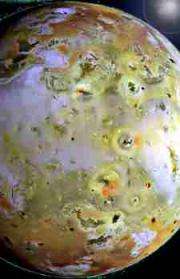
High resolution close-up of Io's volcanic surface. Credit: NASA/Galileo
Jupiter’s moon Io is the most volcanically active body in the solar system. Could it also be a habitat for life?
When it comes to where extraterrestrial life might dwell in our own solar system, Jupiter's moon Europa often grabs the spotlight. However, its extraordinarily volcanic sibling Io might be a possible habitat as well.
A bit larger than Earth's moon, Io is the innermost of Jupiter's large satellites and the most volcanically active body in the solar system, with plumes of matter rising up to 186 miles (300 km) above the surface. This extreme activity is the result of Jupiter's powerful gravitational pull, which causes Io's tormented solid crust to bulge up and down 328 feet (100 meters) or more, generating intense heat in Io due to friction. Although the heat near the volcanoes can reach some 3000 degrees F (1649 degrees C), high enough to keep lava liquid, Io's surface temperature averages at about negative 202 degrees F (-130 degrees C), leading to sulfur dioxide snowfields. This means Io is a land of both fire and ice.
Io is generally considered a poor candidate for life because of all the radiation Jupiter blasts it with. In addition, no organic molecules have been detected on its surface, and it has only an extremely thin atmosphere devoid of detectable water vapor.
"Everyone right away tends to categorically exclude the possibility of life on Io," said astrobiologist Dirk Schulze-Makuch at Washington State University.
Still, conditions on Io might have made it a friendlier habitat in the distant past. If life did ever develop on Io, there is a chance it might have survived to the present day, Schulze-Makuch suggested.
"Life on the surface is all but impossible, but if you go down further into the rocks, it could be intriguing," he said. "We shouldn't categorize it as dead right away just because it's so extreme."
Computer models suggest Io formed in a region around Jupiter where water ice was plentiful. Io's heat, combined with the resulting possibility of liquid water, could have made life plausible.
“There must have been quite a lot of water on Io shortly after formation, judging from the amount of water ice on Europa and Ganymede,” said Schulze-Makuch.
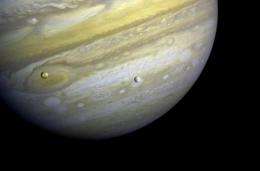
Voyager 1 took photos of Jupiter and two of its satellites (Io, left, and Europa) on Feb. 13, 1979. This photo was assembled from three black and white negatives by the Image Processing Lab at the Jet Propulsion Laboratory. Credit: NASA/JPL
Jupiter's radiation would have stripped this water from Io's surface, perhaps within 10 million years. At this point life could have retreated underground, where water might still be abundant, and geothermal activity and sulfur compounds could provide microbes with sufficient energy to survive.Although no organic molecules have been detected on the moon’s surface, that does not mean they do not exist underground, Schulze-Makuch said. Any organic compounds that once existed on the surface or that may today still emanate from the subsurface -- which probably were naturally present in this region of space during Io's formation -- would get quickly destroyed by Jupiter's radiation.
The many lava tubes thought to exist on Io could serve as an especially favorable environment for life, Schulze-Makuch suggested, by protecting organisms from radiation. The lava tubes also could provide thermal insulation, trapping moisture and providing nutrients such as sulfurous compounds. Microbes are common in lava tubes on Earth, from ice and volcano zones in Iceland to hot sand-floored tubes in Saudi Arabia, and lava tubes are the most plausible cave environment for life on Mars, he added.
The primordial soup that any life on Io might have originated from was likely based on water, but the solvent of choice for organisms there might have drastically changed later on as the moon transformed. Hydrogen sulfide is one choice, as it is reasonably abundant in Io's shallow subsurface and remains liquid from negative 123 to negative 76 degrees F (-86 to -60 degrees C), falling within the environmental conditions that would prevail there. While it is not especially efficient as a solvent for ions, it does dissolve many substances, including many organic compounds. Other possibilities include sulfur dioxide and sulfuric acid.
"I'm exploring with colleagues whether sulfur compounds could work as solvents of life," Schulze-Makuch noted.
Given the wild extremes Io can swing through as it orbits Jupiter, one possible survival strategy for life in this challenging environment would be to remain dormant most of the time, only reverting back when nutrients were rich. "It'd be much easier for life to take a beating if it goes dormant regularly," Schulze-Makuch said.
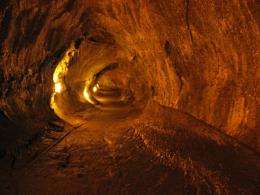
Thurston Lava Tube, Hawai'i Volcanoes National Park, Big Island of Hawai'i, USA. If lava tubes exist on Jupter’s moon Io, they could serve as a protective environment for life. Credit: Michael Oswald
Although Europa and Ganymede are higher priority targets for future exploration missions, Io should not be neglected, said Schulze-Makuch. "Much insight could be gained by sending a radiation-resistant robotic probe capable of detecting the chemistry and physical state of subsurface and surface liquids on Io," he noted, perhaps as part of a larger mission to the Jovian system."I know the chances of life on Io are low, and even if there is some microbial life in lava tube caves in its crust, in the short term there's no way for us to get there," he added. "But let's not totally exclude Io only because it seems strange or foreign."
If a mission to Io is extraordinarily lucky enough to find life in such an unlikely environment, "then it would make life elsewhere in the galaxy seem much more likely," Schulze-Makuch said. "It would really broaden our horizons."
Schulze-Makuch detailed his ideas in the February-March issue of the Journal of Cosmology.
Source: Astrobio.net
-
Microbes found in natural asphalt lake
Apr 21, 2010 |
not rated yet |
0
-
Rosetta, New Horizons team up
Mar 02, 2007 |
not rated yet |
0
-
First Earth-like planet spotted outside solar system likely a volcanic wasteland
Jan 06, 2010 |
not rated yet |
0
-
Researchers Produce Images of Gases Escaping from Jupiter's Moon Io
Jul 19, 2007 |
not rated yet |
0
-
Ganymede makes big impression on Jupiter's auroral lightshows (w/ Video)
Sep 18, 2009 |
not rated yet |
0
-
Engineers build first sub-10-nm carbon nanotube transistor
Feb 01, 2012 |
4.9 / 5 (31) |
30
-
Something old, something new: Evolution and the structural divergence of duplicate genes
Jan 31, 2012 |
4.6 / 5 (7) |
1
-
The hidden nanoworld of ice crystals: Revealing the dynamic behavior of quasi-liquid layers
Jan 30, 2012 |
5 / 5 (3) |
1
-
Stock market network reveals investor clustering
Jan 27, 2012 |
3.9 / 5 (23) |
8
-
Of microchemistry and molecules: Electronic microfluidic device synthesizes biocompatible probes
Jan 26, 2012 |
5 / 5 (1) |
0
-
Scale of the Universe
13 hours ago
-
Titan's lack of impact craters
Feb 09, 2012
-
Real pictures of black hole eating a star?
Feb 08, 2012
-
Hypothetical way to travel faster than light, but not technically exceed lightspeed
Feb 06, 2012
-
How do scientists monitor the Sun's activity?
Feb 05, 2012
-
Search patterns in observational studies
Feb 05, 2012
- More from Physics Forums - General Astronomy
More news stories
Humans may have helped the decline of African rainforests 3000 years ago
(PhysOrg.com) -- Large areas of rainforests in Central Africa mysteriously disappeared over three thousand years ago, to be replaced by savannas. The prevailing theory has been that the cause was a change ...
Could Venus be shifting gear?
(PhysOrg.com) -- ESAs Venus Express spacecraft has discovered that our cloud-covered neighbour spins a little slower than previously measured. Peering through the dense atmosphere in the infrared, the ...
Space & Earth / Space Exploration
20 hours ago |
5 / 5 (7) |
8
|
NASA budget will axe Mars deal with Europe: scientists
US President Barack Obama's budget proposal to be submitted next week for 2013 will cut NASA's budget by 20 percent and eliminate a major partnership with Europe on Mars exploration, scientists said Thursday.
Space & Earth / Space Exploration
23 hours ago |
5 / 5 (2) |
20
Mars Science Laboratory computer issue resolved
(PhysOrg.com) -- Engineers have found the root cause of a computer reset that occurred two months ago on NASA's Mars Science Laboratory and have determined how to correct it.
Space & Earth / Space Exploration
21 hours ago |
4.7 / 5 (6) |
4
|
Two new moons for Jupiter
Advances in technology have lead to the discovery of new planets outside of our Solar System, and now even new moons in our own backyard.
Space & Earth / Space Exploration
20 hours ago |
4 / 5 (1) |
7
Anonymous knocks CIA website offline (Update)
The website of the Central Intelligence Agency was inaccessible on Friday after the hacker group Anonymous claimed to have knocked it offline.
New error-correcting codes guarantee the fastest possible rate of data transmission
Error-correcting codes are one of the triumphs of the digital age. Theyre a way of encoding information so that it can be transmitted across a communication channel such as an optical fiber o ...
Small modular reactor design could be a 'SUPERSTAR'
(PhysOrg.com) -- Though most of today's nuclear reactors are cooled by water, we've long known that there are alternatives; in fact, the world's first nuclear-powered electricity in 1951 came from a reactor ...
New power source discovered
(PhysOrg.com) -- Researchers at the Massachusetts Institute of Technology (MIT) and RMIT University have made a breakthrough in energy storage and power generation.
The power of estrogen -- male snakes attract other males
A new study has shown that boosting the estrogen levels of male garter snakes causes them to secrete the same pheromones that females use to attract suitors, and turned the males into just about the sexiest ...
Google users warned of threat to smartphone wallets
Users of Google smartphone wallets were being warned on Friday that there is a way to crack pass codes intended to thwart thieves from going on illicit shopping sprees.


Jun 10, 2010
Rank: not rated yet
If the volcanism is blasting molten rock hundreds of miles into space, where it presumably falls back down eventually, it seems absurd to assume sub-surface water exists in any form other than steam.
Jun 10, 2010
Rank: not rated yet
Jun 10, 2010
Rank: not rated yet
The moon to the left looks yellow brown to me while the one on the right is smokey white. Check your monitor. Brightness might be too high.
Jun 11, 2010
Rank: 1 / 5 (8)
This should be recognized for what it is: sheer speculation. Current conditions dictate that there is small chance for life even if it was there in the beginning - which is itself highly debatable. This is why most reasonable people dismiss that possiblity out of hand.
Just finding water on a planet does not imply life would be found.
Where would that life come from? We know now just how complex even the simplest cell is, so the spontaneous formation of life is virtually a guaranteed non-event. In fact finding water will be a detriment - surprising as that might sound - water by itself works against long chain organic compounds forming because of the simple chemistry of concentrations.
Life as we know it was created by the creator. Period.
Jun 11, 2010
Rank: 5 / 5 (3)
Reasonable people don't dismiss something until all the evidence is presented. Judging pre-evidence is prejudging.
We've gone through this before. When you state something that is demonstrably false, you're lying. We know that lipids form stable vesicles in aqueous solution and are permeable to monomers all of which are formed through natural processes. We know that under different thermodynamic coonditions (TBC)...
Jun 11, 2010
Rank: 5 / 5 (6)
Sorry, no creator needed. Thermodynamics, basic chemistry, and a reasonable difference in undersea currents, as well as the presence of water, makes the spontaneous assembly of self replicating biology quite easily explainable.
Direct interaction Creationism (young earth or old earth) is thoroughly disproved, empirically and sensically. You have to bury your head in the sand to think otherwise. This doesn't speak to whether there is a God or not, but it certainly shows us that we're not special, nor would any sort of God be a personal one
Jun 11, 2010
Rank: 5 / 5 (5)
Assuming that Io is tidally-locked to Jupiter, then the expansion/contraction of its surface (as it orbits the planet) should always occur in precisely the same locations. Thus - in an analogy to standing waves in a microwave oven - there should be some regions of the moon that stay extremely hot, some should remain extremely cold, but some should always be in a comfortable Goldilocks-zone where solvents like liquid H2O could persist...
Might be a case for life on Io after all.
Jun 11, 2010
Rank: 1.5 / 5 (2)
I actually hope that there is life out there... but thats another story.
Jun 11, 2010
Rank: 5 / 5 (3)
Jun 11, 2010
Rank: 5 / 5 (2)
Jun 11, 2010
Rank: 5 / 5 (3)
(It sure sounds like it when all those biblical folks carry on conversations with the creator).
And if it takes a living intelligent creator to create life, then who created your creator?
If you really have an open mind and want to know how the world works, this forum is a good place.
But if you 'know' that biology, geology astronomy, physics, etc. are all very wrong and the earth is really young, then please don't bother people here.
After all, we don't go onto religious forums and bother people by discussing radio-isotope dating, etc.
Jun 13, 2010
Rank: not rated yet
This article is simply stating that from minerals in the soil, organisms could have been formed, the volcanoes and atmosphere could have breathed the "breath of life" into them.
Why must science and faith always be at odds with one another? TBC
Jun 13, 2010
Rank: not rated yet
Scientist still can't prove how the universe was created, niether can christians. Scientists have theories (beliefs) and christians have beliefs (theories).
To my fellow christians: had it not been for scientists, we would be holding services in damp caves by torch light rather than our lighted, air conditioned churches. We have enjoyed thousands of years as an only child, we should not throw tantrums at the possability of discovering that we have a baby brother.
Thank you for your patiencs during my rant.
Jun 13, 2010
Rank: 1 / 5 (1)
Jun 13, 2010
Rank: not rated yet
You show your ignorance brilliantly in that comment. Atheists don't believe in a god. Done, that's it, end of game. Anything else after that is the belief of an individual. An Atheist may believe in life outside of earth or they may not. It all depends on their scientific opinions on whether conditions necessary for life are present elsewhere in the universe. Even if that first part wasn't nonsense, what connection would making things up as you go have with life outside of earth? Your last line was intended only as an insult you unctuous, sniveling, christian. See, not very civil, is it?
Jun 13, 2010
Rank: 1 / 5 (1)
Jun 13, 2010
Rank: 5 / 5 (1)
Jun 14, 2010
Rank: 1 / 5 (2)
Jun 14, 2010
Rank: 1 / 5 (2)
Jun 14, 2010
Rank: 1 / 5 (2)
Jun 14, 2010
Rank: 1 / 5 (2)
Jun 14, 2010
Rank: not rated yet
I'm all for space exploration and I don't think this has anything to do about evolution.
Arguing the point that it is a waste of money MIGHT be a good point, as there might not be life, though I disagree.