New study indicates an ancient ocean may have covered one-third of Mars
June 13, 2010
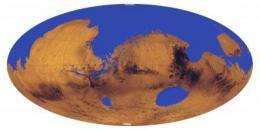
This is an illustration of what Mars might have looked like some 3.5 billion years ago when an ocean likely covered one-third of the planet's surface, according to a new University of Colorado at Boulder study. (Illustration by University of Colorado) Credit: University of Colorado
A vast ocean likely covered one-third of the surface of Mars some 3.5 billion years ago, according to a new study conducted by University of Colorado at Boulder scientists.
The CU-Boulder study is the first to combine the analysis of water-related features including scores of delta deposits and thousands of river valleys to test for the occurrence of an ocean sustained by a global hydrosphere on early Mars. While the notion of a large, ancient ocean on Mars has been repeatedly proposed and challenged over the past two decades, the new study provides further support for the idea of a sustained sea on the Red Planet during the Noachian era more than 3 billion years ago, said CU-Boulder researcher Gaetano Di Achille, lead author on the study.
A paper on the subject authored by Di Achille and CU-Boulder Assistant Professor Brian Hynek of the geological sciences department appears in the June 13 issue of Nature Geoscience. Both Di Achille and Hynek are affiliated with CU-Boulder's Laboratory for Atmospheric and Space Physics.
More than half of the 52 river delta deposits identified by the CU researchers in the new study -- each of which was fed by numerous river valleys -- likely marked the boundaries of the proposed ocean, since all were at about the same elevation. Twenty-nine of the 52 deltas were connected either to the ancient Mars ocean or to the groundwater table of the ocean and to several large, adjacent lakes, Di Achille said.
The study is the first to integrate multiple data sets of deltas, valley networks and topography from a cadre of NASA and European Space Agency orbiting missions of Mars dating back to 2001, said Hynek. The study implies that ancient Mars probably had an Earth-like global hydrological cycle, including precipitation, runoff, cloud formation, and ice and groundwater accumulation, Hynek said.
Di Achille and Hynek used a geographic information system, or GIS, to map the Martian terrain and conclude the ocean likely would have covered about 36 percent of the planet and contained about 30 million cubic miles, or 124 million cubic kilometers, of water. The amount of water in the ancient ocean would have formed the equivalent of an 1,800-foot, or 550-meter deep layer of water spread out over the entire planet.
The volume of the ancient Mars ocean would have been about 10 times less than current volume of Earth's oceans, Hynek said. Mars is slightly more than half the size of Earth.
The average elevation of the deltas on the edges of the proposed ocean was remarkably consistent around the whole planet, said Di Achille. In addition, the large, ancient lakes upslope from the ancient Mars ocean likely formed inside impact craters and would have been filled by the transport of groundwater between the lakes and the ancient sea, according to the researchers.
A second study headed by Hynek and involving CU-Boulder researcher Michael Beach of LASP and CU-Boulder doctoral student Monica Hoke being published in Journal of Geophysical Research - Planets -- which is a publication of the American Geophysical Union -- detected roughly 40,000 river valleys on Mars. That is about four times the number of river valleys that have previously been identified by scientists, said Hynek.
The river valleys were the source of the sediment that was carried downstream and dumped into the deltas adjacent to the proposed ocean, said Hynek. "The abundance of these river valleys required a significant amount of precipitation," he said. This effectively puts a nail in the coffin regarding the presence of past rainfall on Mars." Hynek said an ocean was likely required for the sustained precipitation.
"Collectively, these results support the existing theories regarding the extent and formation time of an ancient ocean on Mars and imply the surface conditions during the time probably allowed the occurrence of a global and active hydrosphere integrating valley networks, deltas and a vast ocean as major components of an Earth-like hydrologic cycle," Di Achille and Hynek wrote in Nature Geoscience.
"One of the main questions we would like to answer is where all of the water on Mars went," said Di Achille. He said future Mars missions -- including NASA's $485 million Mars Atmosphere and Volatile Evolution mission, or MAVEN, which is being led by CU-Boulder and is slated to launch in 2013 -- should help to answer such questions and provide new insights into the history of Martian water.
The river deltas on Mars are of high interest to planetary scientists because deltas on Earth rapidly bury organic carbon and other biomarkers of life and are a prime target for future exploration. Most astrobiologists believe any present indications of life on Mars will be discovered in the form of subterranean microorganisms.
"On Earth, deltas and lakes are excellent collectors and preservers of signs of past life," said Di Achille. "If life ever arose on Mars, deltas may be the key to unlocking Mars' biological past."
Hynek said long-lived oceans may have provided an environment for microbial life to take hold on Mars.
More information: Di Achille, G. & Hynak, B. M. Nature Geoscience, doi:10.1038/NGEO891 (2010).
-
Research team finds definitive evidence for ancient lake on Mars
Jun 18, 2009 |
not rated yet |
0
-
Mars may have had large sea near NASA rover landing site
Sep 08, 2004 |
not rated yet |
0
-
New computer-developed map shows more extensive valley network on Mars
Nov 23, 2009 |
not rated yet |
0
-
Mars breakthrough: Scientists uncover red planet's hot and steamy secrets
Jul 21, 2009 |
not rated yet |
0
-
Important role of groundwater springs in shaping Mars
Dec 11, 2008 |
not rated yet |
0
-
Engineers build first sub-10-nm carbon nanotube transistor
Feb 01, 2012 |
4.9 / 5 (31) |
30
-
Something old, something new: Evolution and the structural divergence of duplicate genes
Jan 31, 2012 |
4.6 / 5 (7) |
1
-
The hidden nanoworld of ice crystals: Revealing the dynamic behavior of quasi-liquid layers
Jan 30, 2012 |
5 / 5 (3) |
1
-
Stock market network reveals investor clustering
Jan 27, 2012 |
3.9 / 5 (23) |
8
-
Of microchemistry and molecules: Electronic microfluidic device synthesizes biocompatible probes
Jan 26, 2012 |
5 / 5 (1) |
0
-
Discrepancy between oxygen and carbon-dioxide levels
Feb 09, 2012
-
where gems are found in the world
Feb 09, 2012
-
Wind Waves in Reservoir ~ Wind run-up and Wind set-up
Feb 08, 2012
-
Balance of oxygen in the atmosphere
Feb 01, 2012
-
The case for a methanol-based economy
Jan 30, 2012
-
Weather in a rotating cylinder
Jan 25, 2012
- More from Physics Forums - Earth
More news stories
Humans may have helped the decline of African rainforests 3000 years ago
(PhysOrg.com) -- Large areas of rainforests in Central Africa mysteriously disappeared over three thousand years ago, to be replaced by savannas. The prevailing theory has been that the cause was a change ...
Could Venus be shifting gear?
(PhysOrg.com) -- ESAs Venus Express spacecraft has discovered that our cloud-covered neighbour spins a little slower than previously measured. Peering through the dense atmosphere in the infrared, the ...
Space & Earth / Space Exploration
13 hours ago |
5 / 5 (7) |
7
|
NASA budget will axe Mars deal with Europe: scientists
US President Barack Obama's budget proposal to be submitted next week for 2013 will cut NASA's budget by 20 percent and eliminate a major partnership with Europe on Mars exploration, scientists said Thursday.
Space & Earth / Space Exploration
16 hours ago |
5 / 5 (2) |
18
Mars Science Laboratory computer issue resolved
(PhysOrg.com) -- Engineers have found the root cause of a computer reset that occurred two months ago on NASA's Mars Science Laboratory and have determined how to correct it.
Space & Earth / Space Exploration
14 hours ago |
4.7 / 5 (6) |
3
|
NASA sees wide-eyed cyclone Jasmine
Cyclone Jasmine's eye has opened wider on NASA satellite imagery, as it moves through the Southern Pacific Ocean.
Space & Earth / Earth Sciences
5 hours ago |
3.5 / 5 (2) |
1
Google users warned of threat to smartphone wallets
Users of Google smartphone wallets were being warned on Friday that there is a way to crack pass codes intended to thwart thieves from going on illicit shopping sprees.
Anonymous knocks CIA website offline (Update)
The website of the Central Intelligence Agency was inaccessible on Friday after the hacker group Anonymous claimed to have knocked it offline.
New error-correcting codes guarantee the fastest possible rate of data transmission
Error-correcting codes are one of the triumphs of the digital age. Theyre a way of encoding information so that it can be transmitted across a communication channel such as an optical fiber o ...
Complex wiring of the nervous system may rely on a just a handful of genes and proteins
Researchers at the Salk Institute have discovered a startling feature of early brain development that helps to explain how complex neuron wiring patterns are programmed using just a handful of critical genes. ...
The power of estrogen -- male snakes attract other males
A new study has shown that boosting the estrogen levels of male garter snakes causes them to secrete the same pheromones that females use to attract suitors, and turned the males into just about the sexiest ...
New power source discovered
(PhysOrg.com) -- Researchers at the Massachusetts Institute of Technology (MIT) and RMIT University have made a breakthrough in energy storage and power generation.
Jun 13, 2010
Rank: 5 / 5 (2)
Where? C'mon, that is obvious to the most casual observer. It went with most of the atmosphere - into space. With a m.w. of only 18 vs. N2 at 28, O2 (How'd that get made??? Photosy....oops, taboo subject!!) at 32, and CO2 at 44, water diffusion into space would have been/is significant.
At the present estimated rate of atmosphere loss, 3.5b yrs ago Mars had an atmospheric pressure many, many, many times the atmospheric press. on Earth today (& Earth's would have been much higher than that, back then).
MAVEN should more clearly define what that pressure range may have been, if we get A Straight Answer from the mission controllers.
Great work by Di Achille et al.
Jun 14, 2010
Rank: 5 / 5 (2)
Jun 14, 2010
Rank: not rated yet
What if fossil record(I was thinking about skeleton of huge ocean dwelling animal) of ancient ocean creature is deep buried in the valley ?
Jun 14, 2010
Rank: 1 / 5 (1)