Scientists track electrons in molecules
June 13, 2010
Scientists peek inside molecules

Enlarge

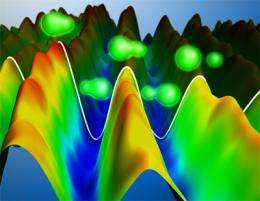
Electron dynamics in molecular hydrogen following photoionisation by an attosecond laser pulse. The remaining electron in the molecule (depicted in green) is measured experimentally and shown as a mountain landscape. Hills and valleys correspond to a higher probability of finding the electron on the left and right side of the molecule respectively. © Christian Hackenberger

(PhysOrg.com) -- Physicists in Europe have successfully glimpsed the motion of electrons in molecules. The results are a major boon for the research world. Knowing how electrons move within molecules will facilitate observations and fuel our understanding of chemical reactions.

Presented in the journal Nature, the study is supported via three EU-funded projects.

The physicists, led by Professor Marc Vrakking, Director of the Max Born Institute for Nonlinear Optics and Short Pulse Spectroscopy in Germany, used attosecond laser pulses to clinch this latest technical feat. Scientists were unable to observe this motion in the past because of the extreme speediness of electrons.

An attosecond is a billionth of a billionth of a second. Light covers a distance of less than 1 millionth of a millimetre during an attosecond. This is basically equal to the distance from one end of a small molecule to the other. By creating attosecond , the scientists could snap 'pictures' of electrons' movements within molecules.

For the purposes of this study, the physicists looked at the (H2) - with just two and two electrons, experts call H2 the 'simplest molecule'. The team used their attosecond laser to determine how ionisation occurs within a hydrogen molecule. During ionisation, one electron is removed from the molecule while the energy status of the other electron changes.

'In our experiment we were able to show for the first time that with the help of an attosecond laser we really have the ability to observe the movement of electrons in molecules,' Professor Vrakking explained. 'First we irradiated a hydrogen molecule with an attosecond laser pulse. This led to the removal of an electron from the molecule - the molecule was ionised. In addition, we split the molecule into two parts using an infrared , just like with a tiny pair of scissors,' he added. 'This allowed us to examine how the charge distributed itself between the two fragments - since one electron is missing, one fragment will be neutral and the other positively charged. We knew where the remaining electron could be found namely in the neutral part.'

For the last 30 years or so, scientists have been using femtosecond lasers to look at molecules and atoms. A femtosecond is one millionth of one billionth of a second, so it makes it 1,000 times slower than an attosecond. It is easy to track the movement of and atoms when femtosecond lasers are used.

Scientists helped drive this technology forward by developing attosecond lasers, which are benefitting diverse studies in natural sciences including the study outlined here.

Commenting on the calculations and the complexity of the problem, co-author Dr Matthias Kling of the Max-Planck Institut für Quantenoptik in Germany, said: 'We found out that also doubly excited states, i.e. with excitation of both of molecular hydrogen, can contribute to the observed dynamics.'

Professor Vrakking concluded: 'We have not - as we originally expected - solved the problem. On the contrary, we have merely opened a door. But in fact this makes the entire project much more important and interesting.'

More information: Sansone, G., et al. (2010) Electron localization following attosecond molecular photoionization. Nature, published online 10 June. DOI:10.1038/nature09084

Provided by Cordis

Filter


Move the slider to adjust rank threshold, so that you can hide some of the comments.


Display comments: newest first

nxtr
Jun 13, 2010

Rank: not rated yet
life is full of peaks and valleys. Apparently electron probability is no different :)
KronosDeret
Jun 14, 2010

Rank: not rated yet
i would almost say that life and existence is really just probability field full of vibrating energy...

crap that sounds so esoteric, but it seems to be true
Rdavid
Jun 14, 2010

Rank: not rated yet
"We knew where the remaining electron could be found namely in the neutral part.'"

Hardly sounds like probability.
baudrunner
Jun 14, 2010

Rank: not rated yet
If you had raised the subject of atto-second laser pulses to Heisenberg, he would have declared the feat, "impossible!"
Rank 5 /5 (18 votes)
Relevant PhysicsForums posts
  • Steam Table issues
    created1 hour ago
  • electrostatic induction in a conductor should be immpossible
    created5 hours ago
  • Help! Physics Momentum/Impulse problem!
    created8 hours ago
  • Gauss' law cubes, how to prove
    created9 hours ago
  • what is significance of torque
    created11 hours ago
  • Difference between volume displaced fluid and volume of the object
    created12 hours ago
  • More from Physics Forums - General Physics

More news stories

'Dark plasmons' transmit energy

Microscopic channels of gold nanoparticles have the ability to transmit electromagnetic energy that starts as light and propagates via "dark plasmons," according to researchers at Rice University.

Nanotechnology / Nanophysics

created 15 hours ago | popularity 5 / 5 (5) | comments 0 | with audio podcast

Nanotube therapy takes aim at breast cancer stem cells

Wake Forest Baptist Medical Center researchers have again proven that injecting multiwalled carbon nanotubes (MWCNTs) into tumors and heating them with a quick, 30-second laser treatment can kill them.

Nanotechnology / Bio & Medicine

created 20 hours ago | popularity 5 / 5 (1) | comments 0 | with audio podcast

New kind of solar cell could capture significantly more energy than current cells

New solar cells could increase the maximum efficiency of solar panels by over 25%, according to scientists from the University of Cambridge.

Nanotechnology / Nanophysics

created Feb 08, 2012 | popularity 4.5 / 5 (11) | comments 14 | with audio podcast

New technology platform for molecule-based electronics

Researchers at the Nano-Science Center at the University of Copenhagen have developed a new nano-technology platform for the development of molecule-based electronic components using the wonder material graphene. At the same ...

Nanotechnology / Nanomaterials

created 22 hours ago | popularity 5 / 5 (2) | comments 0

Nanoshell whispering galleries improve thin solar panels

Visitors to Statuary Hall in the U.S. Capitol Building may have experienced a curious acoustic feature that allows a person to whisper softly at one side of the cavernous, half-domed room and for another on ...

Nanotechnology / Nanomaterials

created Feb 07, 2012 | popularity 4.3 / 5 (6) | comments 6 | with audio podcast


New error-correcting codes guarantee the fastest possible rate of data transmission

Error-correcting codes are one of the triumphs of the digital age. They’re a way of encoding information so that it can be transmitted across a communication channel — such as an optical fiber o ...

A frank discussion of the power law and linking correlation to causation

(PhysOrg.com) -- Michael Stumpf a mathematics professor at Imperial College in London, and Mason Porter a lecturer at Oxford have teamed together to write and publish a perspective piece in Science regarding the in ...

Mars Science Laboratory computer issue resolved

(PhysOrg.com) -- Engineers have found the root cause of a computer reset that occurred two months ago on NASA's Mars Science Laboratory and have determined how to correct it.

Advanced power-grid model finds low-cost, low-carbon future in West

(PhysOrg.com) -- The least expensive way for the Western U.S. to reduce greenhouse gas emissions enough to help prevent the worst consequences of global warming is to replace coal with renewable and other ...

Small modular reactor design could be a 'SUPERSTAR'

(PhysOrg.com) -- Though most of today's nuclear reactors are cooled by water, we've long known that there are alternatives; in fact, the world's first nuclear-powered electricity in 1951 came from a reactor ...

High school students test best with 7 hours' rest

(Medical Xpress) -- Whether or not you know any high school students that actually get nine hours of sleep each night, that’s what federal guidelines currently prescribe.