Reinventing the wheel -- naturally
June 14, 2010
Reinventing the wheel -- naturally

Enlarge

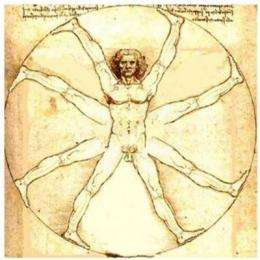
This is a fanciful rendering of Leonardo da Vinci's Vetruvian Man as a wheel. Credit: Adrian Bejan

Humans did not invent the wheel. Nature did. While the evolution from the Neolithic solid stone wheel with a single hole for an axle to the sleek wheels of today's racing bikes can be seen as the result of human ingenuity, it also represents how animals, including humans, have come to move more efficiently and quicker over millions of years on Earth, according to a Duke University engineer.

Adrian Bejan, professor of at Duke's Pratt School of Engineering, argues that just as the design of wheels became lighter with fewer spokes over time, and better at distributing the stresses of hitting the ground, animals have evolved as well to move better on Earth. In essence, over millions of years, animals such as humans developed the fewest "spokes," or legs, as the most efficient method for carrying an increasing body weight and height more easily.

"This prediction of how wheels should emerge in time is confirmed by the evolution of wheel technology," Bejan said. "For example, during the development of the carriage, solid disks were slowly replaced by wheels with tens of spokes."

The advantage of spokes is that they distribute stresses uniformly while being lighter and stronger than a solid wheel. "In contrast with the spoke, the solid wheel of was stressed unevenly, with a high concentration of stresses near the contact with the ground, and zero stresses on the upper side," Bejan said. "The wheel was large and heavy, and most of its volume did not support the load that the
vehicle posed on the axle.

"If you view animal movement as a 'rolling' body, two legs, swinging back and forth, perform the same function of an entire wheel-rim assembly," Bejan said. "They also do it most efficiently - like one wheel with two spokes with the stresses flowing unobstructed and uniformly through each spoke. The animal body is both wheel and vehicle for horizontal movement."

Bejan's analysis was published early online in the American Journal of Physics. His research is supported by the National Science Foundation and the Air Force Office of Scientific Research.

"An animal leg is shaped like a column because it facilitates the flow of stresses between two points - like the foot and hip joint, or paw and shoulder," Bejan said. "In the example of the Neolithic stone wheel, the flow of stresses is between the ground and the whole wheel."

Bejan believes that the constructal theory of design in nature (www.constructal.org), which he started describing in 1996, predicts these changes in the wheel and animal movement. The theory states that for a design (an animal, a river basin) to persist in time, it must evolve to move more freely through its environment.

Since animal locomotion is basically a falling-forward process, Bejan argues that an increase in height predicts an increase in speed. For a centipede, each leg represents a point of contact with ground, which limits the upward movement of the animal. As animals have fewer contacts with ground, they can rise up higher with each stride.

"The constructal theory shows us this forward-falling movement is dictated by the natural phenomenon, which is required for the minimal amount of effort expended for a certain distance traveled," Bejan said.

An earlier analysis by Bejan showed that larger human swimmers are faster because the wave they create while swimming is larger and thus carries them forward faster.

While wheel-like movement evolved naturally, it also describes what Bejan likes to call "nature's gear box." Humans have two basic speeds, Bejan said - walking and running. A running human gets taller, or higher off the ground, with each stride, which increases his speed.

A horse has three speeds - walk, trot and gallop.

"The horse increases its speed by increasing the height from which it falls during each cycle," Bejan said. "Then, from the trot to the gallop, the body movement changes abruptly such that the height of jump increases stepwise for each stride. Nature developed not only wheel-like movement but also mechanisms for changing speeds."

Provided by Duke University (news : web)

3.6 /5 (8 votes)  

Filter


Move the slider to adjust rank threshold, so that you can hide some of the comments.


Display comments: newest first

Squirrel
Jun 14, 2010

Rank: not rated yet
Actually the paper is out and not "early online". see http://dx.doi.org....3431988

Am. J. Phys. / Volume 78 / Issue 7 /
The constructal-law origin of the wheel, size, and skeleton in animal design
American Journal of Physics -- July 2010 -- Volume 78, Issue 7, pp. 692-699
Oxensraiser?
Jun 14, 2010

Rank: not rated yet
Just curious, but for the life of me i cant find one example of stone wheels being used as transportation devices. I see many examples of use for grinding grain and such, but have yet to actually find an honest-to-goodness stone wheel cart. At least i can't on the interwebs. Does anyone know of any actual examples of stone wheels being used as cart wheels? I am also operating under the assumption that our ancestors where just as capable as us of innovation. I can see a prototype wheel of stone, but after one test run you think someone would decide they loved the shape, but hated the weight, and reproduced it out of wood. Any thoughts?
Rank 3.6 /5 (8 votes)
Related Stories
Relevant PhysicsForums posts
  • Pith balls problem
    created34 minutes ago
  • Electrostatics
    created35 minutes ago
  • what is phase constant
    created47 minutes ago
  • Basics In electromagnetic wave
    created56 minutes ago
  • How to calculate theoretical initial velocity?
    created1 hour ago
  • Question about Gravity?
    created3 hours ago
  • More from Physics Forums - General Physics

More news stories

Putting the squeeze on planets outside our solar system

(PhysOrg.com) -- Using high-powered lasers, scientists at Lawrence Livermore National Laboratory and collaborators discovered that molten magnesium silicate undergoes a phase change in the liquid state, abruptly ...

Physics / Condensed Matter

created 11 hours ago | popularity 4.3 / 5 (7) | comments 0 | with audio podcast

Hovering not hard if you're top-heavy, researchers find

Top-heavy structures are more likely to maintain their balance while hovering in the air than are those that bear a lower center of gravity, researchers at New York University's Courant Institute of Mathematical Sciences ...

Physics / General Physics

created 12 hours ago | popularity 5 / 5 (1) | comments 1 | with audio podcast

SLAC, Stanford team focuses on high-energy electrons to treat cancer

Accelerator physicists at SLAC and cancer specialists from Stanford are working on a new technology that could dramatically reduce the time needed for cancer radiation treatments. The team ran an initial experiment ...

Physics / General Physics

created 15 hours ago | popularity 5 / 5 (2) | comments 0

Measurements from high-energy collisions lead to better understanding of why meson particles disappear

For several years, physicists at the Relativistic Heavy Ion Collider (RHIC) at Brookhaven National Laboratory (BNL), USA, have studied an unusual state of matter called the quark–gluon plasma, which they ...

Physics / General Physics

created 15 hours ago | popularity 4.5 / 5 (4) | comments 0

Explained: Sigma

It's a question that arises with virtually every major new finding in science or medicine: What makes a result reliable enough to be taken seriously? The answer has to do with statistical significance -- but ...

Physics / General Physics

created Feb 09, 2012 | popularity 5 / 5 (16) | comments 53


Google users warned of threat to smartphone wallets

Users of Google smartphone wallets were being warned on Friday that there is a way to crack pass codes intended to thwart thieves from going on illicit shopping sprees.

Anonymous knocks CIA website offline (Update)

The website of the Central Intelligence Agency was inaccessible on Friday after the hacker group Anonymous claimed to have knocked it offline.

New error-correcting codes guarantee the fastest possible rate of data transmission

Error-correcting codes are one of the triumphs of the digital age. They’re a way of encoding information so that it can be transmitted across a communication channel — such as an optical fiber o ...

Humans may have helped the decline of African rainforests 3000 years ago

(PhysOrg.com) -- Large areas of rainforests in Central Africa mysteriously disappeared over three thousand years ago, to be replaced by savannas. The prevailing theory has been that the cause was a change ...

New power source discovered

(PhysOrg.com) -- Researchers at the Massachusetts Institute of Technology (MIT) and RMIT University have made a breakthrough in energy storage and power generation.

Complex wiring of the nervous system may rely on a just a handful of genes and proteins

Researchers at the Salk Institute have discovered a startling feature of early brain development that helps to explain how complex neuron wiring patterns are programmed using just a handful of critical genes. ...