Scientists pull Japanese asteroid capsule from Outback (Update, w/ Video)
June 14, 2010 by Madeleine Coorey
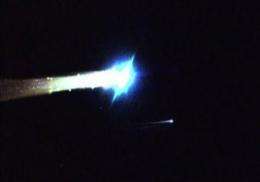
An image grab from video footage released by NASA shows a heat-resistant capsule (right) speeding towards Earth after being ejected from Japan's Hayabusa spacecraft (left). The Japanese space capsule that has travelled around the solar system as part of the first mission to land on an asteroid and return to Earth has been collected by scientists in the remote Australian Outback.
Scientists in Australia's vast Outback on Monday recovered a capsule that they hope contains the first piece of asteroid ever brought to Earth -- perhaps offering a glimpse into ancient space history.
The pod was ejected from a Japanese space probe as the host vessel burned up in a spectacular display over Australia following a seven-year odyssey across the solar system to the far-off Itokawa asteroid.
It lay in the desert dust overnight before scientists were given the go-ahead to retrieve it after Aboriginal elders said it had not landed in any indigenous sacred sites.
"The capsule is deemed intact at the moment," the Japanese space agency JAXA said in a statement.
The heat-resistant capsule parachuted into South Australia's remote Woomera military zone after being released from the Hayabusa spacecraft, which flamed back into the planet's atmosphere late Sunday.
The director of the Woomera test range, Doug Gerrie, said the probe had completed a textbook landing in the South Australian desert and had avoided any sensitive sites.
This video is not supported by your browser at this time.
An aerial video of the speeding sample return capsule released by NASA.
"They (JAXA) landed it exactly where they nominated they would," he said.The Hayabusa, which was launched in 2003, has endured a series of technical mishaps over its five-billion-kilometre (three-billion-mile) journey to the ancient Itokawa asteroid.
After visiting the site to retrieve the capsule, Hitoshi Kuninaka, professor at JAXA, said it "bears no damage at all", in comments reported by Kyodo News agency.
"Though it was flipped vertically, maybe because of a bounce on landing, it caused no inconvenience. It was left very clean," he said.
Fears for the return journey kept watching scientists anxious and Yoshiyuki Hasegawa, JAXA's associate executive director, said when they knew the capsule had made a better-than-expected soft landing, "we were very happy".
He said excitement had been high because the craft had only been designed to last four years and there were concerns about whether its battery would last the full seven years or if its control system would malfunction.
It is still not known whether the craft was able to collect a sample from Itokawa, but any material it does have could shed light on the early history of the solar system, the formation of planets, and help reduce the threat of asteroid collisions in the future, scientists say.
Australian National University scientist Trevor Ireland, who watched the spacecraft's re-entry from the Outback town of Coober Pedy, said it looked like a meteor as it flashed orange across the night sky.
"It looked just like that in terms of fragmentation and pieces flying off it and glowing, it was just absolutely amazing," Ireland told AFP by telephone from Woomera.
Ireland said the mood among the international scientists studying the craft was "hyper" after the capsule landed, successfully deploying its parachute and signalling systems so that it could be found in the vast Outback.
"It was a huge worry that the parachute wouldn't go off, the (signalling) beacons wouldn't go off, and that it would come down in a mud lake and get lost in the landscape," he said.
Ireland said scientists were now abuzz about what the capsule may contain.
"If there is a sample in there that we can analyse that will be a bonus," he said. "It's already been a tremendous mission. It really is a fairy tale."
The historic mission means that for the first time a spacecraft has made contact with an asteroid and returned to Earth.
The re-entry was hailed in Japan, where the government's top spokesman, Chief Cabinet Secretary Yoshito Sengoku, said the spacecraft's travels had "given courage, dreams and hope to us".
In celebration, a Japanese sake rice wine maker has produced a special Hayabusa edition for fans who want to toast the probe's return to Earth.
The capsule, which will remain sealed until it arrives at the JAXA facility near Tokyo, may remain unopened for weeks as it undergoes rigorous testing.
If there is material inside, it will take JAXA until around September to determine whether or not it came from the asteroid, Kyodo reported.
(c) 2010 AFP
-
Aborigines to view Japanese spacecraft on landing
Jun 11, 2010 |
not rated yet |
0
-
Japanese asteroid probe returns to Earth (Update)
Jun 13, 2010 |
not rated yet |
0
-
Japanese space probe Hayabusa close to home
Jun 08, 2010 |
not rated yet |
0
-
Japanese spacecraft to land in Australian outback
Apr 21, 2010 |
not rated yet |
0
-
Japan's Hayabusa asteroid-chaser set for Outback touchdown
Jun 11, 2010 |
not rated yet |
0
-
Engineers build first sub-10-nm carbon nanotube transistor
Feb 01, 2012 |
4.9 / 5 (30) |
30
-
Something old, something new: Evolution and the structural divergence of duplicate genes
Jan 31, 2012 |
4.6 / 5 (7) |
1
-
The hidden nanoworld of ice crystals: Revealing the dynamic behavior of quasi-liquid layers
Jan 30, 2012 |
5 / 5 (3) |
1
-
Stock market network reveals investor clustering
Jan 27, 2012 |
3.9 / 5 (23) |
8
-
Of microchemistry and molecules: Electronic microfluidic device synthesizes biocompatible probes
Jan 26, 2012 |
5 / 5 (1) |
0
-
Titan's lack of impact craters
Feb 09, 2012
-
Real pictures of black hole eating a star?
Feb 08, 2012
-
Hypothetical way to travel faster than light, but not technically exceed lightspeed
Feb 06, 2012
-
How do scientists monitor the Sun's activity?
Feb 05, 2012
-
Search patterns in observational studies
Feb 05, 2012
-
Derivation of Pogson's law
Feb 03, 2012
- More from Physics Forums - General Astronomy
More news stories
Could Venus be shifting gear?
(PhysOrg.com) -- ESAs Venus Express spacecraft has discovered that our cloud-covered neighbour spins a little slower than previously measured. Peering through the dense atmosphere in the infrared, the ...
Space & Earth / Space Exploration
3 hours ago |
5 / 5 (4) |
4
|
Humans may have helped the decline of African rainforests 3000 years ago
(PhysOrg.com) -- Large areas of rainforests in Central Africa mysteriously disappeared over three thousand years ago, to be replaced by savannas. The prevailing theory has been that the cause was a change ...
Clam fields found at deep, low-temperature Mariana vents
(PhysOrg.com) -- Scientists have marveled at the unusual life forms thriving at high temperature hydrothermal vents of the deep ocean.
Space & Earth / Earth Sciences
3 hours ago |
not rated yet |
0
|
Mars Science Laboratory computer issue resolved
(PhysOrg.com) -- Engineers have found the root cause of a computer reset that occurred two months ago on NASA's Mars Science Laboratory and have determined how to correct it.
Space & Earth / Space Exploration
4 hours ago |
5 / 5 (5) |
2
|
Two new moons for Jupiter
Advances in technology have lead to the discovery of new planets outside of our Solar System, and now even new moons in our own backyard.
Space & Earth / Space Exploration
3 hours ago |
not rated yet |
2
New understanding of DNA repair could eventually lead to cancer therapy
A research group in the Faculty of Medicine & Dentistry at the University of Alberta is hoping its latest discovery could one day be used to develop new therapies that target certain types of cancers.
Zuckerberg's focus drives Facebook's ascent
When Mark Zuckerberg showed up to rent Judy Fusco's Los Altos, Calif., house in the fall of 2004, soon after he'd arrived in Silicon Valley, the landlord was immediately struck by his confidence.
Both maternal and paternal age linked to autism
Older maternal and paternal age are jointly associated with having a child with autism, according to a recently published study led by researchers at The University of Texas Health Science Center at Houston (UTHealth).
Night, weekend delivery OK for babies with birth defects
Weekday delivery is no better than night or weekend delivery for infants with birth defects, according to a new study presented today at The Pregnancy Meeting, the Society for Maternal-Fetal Medicine's annual conference. ...
Sonic Cradle lands spot in TED exhibition
A Simon Fraser University graduate student project that melds music, meditation and modern technology has landed a rare spot as an exhibit at TEDActive 2012 in Palm Springs, California this month.
From virginity to Viagra
Americans will spend more than $17 billion on Valentine's Day, but far less on programs like sex education for adolescents. The editors of the new book, Sex for Life, From Virginity to Viagra, How Sexuality Changes Throughout ...
Jun 14, 2010
Rank: 2.6 / 5 (12)
Jun 15, 2010
Rank: not rated yet
Jun 15, 2010
Rank: not rated yet