Hand study reveals brain's distorted body model
June 14, 2010
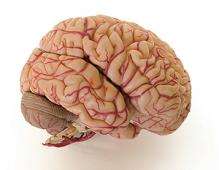
The human brain

Enlarge

The human brain

Our brains contain a highly distorted model of our own bodies, according to new research by scientists at UCL (University College London). A study published today, which focussed on the brain's representation of the hand, found that our model of our bodies is out of sync with reality - with a strong tendency to think that the hands are shorter and fatter than their true shape.

The results of the study, published in the journal , show that the brain maintains a model of the hand in which our fingers are perceived to be shorter and our hands fatter than they are. Neuroscientists suspect the reason for these distortions may lie in the way the brain receives information from different regions of the skin.

Dr Matthew Longo, lead author from the UCL Institute of , said: "The phrase "I know the town like the back of my hand" suggests that we have near-perfect knowledge of the size and position of our own but these results show that this is far from being the case."

"Our results show dramatic distortions of hand shape, which were highly consistent across participants. The hand appears to be represented as wider than it actually is and the fingers as shorter than they actually are - a finding that might also apply to other parts of the body," added Dr Longo.

Participants in the study were asked to put their left hands palm down under a board and judge the location of the covered hand's knuckles and by pointing to where they perceived each of these landmarks to be. A camera situated above the experiment recorded where the participant pointed. By putting together the locations of all the landmarks, the researchers reconstructed the brain's model of the hand, and revealed its striking distortions.

The research, which was funded by the Biotechnology and Biological Science Research Council (BBSRC), aims to find out how the brain knows where all parts of the body are in space even when your eyes are closed - an ability known as 'position sense'. Neuroscientists think that position sense requires two distinct kinds of information. Signals that the brain receives from muscles and joints play an important role in position sense, but the brain also needs a model of the shape and size of each body part. For example, to know where the fingertip is in space, the brain needs to know the angles of joints in the arm and hand, but also the length of the arm, hand, and finger.

It is this model of our body's size and shape that is investigated in the study. "Of course, we know what our hand really looks like" said Dr Longo, "and our participants were very accurate in picking out a photo of their own hand from a set of photos with various distortions of hand shape. So there is clearly a conscious visual image of the body as well. But that visual image seems not to be used for position sense."

The results showed that in this task people estimated that their hands were about two-thirds wider and about one-third shorter than actual measurements.

Neuroscientists suspect that the brain's distorted model of body shape result is due to the way the brain represents different parts of the skin. For example, the size of the representation of the five fingers gets progressively smaller for each finger between the thumb and the little finger, mirroring the relative size of fingers in the body model reported in this study.

"These findings may well be relevant to psychiatric conditions involving body image such as anorexia nervosa, as there may be a general bias towards perceiving the body to be wider than it is. Our healthy participants had a basically accurate visual image of their own body, but the brain's model of the underlying position sense was highly distorted. This distorted perception could come to dominate in some people, leading to distortions of body image as well, such as in eating disorders," said Dr Longo.

More information: 'An implicit body representation underlying human position sense' is published in the Proceedings of the National Academy of Sciences.

Provided by University College London (news : web)

4.1 /5 (11 votes)  

Filter


Move the slider to adjust rank threshold, so that you can hide some of the comments.


Display comments: newest first

Arthur_Zombie
Jun 14, 2010

Rank: 5 / 5 (4)
An important distinction to keep in mind is between 'body image' and 'body schema'. The reporting here seems to confuse the two. Of course, much of the literature confuses the two, as well.

'Body image' refers to the way the body is represented in conscious experience. 'Body schema' refers to the unconscious representations of the body.

Something else that threw me off was mention of "position sense". I have never heard this term used to refer to our ability to perceive bodily position; generally, the term used is 'proprioception'.

fleem
Jun 14, 2010

Rank: not rated yet
I think the conclusion is a little presumptuous. It might be that a primitive circuit reasoned that the fact that the hand couldn't be seen simply increased the probability that it couldn't be seen simply because the hand didn't reach that far. The primitive bias was then used as a "correction factor" to the more intellectual estimate of where the hand was. A better experiment would be to distort the hand's position with a prism (both long and short) and then somehow test when the subject detected the distortion.
irjsiq
Jun 15, 2010

Rank: 1 / 5 (3)
The Brain's: "Perception of 'Hand'" ? ? ?
I was 40 years of age before I heard:
"Your hand will do the catching;
"You needn't involve your mind,
"Hands KNOW!"

My 'inner-self' ? ? ? always had to be in control!

Big mistake!
Perhaps a corollary is:
"I must tell my Alimentary . . . 'You have work to do' . . .
"Digest the food I have swallowed!"
The 'Body parts/components KNOW their JOB(s)' . . . ie. "Lead, follow, or get out of the way!"

Normally, We are oblivious to our individual Corpus? Constituants . . .
they function!
When 'Pain/unusual sensation(s) eminate from a normally complacent 'Part', there is usually a reason, and then our 'Brain' kicks in:
"Something Is WRONG!"

Your Hand; knows how to catch!

Roy Stewart,
Phoenix AZ
localcooling
Jun 15, 2010

Rank: not rated yet
Several questions I have that might be answered in the original paper. First how many participants and tries per participant. Then did they do with hand dorso/plantar flexion resp. touching/not touching the "cover board". Then "finger pointing with say index finger, to mark "position", with and without eyes open. Then with eyes open pointing with a "laser pen" attached to say the forehead. Also that version blinded/unblinded. Numerous other alternatives would be interesting to see in further studies, fingers spread out/non spread etc.
Rank 4.1 /5 (11 votes)
Related Stories
Relevant PhysicsForums posts
  • Is Everyday Technology Killing Us?
    createdFeb 08, 2012
  • Exercise and weight loss
    createdFeb 08, 2012
  • Why do we have head aches? Our brains can't feel anything.
    createdFeb 07, 2012
  • "The end of diseases" by David Agus, interview from Daily Show with Jon Stewart
    createdFeb 04, 2012
  • Oncolytic adenovirus
    createdFeb 04, 2012
  • Nutrition label stuffs and diets
    createdFeb 02, 2012
  • More from Physics Forums - Medical Sciences

More news stories

Human cognitive performance suffers following natural disasters, researchers find

Not surprisingly, victims of a natural disaster can experience stress and anxiety, but a new study indicates that it might also cause them to make more errors - some serious - in their daily lives. In their upcoming Human Fa ...

Medicine & Health / Psychology & Psychiatry

created 30 minutes ago | popularity not rated yet | comments 0

Both maternal and paternal age linked to autism

Older maternal and paternal age are jointly associated with having a child with autism, according to a recently published study led by researchers at The University of Texas Health Science Center at Houston (UTHealth).

Medicine & Health / Psychology & Psychiatry

created 3 hours ago | popularity not rated yet | comments 0 | with audio podcast

Curry spice component may help slow prostate tumor growth

Curcumin, an active component of the Indian curry spice turmeric, may help slow down tumor growth in castration-resistant prostate cancer patients on androgen deprivation therapy (ADT), a study from researchers ...

Medicine & Health / Cancer

created 4 hours ago | popularity 5 / 5 (3) | comments 0 | with audio podcast

Team isolates nerve cells involved in storing long term memory and gene proteins associated with them

(Medical Xpress) -- A research team in Taiwan has succeeded in isolating two nerve cells in fruit fly brains that are believed to be the major players in allowing for the formation of long term memories. Furthermore, ...

Medicine & Health / Neuroscience

created 5 hours ago | popularity 5 / 5 (4) | comments 1 | with audio podcast report

Seeing colors in music, tasting flavors in shapes may happen in life's early months

Famed violinist Itzhak Perlman sees a deep forest green whenever he plays a B-flat on his Stradivarius' G string. The A on the E string is red.

Medicine & Health / Psychology & Psychiatry

created 6 hours ago | popularity 4.5 / 5 (2) | comments 0 | with audio podcast


The power of estrogen -- male snakes attract other males

A new study has shown that boosting the estrogen levels of male garter snakes causes them to secrete the same pheromones that females use to attract suitors, and turned the males into just about the sexiest ...

Putting the squeeze on planets outside our solar system

(PhysOrg.com) -- Using high-powered lasers, scientists at Lawrence Livermore National Laboratory and collaborators discovered that molten magnesium silicate undergoes a phase change in the liquid state, abruptly ...

New error-correcting codes guarantee the fastest possible rate of data transmission

Error-correcting codes are one of the triumphs of the digital age. They’re a way of encoding information so that it can be transmitted across a communication channel — such as an optical fiber o ...

Humans may have helped the decline of African rainforests 3000 years ago

(PhysOrg.com) -- Large areas of rainforests in Central Africa mysteriously disappeared over three thousand years ago, to be replaced by savannas. The prevailing theory has been that the cause was a change ...

Fool's gold may prove an unlikely alternative to overexploited catalytic materials

Catalytic materials, which lower the energy barriers for chemical reactions, are used in everything from the commercial production of chemicals to catalytic converters in car engines. However, with current catalytic materials ...

Could Venus be shifting gear?

(PhysOrg.com) -- ESA’s Venus Express spacecraft has discovered that our cloud-covered neighbour spins a little slower than previously measured. Peering through the dense atmosphere in the infrared, the ...