Understanding the Alzheimer's-Parkinson's link
June 14, 2010 by Tom Vasich
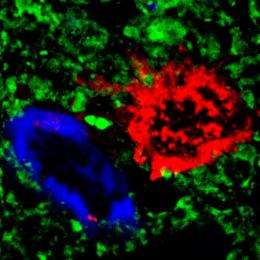
In transgenic mouse models of the Lewy body variant of Alzheimer’s, Parkinson’s-related alpha-synuclein proteins (green) and the beta-amyloid protein plaques (red) and tau protein tangles (blue) associated with Alzheimer’s aggregate into what are called Lewy bodies. Mathew Blurton-Jones / UCI
(PhysOrg.com) -- UCI researchers find the neurodegenerative combo of Alzheimer's and Parkinson's diseases accelerates dementia.
On their own, Alzheimer’s disease and Parkinson’s disease cause the slow regression of mental and physical abilities. But when the proteins behind these neurodegenerative disorders join forces, a dramatic decline in cognition often results, researchers with UC Irvine’s Institute for Memory Impairments and Neurological Disorders have found.
Little has been known about how these disease-inducing proteins interact and influence mental processes, but a group headed by Frank LaFerla, Chancellor’s Professor of neurobiology & behavior and UCI MIND director, is beginning to change that.
Their work is generating hope for people with the Lewy body variant of Alzheimer’s, in which Parkinson’s symptoms are also present. Nearly half of all Alzheimer’s patients have this variant, and about 1.3 million of them in the U.S. suffer from Lewy body dementia.
To learn more about this Alzheimer’s-Parkinson’s phenomenon, the LaFerla group created the first genetically modified, or “transgenic,” mouse model of this Lewy body variant of Alzheimer’s. As with affected patients, this model develops the beta-amyloid protein plaques and tau protein tangles typical of Alzheimer’s while also accumulating Parkinson’s-related alpha-synuclein proteins. These proteins aggregate into what are called Lewy bodies, named after Friederich H. Lewy, the scientist who discovered them.
“Mouse models such as this are opening a window to the complex biological activity that underpins neurodegenerative diseases like Alzheimer’s and Parkinson’s,” LaFerla says. “With enhanced research methods, we’re increasing our abilities to discover treatments.”
Using the new mouse model, he and UCI researchers Lani Clinton, Mathew Blurton-Jones and Kristoffer Myczek examined the interaction among these three proteins to determine how they influence cognition. The results of their study appear in the May 26 issue of The Journal of Neuroscience.
“We found the combination of these proteins in the same mouse accelerated the onset of the diseases,” says Blurton-Jones, an assistant researcher in neurobiology & behavior. “The proteins appeared to exacerbate ‘clumping up.’”
This aggregation, he says, led to a more rapid decline in the mice’s memory performance, similar to that in people with the Lewy body variant of Alzheimer’s.
“We’re hopeful that by better understanding and modeling the interactions among these proteins,” he says, “researchers can develop new treatments to target their activity.”
LaFerla and his UCI colleagues are on the forefront of utilizing genetically modified mice to study neurodegenerative diseases. In 2003, LaFerla created the first mouse model to accumulate beta-amyloid plaques and tau tangles, believed to be the pathological agents of Alzheimer’s disease.
“Everyone uses the mouse,” said Benjamin Wolozin, professor of pharmacology at Boston University’s Alzheimer’s Disease Center, in a 2006 profile of LaFerla in UCI Magazine. “His mouse is among the most important tools available to Alzheimer’s researchers.”
With the model, LaFerla has shown that beta-amyloid in particular may be the initiating factor in both kinds of Alzheimer’s - the “sporadic” type that seems to randomly attack the elderly and the early-onset “familial” version.
Last year, experiments by Blurton-Jones and LaFerla demonstrated that neural stem cells can partially reverse cognitive impairment in these genetically altered mice. The two subsequently received a $3.6-million California Institute for Regenerative Medicine grant toward the development of an Alzheimer’s therapy involving human neural stem cells.
“It’s absolutely critical to discover new ways to help people with Alzheimer’s, which is the leading cause of dementia among the elderly and affects 5.3 million people in the U.S., more than 500,000 of whom live in California,” LaFerla says. “We’re very excited about the advances spurred on by our development of transgenic mice, which we believe will lay the groundwork for Alzheimer’s treatments.”
Provided by UC Irvine
-
Neural stem cells offer potential treatment for Alzheimer's disease
Jul 20, 2009 |
not rated yet |
0
-
Pin1 is beneficial in Alzheimer's disease, detrimental to some forms of dementia
Apr 23, 2008 |
not rated yet |
0
-
Untangling the Mysteries of Alzheimer's Disease
Jun 10, 2010 |
not rated yet |
0
-
Alzheimer's prevention role discovered for prions
Jul 03, 2007 |
not rated yet |
0
-
Lithium chloride slows onset of skeletal muscle disorder
Mar 18, 2008 |
not rated yet |
0
-
Engineers build first sub-10-nm carbon nanotube transistor
Feb 01, 2012 |
4.9 / 5 (31) |
30
-
Something old, something new: Evolution and the structural divergence of duplicate genes
Jan 31, 2012 |
4.6 / 5 (7) |
1
-
The hidden nanoworld of ice crystals: Revealing the dynamic behavior of quasi-liquid layers
Jan 30, 2012 |
5 / 5 (3) |
1
-
Stock market network reveals investor clustering
Jan 27, 2012 |
3.9 / 5 (23) |
8
-
Of microchemistry and molecules: Electronic microfluidic device synthesizes biocompatible probes
Jan 26, 2012 |
5 / 5 (1) |
0
-
Is Everyday Technology Killing Us?
Feb 08, 2012
-
Exercise and weight loss
Feb 08, 2012
-
Why do we have head aches? Our brains can't feel anything.
Feb 07, 2012
-
"The end of diseases" by David Agus, interview from Daily Show with Jon Stewart
Feb 04, 2012
-
Oncolytic adenovirus
Feb 04, 2012
-
Nutrition label stuffs and diets
Feb 02, 2012
- More from Physics Forums - Medical Sciences
More news stories
Complex wiring of the nervous system may rely on a just a handful of genes and proteins
Researchers at the Salk Institute have discovered a startling feature of early brain development that helps to explain how complex neuron wiring patterns are programmed using just a handful of critical genes. ...
59 minutes ago |
5 / 5 (2) |
0
|
Q&A: Obama and the birth control controversy
(AP) -- What birth control debate? A half-century after the introduction of the pill, acceptance of birth control by American women is virtually universal.
56 minutes ago |
not rated yet |
0
Both maternal and paternal age linked to autism
Older maternal and paternal age are jointly associated with having a child with autism, according to a recently published study led by researchers at The University of Texas Health Science Center at Houston (UTHealth).
Medicine & Health / Psychology & Psychiatry
5 hours ago |
not rated yet |
0
|
Curry spice component may help slow prostate tumor growth
Curcumin, an active component of the Indian curry spice turmeric, may help slow down tumor growth in castration-resistant prostate cancer patients on androgen deprivation therapy (ADT), a study from researchers ...
6 hours ago |
4.5 / 5 (4) |
0
|
Team isolates nerve cells involved in storing long term memory and gene proteins associated with them
(Medical Xpress) -- A research team in Taiwan has succeeded in isolating two nerve cells in fruit fly brains that are believed to be the major players in allowing for the formation of long term memories. Furthermore, ...
CIA website offline, Anonymous takes credit
The website of the Central Intelligence Agency was unresponsive on Friday after the hacker group Anonymous claimed to have knocked it offline.
The power of estrogen -- male snakes attract other males
A new study has shown that boosting the estrogen levels of male garter snakes causes them to secrete the same pheromones that females use to attract suitors, and turned the males into just about the sexiest ...
New error-correcting codes guarantee the fastest possible rate of data transmission
Error-correcting codes are one of the triumphs of the digital age. Theyre a way of encoding information so that it can be transmitted across a communication channel such as an optical fiber o ...
Humans may have helped the decline of African rainforests 3000 years ago
(PhysOrg.com) -- Large areas of rainforests in Central Africa mysteriously disappeared over three thousand years ago, to be replaced by savannas. The prevailing theory has been that the cause was a change ...
Could Venus be shifting gear?
(PhysOrg.com) -- ESAs Venus Express spacecraft has discovered that our cloud-covered neighbour spins a little slower than previously measured. Peering through the dense atmosphere in the infrared, the ...
Small modular reactor design could be a 'SUPERSTAR'
(PhysOrg.com) -- Though most of today's nuclear reactors are cooled by water, we've long known that there are alternatives; in fact, the world's first nuclear-powered electricity in 1951 came from a reactor ...