Team reveals secret life of Isaac Newton on new website
June 14, 2010
(PhysOrg.com) -- Sir Isaac Newton, an icon of scientific revelation, led a secret life as a scholar of the mysterious art of alchemy. For the last six years, William Newman has been exploring that hidden life and bringing it to light. Newman is Distinguished Professor of history and philosophy of science in the College of Arts and Sciences at Indiana University Bloomington.
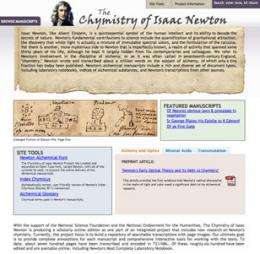
Alchemy, a 17th-century discipline that sought to change metals into gold and discover an elixir of life, among other things, was often called "chymistry" in its time. Newman produces "The Chymistry of Isaac Newton," an interdisciplinary project that provides new research on Newton's chymistry career. Newman's project is supported by the National Science Foundation and the National Endowment for the Humanities.
"The Chymistry of Isaac Newton" project team has just announced the release of 23 edited alchemical manuscripts written by Isaac Newton. This is the first time these documents have been released to the public.
"The Chymistry of Isaac Newton" website, at http://webapp1.dli … .edu/newton/ , also now details how Newton's optical discoveries, which radically transformed millenia-old theories of light and color, interacted with his alchemy. Manuscripts written by Newton reveal that Newton's analysis and synthesis of white light by means of prisms owe an unsuspected debt to his chymistry.
"Newton was a committed alchemist for 30 years," Newman said, "but he kept his activities in this realm largely hidden from his contemporaries and colleagues, so his alchemical work has been imperfectly known."
Newman and project members translated, edited and explicated the manuscripts, which include laboratory notebooks and other documents. The edited manuscripts are fully word-searchable, and the project website combines the edited texts with laboratory replications of Newton's experiments.
Thanks in large part to Newman's efforts, which have been widely featured in places such as Nova and the BBC, Newton's involvement in alchemy is becoming more widely understood.
"'The Chymistry of Isaac Newton' provides not only a unique window into the mind of a creative genius, but also reveals the full breadth of the material culture and technology of the 'chymistry' upon which Newton drew," says Newman.
The project's ultimate goal is to provide complete annotations for Newton's manuscripts and comprehensive interactive tools for working with the texts. To date, more than 600 pages have been edited and are available online, including Newton's most complete laboratory notebook, Portsmouth Collection Add. MS. 3975, found at Cambridge University.
Visitors to the site may also search for Newton's graphic alchemical symbols, some of which represent exotic formulas such as "the Green Lyon," "the Star Regulus of Antimony," and "the Caducean Rod of Mercury." These symbols were the common stock of early modern alchemy, and Newton made full use of them.
Newman and his collaborators have replicated alchemical processes taken from Newton's "Dictionary of Alchemical Terms." Using a primitive charcoal-burning furnace and modern reproductions of period glassware, project members manufactured "oil of vitriol" (sulfuric acid), "aqua fortis" (mostly nitric acid), and "spirit of salt" (hydrochloric acid). These experiments, carried out with the cooperation of the Department of Chemistry at IU Bloomington, are documented with photographs on the project website.
-
New transcription reveals Newton's rare 'theory of everything'
Dec 14, 2006 |
not rated yet |
0
-
First XMM-Newton images of impact
Jul 04, 2005 |
not rated yet |
0
-
Story of Newton's encounter with apple goes online
Jan 18, 2010 |
not rated yet |
0
-
Newton's apple tree bound for gravity-free orbit
May 07, 2010 |
not rated yet |
0
-
Astronaut gives Isaac Newton cosmic view of Earth
May 20, 2010 |
not rated yet |
0
-
Engineers build first sub-10-nm carbon nanotube transistor
Feb 01, 2012 |
4.9 / 5 (30) |
30
-
Something old, something new: Evolution and the structural divergence of duplicate genes
Jan 31, 2012 |
4.6 / 5 (7) |
1
-
The hidden nanoworld of ice crystals: Revealing the dynamic behavior of quasi-liquid layers
Jan 30, 2012 |
5 / 5 (3) |
1
-
Stock market network reveals investor clustering
Jan 27, 2012 |
3.9 / 5 (23) |
8
-
Of microchemistry and molecules: Electronic microfluidic device synthesizes biocompatible probes
Jan 26, 2012 |
5 / 5 (1) |
0
-
Bohr-Einstein debate: why did Bohr not simply say...
Feb 06, 2012
-
Best/Worst U.S. Presidents
Jan 31, 2012
- More from Physics Forums - History & Humanities
More news stories
US workers are 'giving away the store,' costing firms billions
Nearly 70 percent of the nation's service employees give away free goods and services from hamburgers to cable TV costing companies billions of dollars a year, according to a groundbreaking study.
Other Sciences / Economics & Business
14 hours ago |
5 / 5 (1) |
8
Storm warning: Financial tsunami heading this way
In today's global village, national coffers are more interconnected than ever before. And as the current economic crisis has proven, a downturn in one country can travel in a wave across the globe, like a financial tsunami. ...
Other Sciences / Economics & Business
15 hours ago |
3 / 5 (2) |
7
Kids show cultural gender bias
(PhysOrg.com) -- Talk about gender confusion! A recent study by University of Alberta researchers Elena Nicoladis and Cassandra Foursha-Stevenson in the Journal of Cross-Cultural Psychology into whether speaki ...
Other Sciences / Social Sciences
20 hours ago |
1.5 / 5 (2) |
2
Prague gets hold of modern genetics founder Mendel's papers
Germany has handed to the Czech Republic a manuscript of Johann Gregor Mendel, founder of modern genetics, on his plant hybridization experiments, the Czech foreign minister said Thursday.
11 hours ago |
5 / 5 (1) |
1
'Flipped classroom' teaching model gains an online community
Researchers at Harvard University have launched the Peer Instruction (PI) Network, a new global social network for users of interactive teaching methods.
Other Sciences / Social Sciences
15 hours ago |
5 / 5 (2) |
0
'Dark plasmons' transmit energy
Microscopic channels of gold nanoparticles have the ability to transmit electromagnetic energy that starts as light and propagates via "dark plasmons," according to researchers at Rice University.
FDA-approved drug rapidly clears amyloid from the brain, reverses Alzheimer's symptoms in mice
Neuroscientists at Case Western Reserve University School of Medicine have made a dramatic breakthrough in their efforts to find a cure for Alzheimer's disease. The researchers' findings, published in the journal Science, show t ...
Hydrogen from acidic water: Researchers develop potential low cost alternative to platinum for splitting water
A technique for creating a new molecule that structurally and chemically replicates the active part of the widely used industrial catalyst molybdenite has been developed by researchers with the Lawrence Berkeley ...
Ultraviolet protection molecule in plants yields its secrets
Lying around in the sun all day is hazardous not just for humans but also for plants, which have no means of escape. Ultraviolet (UV) radiation from the sun can damage proteins and DNA inside cells, leading ...
Soraa LED light may dim 50-watt halogen rivals
(PhysOrg.com) -- Soraa, a Fremont, California company founded in 2008, this week launched its first product, a light that uses LEDS (light emitting diodes). The "Soraa LED MR16 lamp" is the "perfect" replacement ...
Anyone can learn to be more inventive, cognitive researcher says
There will always be a wild and unpredictable quality to creativity and invention, says Anthony McCaffrey, a cognitive psychology researcher at the University of Massachusetts Amherst, because an "Aha moment" is rare and ...
Jun 15, 2010
Rank: 5 / 5 (1)
Jun 15, 2010
Rank: 5 / 5 (1)
It's nice to see this exploration of the whole Newton, as opposed to merely his works in physics and optics getting a well-deserved airing.