Speech Synthesizer Helps Movie Critic
June 15, 2010 By Phillip F. Schewe
Speech Synthesizer Helps Movie Critic

Enlarge

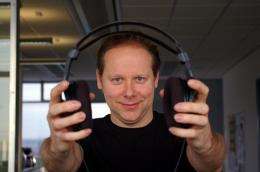
Matthew Aylett and colleagues are aiming to capture a more conversational style of synthesized speech.

The voices you hear on message services are often created artificially by fitting together short audio snippets from a large library of vocalized words and sounds. Scientists are now moving beyond the older generic voices to produce what, to many listeners, sounds like an "actual" person speaking.

Voice synthesis technology had a recent success when a personalized text-to-speech system was crafted for the movie critic Roger Ebert, who suffers from thyroid cancer and is unable to speak any longer. The synthetic Ebert speech was created from many hours of his recorded during past television programs. The company that made Ebert’s system, CereProc, is able to make TTS conversions quickly, allowing them to provide more than just a generic-voice synthesis.

Matthew Aylett, one of the founders of CereProc, said that he and his colleagues do not necessarily aim for smooth voicings. Instead, he said, "We want the variation which gives a voice a fresh and natural feel to it. This means not getting our voice talents to speak in a boring and neutral way but capturing their more conversational speech style."

At CereProc they are even able to build a certain amount of emotion into their voices as well creating regional accents. The company, located in Edinburgh, Scotland, has been successful, for example, in reproducing Scottish and Irish accented speech.

For "cloning" voices of specific people (they did one for President George Bush, for example), he said they sometimes have resort to "found" recordings. The trouble with using snippets of voice is that these recordings were often made under a variety of acoustic conditions, which then have to be corrected in making a final voice.

Roger Ebert learned about the President Bush "voice" and asked if CereProc could assemble a voice for him using the large inventory of of his television show. So far they have used about five hours of Ebert’s voice to produce a voice bank of about 300,000 phonetic sounds.

Timothy Bunnell, a scientist at Nemours Biomedical Research in Wilmington, Del., is working to make personalized voices accessible to everyone, especially for those with neurodegenerative diseases.

Bunnell's voice synthesis system can be prepared for people who still have the power of speech. By contrast, Aylett’s synthetic speech program, such as that for Roger Ebert, is based on recordings of people who can no longer speak.

Carrying out text-to-speech synthesis for children is more difficult. "It is difficult for young children to record enough speech with the required degree of consistency and precision needed to build a high-quality synthetic voice," said Bunnell. The main problem, he said, is not with the nature of the utterances, but with the amount of variability in children's , much more than for adults.

Aylett enjoys synthesis research. "It's fun to use the synthesizer, but it’s even better to see it helping people who really need it."

Provided by Inside Science News Service


Rank 5 /5 (8 votes)
Related Stories
Relevant PhysicsForums posts

More news stories

Google users warned of threat to smartphone wallets

Users of Google smartphone wallets were being warned on Friday that there is a way to crack pass codes intended to thwart thieves from going on illicit shopping sprees.

Technology / Internet

created 5 hours ago | popularity 5 / 5 (2) | comments 0

Anonymous knocks CIA website offline (Update)

The website of the Central Intelligence Agency was inaccessible on Friday after the hacker group Anonymous claimed to have knocked it offline.

Technology / Internet

created 6 hours ago | popularity 5 / 5 (7) | comments 11

New error-correcting codes guarantee the fastest possible rate of data transmission

Error-correcting codes are one of the triumphs of the digital age. They’re a way of encoding information so that it can be transmitted across a communication channel — such as an optical fiber o ...

Technology / Computer Sciences

created 15 hours ago | popularity 4.8 / 5 (6) | comments 6 | with audio podcast

New power source discovered

(PhysOrg.com) -- Researchers at the Massachusetts Institute of Technology (MIT) and RMIT University have made a breakthrough in energy storage and power generation.

Technology / Energy & Green Tech

created 14 hours ago | popularity 4.7 / 5 (22) | comments 8 | with audio podcast

Small modular reactor design could be a 'SUPERSTAR'

(PhysOrg.com) -- Though most of today's nuclear reactors are cooled by water, we've long known that there are alternatives; in fact, the world's first nuclear-powered electricity in 1951 came from a reactor ...

Technology / Energy & Green Tech

created 14 hours ago | popularity 4.3 / 5 (11) | comments 21 | with audio podcast


Complex wiring of the nervous system may rely on a just a handful of genes and proteins

Researchers at the Salk Institute have discovered a startling feature of early brain development that helps to explain how complex neuron wiring patterns are programmed using just a handful of critical genes. ...

The power of estrogen -- male snakes attract other males

A new study has shown that boosting the estrogen levels of male garter snakes causes them to secrete the same pheromones that females use to attract suitors, and turned the males into just about the sexiest ...

Humans may have helped the decline of African rainforests 3000 years ago

(PhysOrg.com) -- Large areas of rainforests in Central Africa mysteriously disappeared over three thousand years ago, to be replaced by savannas. The prevailing theory has been that the cause was a change ...

Putting the squeeze on planets outside our solar system

(PhysOrg.com) -- Using high-powered lasers, scientists at Lawrence Livermore National Laboratory and collaborators discovered that molten magnesium silicate undergoes a phase change in the liquid state, abruptly ...

Could Venus be shifting gear?

(PhysOrg.com) -- ESA’s Venus Express spacecraft has discovered that our cloud-covered neighbour spins a little slower than previously measured. Peering through the dense atmosphere in the infrared, the ...

Advanced power-grid model finds low-cost, low-carbon future in West

(PhysOrg.com) -- The least expensive way for the Western U.S. to reduce greenhouse gas emissions enough to help prevent the worst consequences of global warming is to replace coal with renewable and other ...