Faecal attraction: Whale poop fights climate change
June 15, 2010
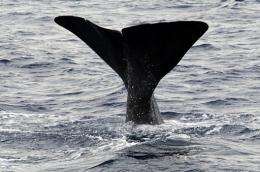
A sperm whale swims in the Mediterranean sea

Enlarge

A sperm whale swims in the Mediterranean sea. Southern Ocean sperm whales are an unexpected ally in the fight against global warming, removing the equivalent carbon emissions from 40,000 cars each year thanks to their faeces, a study found on Wednesday.

Southern Ocean sperm whales are an unexpected ally in the fight against global warming, removing the equivalent carbon emissions from 40,000 cars each year thanks to their faeces, a study found on Wednesday.

The cetaceans have been previously fingered as climate culprits because they breathe out carbon dioxide (CO2), the commonest .

But this is only a part of the picture, according to the paper, published in the British journal .

In a heroic calculation, Australian biologists estimated that the estimated 12,000 sperm whales in the each defecate around 50 tonnes of iron into the sea every year after digesting the fish and squid they hunt.

The iron is a terrific food for phytoplankton -- marine plants that live near the ocean surface and which suck up CO2 from the atmosphere through photosynthesis.

As a result of faecal fertilisation, the whales remove 400,000 tonnes of carbon each year, twice as much as the 200,000 tonnes of CO2 that they contribute through respiration.

By way of comparison, 200,000 tonnes of CO2 is equal to the emissions of almost 40,000 passenger cars, according to an equation on the website of the US (EPA).

The whales' faeces are so effective because they are emitted in liquid form and close to the surface, before the mammals dive, said the paper.

Industrialised whaling not only gravely threatened Southern Ocean sperm whales, it also damaged a major carbon "sink," the scientific term for something that removes more greenhouse gases than it produces, it added.

Before industrial whaling, the population of this species was about 10 times bigger, which meant around two million tonnes of CO2 were removed annually, said the paper.

The Southern Ocean is rich in nitrogen but poor in iron, which is essential for phytoplankton.

The scientists suspect that because sperm whales cluster in specific areas of the Southern Ocean there is a clear link between food availability and cetacean .

This could explain the "krill paradox," they believe. Researchers have previously found that when balleen whales are killed, the amount of krill in that sea area declines, which thus affects the entire food chain.

The study is lead-authored by Trish Lavery of the School of Biological Sciences at Flinders University in Adelaide.

The EPA's website, on the basis of a calculation made in 2005, says that a passenger car that is driven for 20,000 kilometers (12,000 miles) a year yields annual emissions in CO2 or its equivalent of just over five tonnes.

The future of and other species comes under scrutiny next week in Agadir, Morocco, where the International Whaling Commission (IWC) discusses a plan to relax a 24-year moratorium on commercial whaling.

(c) 2010 AFP

Filter


Move the slider to adjust rank threshold, so that you can hide some of the comments.


Display comments: newest first

gwrede
Jun 15, 2010

Rank: 5 / 5 (2)
Tell that to the Japanese.
alq131
Jun 16, 2010

Rank: 1 / 5 (2)
The cetaceans have been previously fingered as climate culprits because they breathe out carbon dioxide (CO2),


How about the 6+ Billion people that breathe? Shouldn't they be eliminated for emitting CO2? Maybe we could install CO2 scrubbers on people's mouths when born?
Starblade_Enkai
Jun 16, 2010

Rank: not rated yet
The cetaceans have been previously fingered as climate culprits because they breathe out carbon dioxide (CO2),


How about the 6+ Billion people that breathe? Shouldn't they be eliminated for emitting CO2? Maybe we could install CO2 scrubbers on people's mouths when born?

No, people should eat a more iron heavy diet, like liver every week, so that OUR feces help plankton and let iron into the ocean. Of course, we'd treat the sewage so that more harmful stuff doesn't go in there.
mysticshakra
Jun 16, 2010

Rank: 3 / 5 (4)
Studies like this show how silly and weak the case for AGW is. Not that anyone should have continued to take them seriously after putting backpacks on cows but....
TegiriNenashi
Jun 16, 2010

Rank: 1 / 5 (2)
That is just one whale hugger discovering an unconventional way to fight against japanese.

P.S. For those who are not fluent in russian, "Te Giri Ne Nashi" has little to do with japanese.
Rank 4 /5 (12 votes)
Related Stories
Relevant PhysicsForums posts
  • Is the Earth really going to die
    created11 hours ago
  • Do some geologists actually act a lot like Randy Marsh?
    createdFeb 11, 2012
  • Discrepancy between oxygen and carbon-dioxide levels
    createdFeb 09, 2012
  • where gems are found in the world
    createdFeb 09, 2012
  • Wind Waves in Reservoir ~ Wind run-up and Wind set-up
    createdFeb 08, 2012
  • Balance of oxygen in the atmosphere
    createdFeb 01, 2012
  • More from Physics Forums - Earth

More news stories

Spitzer finds solid buckyballs in space

(PhysOrg.com) -- Astronomers using data from NASA's Spitzer Space Telescope have, for the first time, discovered buckyballs in a solid form in space. Prior to this discovery, the microscopic carbon spheres ...

Space & Earth / Astronomy

created 11 hours ago | popularity 4.7 / 5 (12) | comments 6 | with audio podcast

Going up: Japan builder eyes space elevator

A Japanese construction firm claimed Wednesday it could execute an out-of-this-world plan to put tourists in space within 40 years by building an elevator that stretches a quarter of the way to the moon.

Space & Earth / Space Exploration

created 18 hours ago | popularity 3.5 / 5 (13) | comments 25

ENASA satellite finds Earth's clouds are getting lower

(PhysOrg.com) -- Earth's clouds got a little lower -- about one percent on average -- during the first decade of this century, finds a new NASA-funded university study based on NASA satellite data. The results ...

Space & Earth / Earth Sciences

created 15 hours ago | popularity 5 / 5 (8) | comments 11 | with audio podcast

Fresh scandal embroils US climate science debate

A fresh scandal over climate change has erupted in the United States after leaked documents appeared to show a right-wing funded campaign to influence how climate science is taught in schools.

Space & Earth / Environment

created 8 hours ago | popularity 4.5 / 5 (8) | comments 7

World's oceans get an acid bath

Among the repercussions of global climate change, the effect of ocean acidification on marine life is one of the least-understood variables.

Space & Earth / Environment

created 15 hours ago | popularity 4.3 / 5 (6) | comments 4 | with audio podcast


CT colonography shown to be comparable to standard colonoscopy

Computerized tomographic (CT) colonography (CTC), also known as virtual colonoscopy, is comparable to standard colonoscopy in its ability to accurately detect cancer and precancerous polyps in people ages 65 and older, according ...

Study: Virtual colonoscopy effective screening tool for adults over 65

Computed tomography (CT) colonography can be used as a primary screening tool for colorectal cancer in adults over the age of 65, according to a new study published online in the journal Radiology.

Researchers build first physical 'metatronic' circuit

(PhysOrg.com) -- The technological world of the 21st century owes a tremendous amount to advances in electrical engineering, specifically, the ability to finely control the flow of electrical charges using ...

Faster than light neutrinos? More like faulty wiring

You can shelf your designs for a warp drive engine (for now) and put the DeLorean back in the garage; it turns out neutrinos may not have broken any cosmic speed limits after all.

Physicists surprised by disappearing and reappearing superconductivity in iron selenium chalcogenides

Superconductivity is a rare physical state in which matter is able to conduct electricity -- maintain a flow of electrons -- without any resistance. This phenomenon can only be found in certain materials at low temperatures, ...

Stanford research team cracks animated NuCaptcha

(PhysOrg.com) -- The research team from Stanford University, led by Elie Bursztein, that previously had cracked regular CAPTCHAs and then audio CAPTCHAs, now has also successfully cracked the animated version called NuCapt ...