World's oldest fig wasp fossil proves that if it works, don't change it
June 15, 2010
The world's oldest known example of a fig wasp has been found on the Isle of Wight. The fossil wasp is almost identical to the modern species, proving that this tiny but specialised insect has remained virtually unchanged for over 34 million years.
The fossil isn't a new find but was wrongly identified as an ant when it was first discovered in the 1920s. Fig wasp expert at the University of Leeds, Dr Steve Compton, was called in to study the fossil when the late Dr Mikhail Kozlov spotted the mistake during research at the Natural History Museum, London into the flora and fauna of the Isle of Wight. The findings of Dr Compton and the team are published today in the Royal Society journal Biology Letters.
"There were three very well-preserved specimens and we were able to use modern techniques to look at them in detail," says Dr Compton. "What makes this fossil fascinating is not just its age, but that it is so similar to the modern species. This means that the complex relationship that exists today between the fig wasps and their host trees developed more than 34 million years ago and has remained unchanged since then."
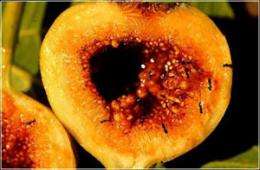
Fig wasps and fig trees are mutually dependent, with each of the 800 or so modern species of tree pollinated by just one or two species of fig wasp that ignore other fig trees. The wasps - which measure just 1.5mm in length - have developed a particular body shape and features to enable them to crawl into figs to reach the flowers there.
Using state of the art microscopy facilities at the Museum, Dr Compton's team compared the fossils with modern fig wasps and with an example in Dominican amber dated to 20 million years, which he had bought over the internet and has since donated to the Museum. Their findings show that both fossil insects had the same body shape and features as modern species.
Because fig wasp larvae do better if they feed within a pollinated flower, the most highly developed species of wasps actively pollinate the figs before laying their eggs, rather than passively spreading pollen as they move between trees. The wasps collect pollen in pockets on the underside of their bodies and then take it to another tree, where they pull it out and spread in on the flowers before laying their eggs.
The team found pollen pockets on the underside of the fossil wasp and the wasp in amber and, using scanning electron microscopy, identified grains of fig pollen within the pockets. This proves that active pollination was already achieved over 34 million years ago and has remained unchanged to this day.
The edible figs we eat today are produced on specialised female plants that trick the wasps into entering the figs and strip off their wings, but then prevent them from laying any eggs. As a result, the figs produce only seeds and no wasp offspring. The length of the ovipositor - the organ the wasp uses to lay its eggs - of the Isle of White fig wasp shows that its host fig tree had already evolved this method of cheating on its partner.
"We believe from molecular evidence that fig wasps and fig trees have been evolving together for over 60 million years," says Dr Compton. "Now we have fossil confirmation that gets us a bit closer to that date. Although we often think of the world as constantly changing, what this fossil gives us is an example of something remaining unchanged for tens of millions of years - something which in biology we call 'stasis'."
One of the major changes the fig and its wasp will have had to face - beyond obvious climatic differences that mean fig trees are no longer native to the Isle of Wight - is the range of animals that eat the fruit and spread its seeds. Figs are a major source of food in tropical forests and more birds and mammals feed on figs than on any other fruit - so it's reassuring to know that these plants and their pollinators have responded successfully to previous episodes of climate change.
-
Trees retaliate when their fig wasps don't service them
Jan 27, 2010 |
not rated yet |
0
-
Cooperation between figs, wasps and parasites proves 3 is not always a crowd
Mar 11, 2008 |
not rated yet |
0
-
Punishment important in plant-pollinator relationship
Jan 14, 2010 |
not rated yet |
0
-
Well-traveled wasps provide hope for vanishing species
Nov 09, 2009 |
not rated yet |
0
-
Hawaii looks at wasps to control invaders
Feb 28, 2008 |
not rated yet |
0
-
Engineers build first sub-10-nm carbon nanotube transistor
Feb 01, 2012 |
4.9 / 5 (31) |
30
-
Something old, something new: Evolution and the structural divergence of duplicate genes
Jan 31, 2012 |
4.6 / 5 (7) |
1
-
The hidden nanoworld of ice crystals: Revealing the dynamic behavior of quasi-liquid layers
Jan 30, 2012 |
5 / 5 (3) |
1
-
Stock market network reveals investor clustering
Jan 27, 2012 |
3.9 / 5 (23) |
8
-
Of microchemistry and molecules: Electronic microfluidic device synthesizes biocompatible probes
Jan 26, 2012 |
5 / 5 (1) |
0
-
Mitosis
8 hours ago
-
Stem cell question.
9 hours ago
-
Protease cleavage
15 hours ago
-
Pertubance in a model
22 hours ago
-
Cancer drugs and Alzheimer's, Oh my!
Feb 09, 2012
-
Squishing cells
Feb 09, 2012
- More from Physics Forums - Biology
More news stories
The power of estrogen -- male snakes attract other males
A new study has shown that boosting the estrogen levels of male garter snakes causes them to secrete the same pheromones that females use to attract suitors, and turned the males into just about the sexiest ...
20 hours ago |
4.8 / 5 (6) |
2
|
Grass to gas: Researchers' genome map speeds biofuel development
Researchers at the University of Georgia have taken a major step in the ongoing effort to find sources of cleaner, renewable energy by mapping the genomes of two originator cells of Miscanthus x giganteus, a large perenn ...
17 hours ago |
3.8 / 5 (5) |
0
|
Experts reveal how plants don't get sunburn
(PhysOrg.com) -- Experts at the University of Glasgow have discovered how plants survive the harmful rays of the sun.
20 hours ago |
4.8 / 5 (5) |
0
|
Protein libraries in a snap
(PhysOrg.com) -- A Rice University undergraduate will depart with not only a degree but also a possible patent for his invention of an efficient way to create protein libraries, an important component of biomolecular ...
23 hours ago |
4.8 / 5 (4) |
1
|
Entire genome of extinct human decoded from fossil
(PhysOrg.com) -- In 2010, Svante Pääbo and his colleagues presented a draft version of the genome from a small fragment of a human finger bone discovered in Denisova Cave in southern Siberia. The ...
Feb 07, 2012 |
4.7 / 5 (56) |
42
|
Anonymous knocks CIA website offline (Update)
The website of the Central Intelligence Agency was inaccessible on Friday after the hacker group Anonymous claimed to have knocked it offline.
New error-correcting codes guarantee the fastest possible rate of data transmission
Error-correcting codes are one of the triumphs of the digital age. Theyre a way of encoding information so that it can be transmitted across a communication channel such as an optical fiber o ...
Small modular reactor design could be a 'SUPERSTAR'
(PhysOrg.com) -- Though most of today's nuclear reactors are cooled by water, we've long known that there are alternatives; in fact, the world's first nuclear-powered electricity in 1951 came from a reactor ...
New power source discovered
(PhysOrg.com) -- Researchers at the Massachusetts Institute of Technology (MIT) and RMIT University have made a breakthrough in energy storage and power generation.
Advanced power-grid model finds low-cost, low-carbon future in West
(PhysOrg.com) -- The least expensive way for the Western U.S. to reduce greenhouse gas emissions enough to help prevent the worst consequences of global warming is to replace coal with renewable and other ...
Fool's gold may prove an unlikely alternative to overexploited catalytic materials
Catalytic materials, which lower the energy barriers for chemical reactions, are used in everything from the commercial production of chemicals to catalytic converters in car engines. However, with current catalytic materials ...