Sanyo announces world's most efficient solar module
June 16, 2010 by Lin Edwards report
Sanyo announces world's most efficient solar module

Enlarge

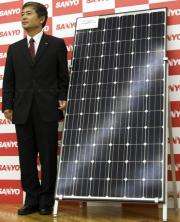
(PhysOrg.com) -- Sanyo has announced its development of the world's most energy efficient solar module, the HIT-N230. The module was unveiled at a press conference run by Sanyo Electric's Solar Division.

Sanyo is a major manufacturer of solar panels, with three factories in , one in Hungary serving Europe, and a fifth in Mexico that serves the US market. The N series of modules are produced in Japan and consist of solar cells of the Hetero-junction with Intrinsic Thin-layer (HIT) type.

HIT solar cells contain a single thin crystalline wafer of silicon surrounded by ultra-thin amorphous layers of silicon. They are characterized by at high temperatures, and increased output power even during high summertime temperatures. The high conversion efficiency of HIT cells means more capacity can be installed compared to conventional solar cells.

The new N230 solar cell module is claimed to have an of 20.7 percent, which makes it the most efficient solar module produced so far. The unprecedented efficiency was achieved by increasing the number of solar cell tabs from two to three and making each tab thinner. They also applied AG coated glass to the cells, and this reduces the amount of scattering and reflection of light. The increase in energy conversion efficiency could make the solar modules useful in areas with less than ideal amounts of sunshine.

Sanyo is already one of the leading manufacturers of and modules, and the company is currently expanding its solar cell module production at Kaizuka City and Ohtsu City in Japan in response to increased demand. In total Sanyo plans to nearly double its HIT solar cell production from the current level of 340 MW to 600 MW by March next year.

National and local installation subsidies in Japan have seen the local market expand rapidly, and this has also been helped by the national government’s new program for purchasing surplus electricity generated by solar installations.

The 230W model N230 and 225W N225 will both be officially launched in Japan in autumn this year and in Europe in 2011.

© 2010 PhysOrg.com

4.3 /5 (35 votes)  

Filter


Move the slider to adjust rank threshold, so that you can hide some of the comments.


Display comments: newest first

gmurphy
Jun 16, 2010

Rank: 5 / 5 (5)
20%, this is the most efficient?, spacecraft solar cells can achieve efficiencies of 30% http://en.wikiped...acecraft
Sonhouse
Jun 16, 2010

Rank: 5 / 5 (5)
I think they are talking about the price, PV cells on spacecraft are not cheap, extremely expensive where the power V weight and reliability are the main concern since a PV roving around on Mars can't be fixed by just climbing up a ladder. These cells are using thin technology which makes the cells a lot cheaper. I would like to see the dollar/watt ratio though.
Anyway, the highest percent efficiency now is more like 40% with the newest multi-layer cells tuned to react to different color bands.
Sonhouse
Jun 16, 2010

Rank: 4.5 / 5 (4)
I found an earlier version of this PV rack, with an efficiency rating of just over 19%, and the price for the 230 watt module is 948 Euro's, about 1200 bucks US which puts it around 6 bucks/watt. Not a bargain.
I can only assume these newer ones will be in that price range or even more expensive. Nice if you are rich. Ten of them would give you 2300 watts at a price of about 12,000 bucks US. That does not include installation. You would probably need 20 of them to get enough power 24/7 to power your home, or 24,000 bucks US plus the price of installation.
Doug_Huffman
Jun 16, 2010

Rank: 1 / 5 (2)
Don't forget that the Solar Constant is constant and defined outside the atmosphere; 1350 Watts meter^-2.

Power here is 6¢ KWh^-1. You do the payback.
Shootist
Jun 16, 2010

Rank: 3.2 / 5 (6)
$6/watt for electricity that costs 12 cents a kilowatt hour?

We are not going to save the world with pixie dust.

Building 100 1000 megawatt nuclear reactors would be money much better spent.
El_Nose
Jun 16, 2010

Rank: 5 / 5 (3)
@Sonhouse

I agree with your estimates and that IS the actual cost of making your home solar it runs from 34k cheap to about 55k to make your home solar. There are tax breaks on the federal level that knock of up to 30% and many states and county offer similar local tax breaks on installation that can get hte overall price down to about 14k - 25k but you still have to front the upfront cost to then 'realize' the savings as they say.

you say 6/watt but its really 6 for the first watt right... and each additional watt makes that number smaller and smaller...
Arkaleus
Jun 16, 2010

Rank: 1 / 5 (8)
Shootist, you're missing the point.

First of all, you're balancing the equations with old fashioned math, which assumes numbers have a fixed meaning. Nu-math overcomes the difficulties of absolute values by introducing the concept of "legal" numbering and "perceived" value.

Green energy is 100% efficient when calculated with nu-math, but sometimes the same calculations can provide what old math would call "over-unity" gain. For example, spending 100,000 dollars to provide 10,000 dollars worth of energy is a fine business model under nu-math.

In the brave nu future, individuals will be "convinced" to pay energy taxes according to nu-math, which will impose the "legal" numbering system on their transactions. The most powerful feature of nu-math is the ability to buy weather with money, with the nations agreeing on a fixed exchange of currency units per degree C. Legally, weather is required to comply with the arrangement, as are people.
re_coyote
Jun 16, 2010

Rank: 4.7 / 5 (3)
Hello, did anyone hear about the Fraunhofer researcher who doubled the numbers that all of you are talking about. 20.7 efficiency is a joke compared to this,

http://www.semico...0610.htm

http://www.fraunh...rize.jsp
Birthmark
Jun 16, 2010

Rank: 3.7 / 5 (3)
I can't wait until the prices go down and the efficiency goes up and it becomes common place to find solar technology in homes across the country, across the world :D
Bonkers
Jun 16, 2010

Rank: 5 / 5 (2)
peak sun hours at http://www.oynot....map.html is five for most of america.
These panels generate 420kWh per year, or about $50 of electricity at 12c per kWh. Thats enough to service the original debt forever at 4%, too simple an analysis. Put in the CAGR of electricity (7%) and assume a loan interest of 4% and system will pay back after 18 years. Assuming no maintenance.
Not the best deal ever, but respectable.
Uri
Jun 16, 2010

Rank: not rated yet
Don't forget that the Solar Constant is constant and defined outside the atmosphere; 1350 Watts meter^-2.


I've seen that number before and you referenced it correctly in that its 1350 / m^2 at the TOP of the atmosphere. Does anyone have reliable numbers on what it actually is at sea level, given a surface perpendicular to the sun? The only source i've seen is wikipedia which claims 1000 watts/ m^2 which is obviously about a 30% reduction. If anyone has better sources (IE you want to do some searching and let me reap the benefits), I'd like to see them.

Oh and the wiki reference is:
http://en.wikiped...solation

Second paragraph

Uri
Jun 16, 2010

Rank: not rated yet
peak sun hours at http://www.oynot....map.html is five for most of america.
These panels generate 420kWh per year, or about $50 of electricity at 12c per kWh. ..... Put in the CAGR of electricity (7%) and assume a loan interest of 4% and system will pay back after 18 years. .....


I haven't looked in detail but assuming truth in advertising on power output, thats probably DC . Add an inverter and you loose ~8-12% if i recall correctly. Also since I'm giving Wikipedia love today, the center of population of the US is somewhere in Missouri, which would mean (according to your source) that average Peak sun for American's would be 3.0-3.9 hours per day.
http://en.wikiped...pulation

And if you really wanted to get a fair view you'd have to include the opportunity cost of spending the capital at purchase. I like solar, I just think a lot of the numerical justifications are over-simplified.
Bonkers
Jun 16, 2010

Rank: 3 / 5 (1)
Uri, I re-ran the figures with 4 hours per day, 4% loan cost and 6% growth in electricity prices, looks like 23 years to break even, neglecting maintenance and cell ageing.
I didn't include efficiency losses, assuming most of the electric will be used directly - also there may well be a lower price for pumping it back into the grid, btw here in the UK we have a guaranteed parity (..but no sunshine) :( .
the interest rates make all the difference, if you have the capital, the 4% loan rate would be more like 2% deposit rate, then payback in 19 years. Similarly the growth in kWh price may well exceed 6%. you don't have to be a whizz at Excel to work out that its marginal given these figures.
CouchP
Jun 16, 2010

Rank: 2 / 5 (1)
Arkaleus, o' brother!
Uri
Jun 16, 2010

Rank: 2 / 5 (1)
Not including efficiency losses is problematic, I dont know of any house offhand that runs on DC. Everything currently runs AC, so whether you're using it yourself or selling it back to the grid you're going to be loosing that 10% going from DC->AC, and thats just the inverter. I've seen info that miscellaneous losses are as much as 20% going DC->AC.

purringrumba
Jun 16, 2010

Rank: not rated yet
Those who think this announcement is weak compared to record efficiencies announced by academic research institutions, know that there is a world of difference between lab demonstration and production technology. Sanyo's announcement is for product that will launch in 2011.

When you announce a mass-produced product, all technology and know-how required in pumping out miles and miles of the stuff while maintaining quality have all been developed and understood. When academic research institutions announce their scientific finding, it's often based on a few devices built with unscalable methods. It can take years and 100s million dollars to turn that concept into a manufacturable product, if it is feasible at all.

So yeah, 20% efficiency in a product is a big deal, a much bigger deal than some theoretical efficiencies reported by research labs.
Roj
Jun 16, 2010

Rank: not rated yet
Fraunhofer researcher who doubled the numbers
If the Fraunhofer consortium accomplishes a production panel costs could be exclusive to the aerospace industry.

When new research, like Fraunhofer cells, are evaluated for mass-market production, which avoid re-tooling factories, new tech. may wait for existing methods to improve.

Those with leading production panels right now, are better positioned to evaluate Fraunhofer intelectual capital, and others for future-generation panels.
Uri
Jun 16, 2010

Rank: not rated yet
Well it doesn't look like they have a large number of sources, but it looks like the data are available and it gives a nice map of insolation for the US from 1961-1990.

http://rredc.nrel...k/atlas/

JeffJohnson17
Jun 16, 2010

Rank: 5 / 5 (1)
I just bought some solar panels for $2.93 a watt including shipping!
What a lot of people forget to take into account is that this cost is only for the first watt!
After that the next watt gets a lot cheaper.
Plus my electric company buys back solar power at 15 cents a kwh. Not the 10 cents a kwh I have to pay them.
Also one more note. Most of my power bill is not the kwh its all the taxes and service fees I get charged.
Can't wait to get rid of it completely.
Cheers
VOR
Jun 16, 2010

Rank: not rated yet
In many areas you can power your house with solar now for the same price as you pay the power co. You can do this by signing a contract with a company that specializes in providing it. Its no cheaper to you, but it is greener. So saying it not practical or available is total BS. (in many areas). You dont have to do anything at all or pay any more than you pay now. Just sign up. Read fine print though, it is a contract.
Sonhouse
Jun 16, 2010

Rank: not rated yet
The efficiency rating of 20 and change % is not like a doubling or anything like that, the previous generation of PV's in the same series was rated at 19% so it's just a small incremental increase.
C2STJustin
Jun 17, 2010

Rank: not rated yet
I appreciate the R&D Sanyo put it to bring this product to the not-so-distant future market. It's definitely cool/green science. But it seems to me that until we get better technologies to store the energy the solar panels are collecting, money is being wasted.
probes
Jun 17, 2010

Rank: 1 / 5 (1)
These 20% efficient PVs would be good for powering 200KW VASIMR engines.
Dancr
Jun 19, 2010

Rank: not rated yet
I wish manufacturers would use a black material or paint the metal black on the silver pieces at the corners of each cell. It would look a lot better on the house than the messy looking ones that are available now.
Lord_jag
Jun 19, 2010

Rank: not rated yet
One thing that noone is considering... The electricity you get from the plug. It is from coal. What will be the cost to clean up the earth or relocate the coastal population if these global warming people are correct?

How much will the oil spills cost to clean up?

$.12 /kwh + 200 trillion dollars in 40 years vs 50K/household now and free energy forever....
RTT
Jun 19, 2010

Rank: not rated yet
If Sanyo is correct about its 20% efficiency, then that is about double of what is currently available (10 - 12%) to the average consumer. That to me is a big increase and worth looking at closer. Even with the inverter loss it is still a significant increase in efficiency.
SteveH
Jun 20, 2010

Rank: not rated yet
If I have extra power during the day and a run a grid tie in unit to pump back in to the grid, will my standard rotating disk kWh meter go backwards and reduce my bill ?

My Supplier does not offer buy back from small producers. It takes large ( >100M watt ) co-producers years to get approval.
Rank 4.3 /5 (35 votes)
Relevant PhysicsForums posts
  • Calling function with no input argument
    created2 hours ago
  • Force free body diagram problem on gym equipment
    created3 hours ago
  • Empirical data regarding shower heads and water
    created11 hours ago
  • feed hold button on CNC lathe
    createdFeb 09, 2012
  • RFAC in Fortran
    createdFeb 09, 2012
  • dynamics 2/32
    createdFeb 08, 2012
  • More from Physics Forums - General Engineering

More news stories

Zuckerberg's focus drives Facebook's ascent

When Mark Zuckerberg showed up to rent Judy Fusco's Los Altos, Calif., house in the fall of 2004, soon after he'd arrived in Silicon Valley, the landlord was immediately struck by his confidence.

Technology / Internet

created 1 hour ago | popularity 1 / 5 (1) | comments 0

Review: Netflix and Hulu's new scripted originals

Within just over a week, Netflix and Hulu are both debuting their first stabs at original scripted programming.

Technology / Business

created 1 minute ago | popularity not rated yet | comments 0

Tailor-made search tools for the Web

For companies, customer feedback is a matter of strategic importance. Smart apps for the semantic analysis of user opinions from the Web help businesses keep an eye on feedback. Users benefit as well: with ...

Technology / Software

created 16 minutes ago | popularity not rated yet | comments 0

New error-correcting codes guarantee the fastest possible rate of data transmission

Error-correcting codes are one of the triumphs of the digital age. They’re a way of encoding information so that it can be transmitted across a communication channel — such as an optical fiber o ...

Technology / Computer Sciences

created 5 hours ago | popularity 5 / 5 (3) | comments 2 | with audio podcast

Netflix light on flicks as viewers soak up TV shows

Like most fresh faces that arrive in Hollywood, Netflix wanted to be a movie star. But now it's learning what many in Tinseltown have known for decades: Movies are sexy, but the real money is in television.

Technology / Business

created 2 hours ago | popularity not rated yet | comments 1


New understanding of DNA repair could eventually lead to cancer therapy

A research group in the Faculty of Medicine & Dentistry at the University of Alberta is hoping its latest discovery could one day be used to develop new therapies that target certain types of cancers.

Hovering not hard if you're top-heavy, researchers find

Top-heavy structures are more likely to maintain their balance while hovering in the air than are those that bear a lower center of gravity, researchers at New York University's Courant Institute of Mathematical Sciences ...

Grass to gas: Researchers' genome map speeds biofuel development

Researchers at the University of Georgia have taken a major step in the ongoing effort to find sources of cleaner, renewable energy by mapping the genomes of two originator cells of Miscanthus x giganteus, a large perenn ...

Both maternal and paternal age linked to autism

Older maternal and paternal age are jointly associated with having a child with autism, according to a recently published study led by researchers at The University of Texas Health Science Center at Houston (UTHealth).

Night, weekend delivery OK for babies with birth defects

Weekday delivery is no better than night or weekend delivery for infants with birth defects, according to a new study presented today at The Pregnancy Meeting, the Society for Maternal-Fetal Medicine's annual conference. ...

Sonic Cradle lands spot in TED exhibition

A Simon Fraser University graduate student project that melds music, meditation and modern technology has landed a rare spot as an exhibit at TEDActive 2012 in Palm Springs, California this month.