New process is promising for hydrogen fuel cell cars
June 16, 2010 by Emil Venere
New process is promising for hydrogen fuel cell cars

Enlarge

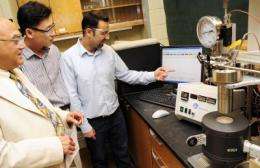
From left, Arvind Varma, Purdue University's R. Games Slayter Distinguished Professor of Chemical Engineering, postdoctoral researcher Hyun Tae Hwang and doctoral student Ahmad Al-Kukhun review data from a new process for storing and generating hydrogen to run fuel cells in cars and portable consumer electronics. The process, called hydrothermolysis, uses a powdered material called ammonia borane, which contains one of the highest hydrogen contents of all solid materials. Credit: Purdue University photo/Andrew Hancock

A new process for storing and generating hydrogen to run fuel cells in cars has been invented by chemical engineers at Purdue University.

The process, given the name hydrothermolysis, uses a powdered chemical called ammonia borane, which has one of the highest hydrogen contents of all solid materials, said Arvind Varma, R. Games Slayter Distinguished Professor of Chemical Engineering and head of the School of Chemical Engineering.

"This is the first process to provide exceptionally high hydrogen yield values at near the operating temperatures without using a catalyst, making it promising for hydrogen-powered vehicles," he said. "We have a proof of concept."

The new process combines hydrolysis and thermolysis, two hydrogen-generating processes that are not practical by themselves for vehicle applications.

Research findings were presented June 15 during the International Symposium on Chemical Reaction Engineering in Philadelphia. The research also is detailed in a paper appearing online in the AIChE Journal, published by the American Institute of Chemical Engineers, and will be published in an upcoming issue of the journal.

Ammonia borane contains 19.6 percent hydrogen, a high weight percentage that means a relatively small quantity and volume of the material are needed to store large amounts of hydrogen, Varma said.

"The key is how to efficiently release the hydrogen from this compound, and that is what we have discovered," he said.

The paper was written by former Purdue doctoral student Moiz Diwan, now a senior research engineer at Abbott Laboratories in Chicago; Purdue postdoctoral researcher Hyun Tae Hwang; doctoral student Ahmad Al-Kukhun; and Varma. Purdue has filed a on the technology.

In hydrolysis, water is combined with ammonia borane and the process requires a catalyst to generate hydrogen, while in thermolysis the material must be heated to more than 170 degrees Celsius, or more than 330 degrees Fahrenheit, to release sufficient quantities of hydrogen.

However, fuel cells that will be used in cars operate at about 85 degrees Celsius (185 degrees Fahrenheit). Hydrogen fuel cells generate electricity to run an electric motor.

The new process also promises to harness waste heat from fuel cells to operate the hydrogen generation reactor, Varma said.

The researchers conducted experiments using a reactor vessel operating at the same temperature as fuel cells. The process requires maintaining the reactor at a pressure of less than 200 pounds per square inch, far lower than the 5,000 psi required for current hydrogen-powered test vehicles that use compressed hydrogen gas stored in tanks.

In some experiments, the researchers used water containing a form of hydrogen called deuterium. Using water containing deuterium instead of hydrogen enabled the researchers to trace how much hydrogen is generated from the hydrolysis reaction and how much from the thermolysis reaction, details critical to understanding the process.

At the optimum conditions, hydrogen from the hydrothermolysis approach amounted to about 14 percent of the total weight of the ammonia borane and water used in the process. This is significantly higher than the hydrogen yields from other experimental systems reported in the scientific literature, Varma said.

"This is important because the U.S. Department of Energy has set a 2015 target of 5.5 weight percent hydrogen for hydrogen storage systems, meaning available hydrogen should be at least 5.5 percent of a system's total weight," he said. "If you're only yielding, say, 7 percent hydrogen from the material, you're not going to make this 5.5 percent requirement once you consider the combined weight of the entire system, which includes the reactor, tubing, the ammonia borane, water, valves and other required equipment."

The researchers determined that a concentration of 77 percent ammonia borane is ideal for maximum hydrogen yield using the new process.

The research has been funded by the U.S. Department of Energy by a grant through the Energy Center in Purdue's Discovery Park.

Future work on hydrothermolysis will explore scaling up the reactor to the size required for a vehicle to drive 350 miles before refueling. Additional research also is needed to develop recycling technologies for turning waste residues produced in the process back into .

The technology may also be used to produce for fuel cells to recharge batteries in portable electronics, such as notebook computers, cell phones, personal digital assistants, digital cameras, handheld medical diagnostic devices and defibrillators.

"The recycling isn't important for small-scale applications, such as portable electronics, but is needed before the process becomes practical for cars," Varma said.

Provided by Purdue University (news : web)

4.3 /5 (20 votes)  

Filter


Move the slider to adjust rank threshold, so that you can hide some of the comments.


Display comments: newest first

lengould100
Jun 16, 2010

Rank: 3 / 5 (2)
Ok, now what's the energy input amounts and characteristics for generating of ammonia borane?
StandingBear
Jun 16, 2010

Rank: 1 / 5 (1)
Hey I like this one. These guys are smart. Boron is common in the earth. Adoption on a massive scale once a practical design is formulated will allow us to protect our remaining oil supply for use as lubricants, as it should be.
antialias_physorg
Jun 16, 2010

Rank: 3.5 / 5 (2)
The additional advantage is that you could go to a gas station, dump the used ammonia borane to be recycled and fill up with a charged load.

No long recharging times like E-vehicles and no self discharge, either. Good stuff.
JimB135
Jun 16, 2010

Rank: 4 / 5 (2)
protect our remaining oil supply for use as lubricants, as it should be.


Much more than lubricants. Petrochemicals are the entire basis for modern civilization. From the energy provided to run everything to the raw materials needed to provide us with a mind boggling number of products. From the road you drive on, to the medications you need to the cell phone you talk on -- petrochemicals are there every step of the way.
Shootist
Jun 16, 2010

Rank: 1 / 5 (1)
Hey I like this one. These guys are smart. Boron is common in the earth. Adoption on a massive scale once a practical design is formulated will allow us to protect our remaining oil supply for use as lubricants, as it should be.


Yeah, right. And the ammonia comes from?

Petroleum.
Tan0r5
Jun 17, 2010

Rank: 1 / 5 (2)
Water is necessary for life. How many will die of thirst without clean water which was converted into hydrogen? How many will die of hunger because corn is converted into ethanol? Convert all wastes into fuel without petroleum, chemicals, or burning using a heat compression process.
antialias
Jun 17, 2010

Rank: not rated yet
Yeah, right. And the ammonia comes from?

Petroleum.

But in this case it is a reusable/rechargeable energy carrier - and not a primary energy source which gets used up.
Bog_Mire
Jun 17, 2010

Rank: 1 / 5 (1)
Hey I like this one. These guys are smart. Boron is common in the earth. Adoption on a massive scale once a practical design is formulated will allow us to protect our remaining oil supply for use as lubricants, as it should be.


Yeah, right. And the ammonia comes from?

Petroleum.


chook poo?
Shootist
Jun 17, 2010

Rank: not rated yet
Water is necessary for life. How many will die of thirst without clean water which was converted into hydrogen? How many will die of hunger because corn is converted into ethanol? Convert all wastes into fuel without petroleum, chemicals, or burning using a heat compression process.


I dunno, jeez just flash sea water if you're worried about it. Several dozen 1000MW Nuke plants will go a long way.
Shootist
Jun 17, 2010

Rank: not rated yet
Yeah, right. And the ammonia comes from?

Petroleum.


But in this case it is a reusable/rechargeable energy carrier - and not a primary energy source which gets used up.


No it isn't reuseable. The ammonia is broken down for its H2. Poof no more ammonia.

To make this fairie dust work, YOU HAVE TO:

Use petroleum to find more petroleum.
Use petroleum to pump more petroleum.
Use petroleum to refine more petroleum.
Use petroleum to make more ammonia.
Use petroleum to power all these refining/refractory processes.
Use petroleum to transport the ammonia.
Use petroleum to mine the borax.
Use petroleum to refine the Borax.
Use petroleum to transport the borax.

And, finally,

use petroleum to combine the borax and ammonia,
use petroleum to transport the ammonia-boron compound, to fuel the fuel cell powered vehicles which were transported from the point of manufacture to the point of sale via petroleum powered vehicles.
Shootist
Jun 17, 2010

Rank: not rated yet
We have to stop getting excited about energy negative energy sources. More energy goes into the creation of this ammonia-boron mess than will ever be extracted.

There are no Hydrogen mines.

Unless, or until, sufficient nuclear generating capacity is built to cheaply (nearly free) extract H2 from seawater, H2 will, like ethanol/methanol, remain the fuel of fools.
CyberRat
Jun 17, 2010

Rank: not rated yet
Correction

--------------
Yeah, right. And the ammonia comes from?
To make this fairie dust work, YOU HAVE TO:
Use nuclear/solar/wind/etc to produce hydrogen
Use hydrogen to find more petroleum.
Use hydrogen to pump more petroleum.
Use hydrogen to refine more petroleum.
Use hydrogen/petroleum to make more ammonia.
Use solar/nuclear to power all these refining/refractory processes.
Use hydrogen to transport the ammonia.
Use hydrogen to mine the borax.
Use hydrogen to refine the Borax.
Use hydrogen to transport the borax.
use hydrogen to combine the borax and ammonia,
use hydrogen to transport the ammonia-boron compound, to fuel the fuel cell powered vehicles which were transported from the point of manufacture to the point of sale via hydrogen powered vehicles.

antialias_physorg
Jun 17, 2010

Rank: not rated yet
We have to stop getting excited about energy negative energy sources. More energy goes into the creation of this ammonia-boron mess than will ever be extracted.


Umm...ALL energy sources are energy negative. Ammonia borane is not an energy source but energy STORAGE. It's liek a battery (with a alot of advantages). Even with a battery you have to put more energy in than you get out.

The point is that lot of alternative enery sources require an energy storage solution (wind, solar) because they need to store excess production and/or keep delivering energy to the grid when the sund doesn't shine or the wind doesn't blow.

For alternative automotive solutions we require an energy storage medium that that can be stored indefinitely and doesn't take long to recharge (or can simply be exchanged like liquid fuel). This stuff could do that.
Ozz
Jun 18, 2010

Rank: not rated yet
When I was in Organic Chemistry we were told that basicly all of our pharmaceuticals come from oil. As a matter of fact, early organic chemistry students were handed a tar ball and instructed to extract different hydrocarbons. The pharm industry has grown up with the the oil industry. We do need to save the oil for important medicines.
Hydrogen is the transportation energy gold standard.
Ozz
Jun 18, 2010

Rank: not rated yet
We won't use up the water by using hydrogen for transportation. In making electricity using hydrogen water is made. Water and oxygen are the reaction waste products in supplying the electons from hydrogen. Ammonia is already big in the energy world and many are calling it "The Other Hydrogen." Check out Iowa University or Iowa State I can't remember which, but they have a great plan using ammonia and several other energy sources.
Forestgnome
Jun 19, 2010

Rank: not rated yet
Hey I like this one. These guys are smart. Boron is common in the earth. Adoption on a massive scale once a practical design is formulated will allow us to protect our remaining oil supply for use as lubricants, as it should be.


Yeah, right. And the ammonia comes from?

Petroleum.


No, actually from coal. But that's okay, as most of it comes from China. They'll get the pollution, we'll get to clean up and feel good about ourselves!
Ozz
Jun 19, 2010

Rank: not rated yet
Ammonia is made using many different energy sources including coal, but it is not burned ammonia NH3 is being produced in very large volumes in this country and can be used a as fuel itself. Check out the Iowa Energy Center and see the intergrated system they have designed. I'm sure google will do.
ShotmanMaslo
Jun 20, 2010

Rank: not rated yet
The additional advantage is that you could go to a gas station, dump the used ammonia borane to be recycled and fill up with a charged load.

No long recharging times like E-vehicles and no self discharge, either. Good stuff.


Batteries in EVs could be made swappable, so long recharging times are not a show-stoper.
Sanescience
Jun 21, 2010

Rank: not rated yet
STOP THE MADNESS

Hydrogen systems are generally a bad idea. Inefficient, expensive, and will put car maintenance out of the hands of ordinary mechanics and owners.

We need to re-use our current infrastructure for storage and transportation of energy and not pay big corporations trillions of dollars to build a new one.

We need Bio Diesel that is carbon neutral, from processes and crops that do not compete with food. And is fully sustainable without the need for major mining operations and can be decentralized to reduce transportation waste.

Three sources for bio-diesel could satisfy much of the demand:
1) Conversion of cellulose from crop waste or grown on marginal land (like switch grass)
2) Hydroponic algae farms in the desserts.
3) Direct energy conversion from solar and wind into fuel via microbial electrosynthesis.
antialias
Jun 21, 2010

Rank: not rated yet
Batteries in EVs could be made swappable, so long recharging times are not a show-stoper.
This would require universal standardization of batteries. With the ongoing development of new and better battery types that's unlikely to happen (and if it did it would be counter-productive).

and will put car maintenance out of the hands of ordinary mechanics and owners

As if anyone could repair a modern car in their own garage. Battery/electrical faults account for 40% of all car failures already.

1) Conversion of cellulose from crop waste or grown on marginal land (like switch grass)
2) Hydroponic algae farms in the desserts.
3) Direct energy conversion from solar and wind into fuel via microbial electrosynthesis.

Wow - you're calling hydrogen conversion inefficient (currently at 12.4% direct solar to hydrogen) but are advocating photosythesis derived biomass (which is only 3% efficient)? Astonishing.
Rank 4.3 /5 (20 votes)
Relevant PhysicsForums posts
  • Stoichiometry
    created10 hours ago
  • Boiling and melting point of impure substances
    created11 hours ago
  • Safe nitrogen compound to decompose a 500 deg C in a furnace?
    created18 hours ago
  • [ask]electron inside drinking water
    createdFeb 08, 2012
  • How to avoid formation of Lithium Chromate ???
    createdFeb 08, 2012
  • how to choose a reduced or oxidated form in a redox
    createdFeb 08, 2012
  • More from Physics Forums - Chemistry

More news stories

Fool's gold may prove an unlikely alternative to overexploited catalytic materials

Catalytic materials, which lower the energy barriers for chemical reactions, are used in everything from the commercial production of chemicals to catalytic converters in car engines. However, with current catalytic materials ...

Chemistry / Materials Science

created 1 hour ago | popularity 5 / 5 (1) | comments 1 | with audio podcast

Unpicking HIV’s invisibility cloak

Drug researchers hunting for alternative ways to treat human immunodeficiency virus (HIV) infections may soon have a novel target—its camouflage coat. HIV hides inside a cloak unusually rich in a sugar ...

Chemistry / Biochemistry

created 1 hour ago | popularity 5 / 5 (2) | comments 0

Hydrogen from acidic water: Researchers develop potential low cost alternative to platinum for splitting water

A technique for creating a new molecule that structurally and chemically replicates the active part of the widely used industrial catalyst molybdenite has been developed by researchers with the Lawrence Berkeley ...

Chemistry / Materials Science

created 21 hours ago | popularity 5 / 5 (11) | comments 11 | with audio podcast

No entry without protein recycling: Researchers discover new coherence in enzyme transport

The group of Prof. Dr. Ralf Erdmann at the Ruhr-Universität Bochum, Germany, discovered a connection of peroxisomal protein import and receptor export. In the Journal of Biological Chemistry, they disclo ...

Chemistry / Biochemistry

created 1 hour ago | popularity not rated yet | comments 0

Flexible paper robots

(PhysOrg.com) -- These inexpensive robots can stretch, bend and twist under control, and lift objects up to 120 times their own weight. Being soft, they can apply gentle and even pressure, and adapt to varied ...

Chemistry / Materials Science

created 19 hours ago | popularity 5 / 5 (5) | comments 3 | with audio podcast


Netflix light on flicks as viewers soak up TV shows

Like most fresh faces that arrive in Hollywood, Netflix wanted to be a movie star. But now it's learning what many in Tinseltown have known for decades: Movies are sexy, but the real money is in television.

Antidepressants and pregnancy: Women must consider the impact of drugs on baby, and of depression on baby, themselves

Upon learning they are pregnant, most women dutifully nix the alcohol, sushi and caffeine. But what about antidepressants?

Curry spice component may help slow prostate tumor growth

Curcumin, an active component of the Indian curry spice turmeric, may help slow down tumor growth in castration-resistant prostate cancer patients on androgen deprivation therapy (ADT), a study from researchers ...

The power of estrogen -- male snakes attract other males

A new study has shown that boosting the estrogen levels of male garter snakes causes them to secrete the same pheromones that females use to attract suitors, and turned the males into just about the sexiest ...

Humans may have helped the decline of African rainforests 3000 years ago

(PhysOrg.com) -- Large areas of rainforests in Central Africa mysteriously disappeared over three thousand years ago, to be replaced by savannas. The prevailing theory has been that the cause was a change ...

Experts reveal how plants don't get sunburn

(PhysOrg.com) -- Experts at the University of Glasgow have discovered how plants survive the harmful rays of the sun.