Hubble scrutinizes site of mysterious flash and missing cloud belt on Jupiter
June 16, 2010
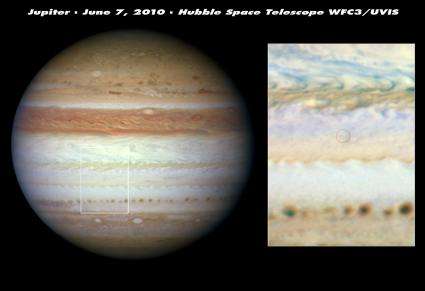
Detailed observations made by the NASA/ESA Hubble Space Telescope have led researchers to believe that the flash of light seen on Jupiter on 3 June was a meteor. This visitor from space did not plunge deep enough into the atmosphere to explode and leave behind any telltale cloud of debris, as seen in previous Jupiter collisions. Hubble’s sharp vision and ultraviolet sensitivity were used to seek out any trace evidence of the aftermath of the cosmic collision (right inset). Images taken on June 7 show no sign of dark debris above Jupiter’s cloud tops. This means that the object didn't descend beneath the clouds and explode as a fireball. If it had, dark sooty blast debris would have been ejected and would have subsequently settled down onto the cloud tops. Australian amateur astronomer Anthony Wesley first saw the flash at 22:31 CEST on 3 June. He was watching a live video feed of Jupiter from his telescope. In the Philippines, amateur astronomer Chris Go confirmed that he had simultaneously recorded the transitory event on video. This natural color photo was taken in visible light with Hubble’s Wide Field Camera 3. Credit: NASA, ESA, M. H. Wong (University of California, Berkeley, USA), H. B. Hammel (Space Science Institute, Boulder, Colorado, USA), A. A. Simon-Miller (Goddard Space Flight Center, Greenbelt, Maryland, USA) and the Jupiter Impact Science Team.
At 22:31 (CEST) on 3 June 2010 Australian amateur astronomer Anthony Wesley saw a two-second-long flash of light on the disc of Jupiter. He was watching a live video feed from his telescope. In the Philippines, amateur astronomer Chris Go confirmed that he had simultaneously recorded the transitory event on video. Wesley was the discoverer of the now world-famous July 2009 impact.
Astronomers around the world suspected that something significant must have hit the giant planet to unleash a flash of energy bright enough to be seen here on Earth, about 770 million kilometres away. But they didn't know how just how big it was or how deeply it had penetrated into the atmosphere. Over the past two weeks there have been ongoing searches for the "black-eye" pattern of a deep direct hit like those left by former impactors.
The sharp vision and ultraviolet sensitivity of the Wide Field Camera 3 aboard the NASA/ESA Hubble Space Telescope were used to seek out any trace evidence of the aftermath of the cosmic collision. Images taken on 7 June — just over three days after the flash was sighted — show no sign of debris above Jupiter's cloud tops. This means that the object didn't descend beneath the clouds and explode as a fireball. If it had done, then dark sooty blast debris would have been ejected and would have rained down onto the clouds.
Instead the flash is thought to have come from a giant meteor burning up high above Jupiter's cloud tops, which did not plunge deep enough into the atmosphere to explode and leave behind any telltale cloud of debris, as seen in previous Jupiter collisions.
"The cloud tops and the impact site would have appeared dark in the ultraviolet and visible images due to debris from an explosion," says team member Heidi Hammel of the Space Science Institute in Boulder, Colorado, USA. "We can see no feature that has those distinguishing characteristics in the known vicinity of the impact, suggesting there was no major explosion and no 'fireball'."
Dark smudges marred Jupiter's atmosphere when a series of fragments of Comet Shoemaker-Levy 9 hit Jupiter in July 1994. A similar phenomenon occurred in July 2009 when a suspected asteroid slammed into Jupiter. The latest intruder is estimated to be only a fraction of the size of these previous impactors and is thought to have been a meteor.
"Observations of these impacts provide a window on the past — onto the processes that shaped our Solar System in its early history," says team member Leigh Fletcher of the University of Oxford, UK. "Comparing the two collisions — from 2009 and 2010 — will hopefully yield insights into the types of impact processes in the outer Solar System, and the physical and chemical response of Jupiter's atmosphere to these amazing events."
As a bonus, Hubble's observations also allowed scientists to get a close-up look at changes in Jupiter's atmosphere following the disappearance of the dark cloud feature known as the Southern Equatorial Belt several months ago.
In the Hubble view, a slightly higher altitude layer of white ammonia ice crystal clouds appears to obscure the deeper, darker belt clouds. "Weather forecast for Jupiter's Southern Equatorial Belt: cloudy with a chance of ammonia," Hammel says.
The team predicts that these ammonia clouds should clear out in a few months, as they have done in the past. The clearing of the ammonia cloud layer should begin with a number of dark spots like those seen by Hubble along the boundary of the south tropical zone.
"The Hubble images tell us these spots are holes resulting from localised downdrafts. We often see these types of holes when a change is about to occur," Simon-Miller says.
"The Southern Equatorial Belt last faded in the early 1970s. We haven't been able to study this phenomenon at this level of detail before," Simon-Miller adds. "The changes of the last few years are adding to an extraordinary database on dramatic cloud changes on Jupiter."
More information: Jupiter Impact: Mystery of the Missing Debris
-
Jupiter Impact: Mystery of the Missing Debris
Jun 15, 2010 |
not rated yet |
0
-
What Hit Jupiter?
Aug 03, 2009 |
not rated yet |
0
-
Hubble captures rare Jupiter collision
Jul 25, 2009 |
not rated yet |
0
-
Jupiter has lost one of its cloud stripes
May 14, 2010 |
not rated yet |
0
-
Hubble Images Suggest Rogue Asteroid Smacked Jupiter
Jun 03, 2010 |
not rated yet |
0
-
Engineers build first sub-10-nm carbon nanotube transistor
Feb 01, 2012 |
4.9 / 5 (31) |
30
-
Something old, something new: Evolution and the structural divergence of duplicate genes
Jan 31, 2012 |
4.6 / 5 (7) |
1
-
The hidden nanoworld of ice crystals: Revealing the dynamic behavior of quasi-liquid layers
Jan 30, 2012 |
5 / 5 (3) |
1
-
Stock market network reveals investor clustering
Jan 27, 2012 |
3.9 / 5 (23) |
8
-
Of microchemistry and molecules: Electronic microfluidic device synthesizes biocompatible probes
Jan 26, 2012 |
5 / 5 (1) |
0
-
Titan's lack of impact craters
Feb 09, 2012
-
Real pictures of black hole eating a star?
Feb 08, 2012
-
Hypothetical way to travel faster than light, but not technically exceed lightspeed
Feb 06, 2012
-
How do scientists monitor the Sun's activity?
Feb 05, 2012
-
Search patterns in observational studies
Feb 05, 2012
-
Derivation of Pogson's law
Feb 03, 2012
- More from Physics Forums - General Astronomy
More news stories
Humans may have helped the decline of African rainforests 3000 years ago
(PhysOrg.com) -- Large areas of rainforests in Central Africa mysteriously disappeared over three thousand years ago, to be replaced by savannas. The prevailing theory has been that the cause was a change ...
Could Venus be shifting gear?
(PhysOrg.com) -- ESAs Venus Express spacecraft has discovered that our cloud-covered neighbour spins a little slower than previously measured. Peering through the dense atmosphere in the infrared, the ...
Space & Earth / Space Exploration
7 hours ago |
5 / 5 (5) |
7
|
Mars Science Laboratory computer issue resolved
(PhysOrg.com) -- Engineers have found the root cause of a computer reset that occurred two months ago on NASA's Mars Science Laboratory and have determined how to correct it.
Space & Earth / Space Exploration
8 hours ago |
5 / 5 (5) |
3
|
Clam fields found at deep, low-temperature Mariana vents
(PhysOrg.com) -- Scientists have marveled at the unusual life forms thriving at high temperature hydrothermal vents of the deep ocean.
Space & Earth / Earth Sciences
7 hours ago |
not rated yet |
0
|
Two new moons for Jupiter
Advances in technology have lead to the discovery of new planets outside of our Solar System, and now even new moons in our own backyard.
Space & Earth / Space Exploration
7 hours ago |
not rated yet |
5
Complex wiring of the nervous system may rely on a just a handful of genes and proteins
Researchers at the Salk Institute have discovered a startling feature of early brain development that helps to explain how complex neuron wiring patterns are programmed using just a handful of critical genes. ...
CIA website offline, Anonymous takes credit
The website of the Central Intelligence Agency was unresponsive on Friday after the hacker group Anonymous claimed to have knocked it offline.
Q&A: Obama and the birth control controversy
(AP) -- What birth control debate? A half-century after the introduction of the pill, acceptance of birth control by American women is virtually universal.
The power of estrogen -- male snakes attract other males
A new study has shown that boosting the estrogen levels of male garter snakes causes them to secrete the same pheromones that females use to attract suitors, and turned the males into just about the sexiest ...
New error-correcting codes guarantee the fastest possible rate of data transmission
Error-correcting codes are one of the triumphs of the digital age. Theyre a way of encoding information so that it can be transmitted across a communication channel such as an optical fiber o ...
Both maternal and paternal age linked to autism
Older maternal and paternal age are jointly associated with having a child with autism, according to a recently published study led by researchers at The University of Texas Health Science Center at Houston (UTHealth).