New insights into volcanic activity on the ocean floor
June 16, 2010
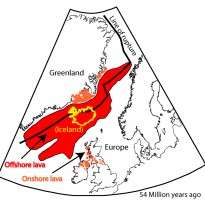
The red zone indicates ancient eruptions that happened when North America split from Europe
New research reveals that when two parts of the Earth's crust break apart, this does not always cause massive volcanic eruptions. The study, published today in the journal Nature, explains why some parts of the world saw massive volcanic eruptions millions of years ago and others did not.
The Earth's crust is broken into plates that are in constant motion over timescales of millions of years. Plates occasionally collide and fuse, or they can break apart to form new ones. When the latter plates break apart, a plume of hot rock can rise from deep within the Earth's interior, which can cause massive volcanic activity on the surface.
When the present-day continent of North America broke apart from what is now Europe, 54 million years ago, this caused massive volcanic activity along the rift between the two. Prior to today's study, scientists had thought that such activity always occurred along the rifts that form when continents break apart.
However, today's research shows that comparatively little volcanic activity occurred when the present-day sub-continent of India broke away from what is now the Seychelles, 63 million years ago.
Researchers had previously believed that the temperature of the mantle beneath a plate was the key to determining the level of volcanic activity where a rift occurred. The new study reveals that in addition, the prior history of a rift also strongly influences whether or not volcanic activity will occur along it.
In the case of the break-up of America from Europe, massive volcanic activity occurred along the rift because a previous geological event had thinned the plate, according to today's study. This provided a focal point where the mantle underneath the plate could rapidly melt, forming magma that erupted easily through the thinned plate and onto the surface, in massive outbursts of volcanic activity.
In comparison, when India broke away from the Seychelles very little volcanic activity occurred along the North Indian Ocean floor, because the region had experienced volcanic activity in a neighbouring area called the Gop Rift 6 million years earlier. This exhausted the supply of magma and cooled the mantle, so that when a rift occurred, very little magma was left to erupt.
Dr Jenny Collier, co-author from the Department of Earth Science and Engineering at Imperial College London, says: "Mass extinctions, the formation of new continents and global climate change are some of the effects that can happen when plates break apart and cause super volcanic eruptions. Excitingly, our study is helping us to see more clearly some of the factors that cause the events that have helped to shape the Earth over millions of years."
The team reached their conclusions after carrying out deep sea surveys of the North Indian Ocean to determine the type of rock below the ocean floor. They discovered only small amounts of basalt rock, which is an indicator of earlier volcanic activity .The team also used new computer models that they had developed to simulate what had happened along the ocean floor in the lead up to India and the Seychelles splitting apart.
Dr John Armitage, lead author of the paper from the Department of Earth Science and Engineering at Imperial College London, adds: "Our study is helping us to see that the history of the rift is really important for determining the level of volcanic activity when plates break apart. We now know that this rift history is just as important as mantle temperature in controlling the level of volcanic activity on the Earth's surface."
In the future, the team hope to further explore the ocean floor off the coast of South America where that continent split from Africa millions of years ago to determine the level of ancient volcanic activity in the region.
More information: "The importance of rift history for volcanic margin formation" Nature, 17 June 2010
-
Volcanic eruptions may split Africa: scientists
Nov 03, 2009 |
not rated yet |
0
-
Tracking a hot spot
May 17, 2007 |
not rated yet |
0
-
Towards a better understanding of hot spot volcanism
Jan 31, 2008 |
not rated yet |
0
-
Flow in Earth's mantle moves mountains: study
Jun 02, 2010 |
not rated yet |
0
-
Hot Fluids and Deep Earthquakes
May 08, 2007 |
not rated yet |
0
-
Engineers build first sub-10-nm carbon nanotube transistor
Feb 01, 2012 |
4.9 / 5 (31) |
30
-
Something old, something new: Evolution and the structural divergence of duplicate genes
Jan 31, 2012 |
4.6 / 5 (7) |
1
-
The hidden nanoworld of ice crystals: Revealing the dynamic behavior of quasi-liquid layers
Jan 30, 2012 |
5 / 5 (3) |
1
-
Stock market network reveals investor clustering
Jan 27, 2012 |
3.9 / 5 (23) |
8
-
Of microchemistry and molecules: Electronic microfluidic device synthesizes biocompatible probes
Jan 26, 2012 |
5 / 5 (1) |
0
-
Discrepancy between oxygen and carbon-dioxide levels
Feb 09, 2012
-
where gems are found in the world
Feb 09, 2012
-
Wind Waves in Reservoir ~ Wind run-up and Wind set-up
Feb 08, 2012
-
Balance of oxygen in the atmosphere
Feb 01, 2012
-
The case for a methanol-based economy
Jan 30, 2012
-
Weather in a rotating cylinder
Jan 25, 2012
- More from Physics Forums - Earth
More news stories
Humans may have helped the decline of African rainforests 3000 years ago
(PhysOrg.com) -- Large areas of rainforests in Central Africa mysteriously disappeared over three thousand years ago, to be replaced by savannas. The prevailing theory has been that the cause was a change ...
Could Venus be shifting gear?
(PhysOrg.com) -- ESAs Venus Express spacecraft has discovered that our cloud-covered neighbour spins a little slower than previously measured. Peering through the dense atmosphere in the infrared, the ...
Space & Earth / Space Exploration
18 hours ago |
5 / 5 (7) |
8
|
NASA budget will axe Mars deal with Europe: scientists
US President Barack Obama's budget proposal to be submitted next week for 2013 will cut NASA's budget by 20 percent and eliminate a major partnership with Europe on Mars exploration, scientists said Thursday.
Space & Earth / Space Exploration
21 hours ago |
5 / 5 (2) |
18
Two new moons for Jupiter
Advances in technology have lead to the discovery of new planets outside of our Solar System, and now even new moons in our own backyard.
Space & Earth / Space Exploration
18 hours ago |
4 / 5 (1) |
7
Mars Science Laboratory computer issue resolved
(PhysOrg.com) -- Engineers have found the root cause of a computer reset that occurred two months ago on NASA's Mars Science Laboratory and have determined how to correct it.
Space & Earth / Space Exploration
19 hours ago |
4.7 / 5 (6) |
3
|
Anonymous knocks CIA website offline (Update)
The website of the Central Intelligence Agency was inaccessible on Friday after the hacker group Anonymous claimed to have knocked it offline.
New error-correcting codes guarantee the fastest possible rate of data transmission
Error-correcting codes are one of the triumphs of the digital age. Theyre a way of encoding information so that it can be transmitted across a communication channel such as an optical fiber o ...
Google users warned of threat to smartphone wallets
Users of Google smartphone wallets were being warned on Friday that there is a way to crack pass codes intended to thwart thieves from going on illicit shopping sprees.
New power source discovered
(PhysOrg.com) -- Researchers at the Massachusetts Institute of Technology (MIT) and RMIT University have made a breakthrough in energy storage and power generation.
Small modular reactor design could be a 'SUPERSTAR'
(PhysOrg.com) -- Though most of today's nuclear reactors are cooled by water, we've long known that there are alternatives; in fact, the world's first nuclear-powered electricity in 1951 came from a reactor ...
The power of estrogen -- male snakes attract other males
A new study has shown that boosting the estrogen levels of male garter snakes causes them to secrete the same pheromones that females use to attract suitors, and turned the males into just about the sexiest ...
Jun 16, 2010
Rank: 1 / 5 (3)