Astronomers study Kuiper Belt object during stellar occultation
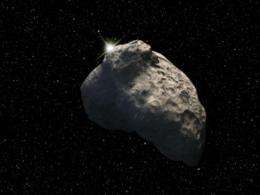
(PhysOrg.com) -- Until now, astronomers have used telescopes to find Kuiper Belt objects (KBOs), moon-sized bodies, and obtain their spectra to determine what types of ices are on their surface. They have also used thermal-imaging techniques to get a rough idea of the size of KBOs, but other details have been difficult to glean. While astronomers think there are about 70,000 KBOs that are larger than 100 kilometers in diameter, the objects' relatively small size and location make it hard to study them in detail.
Far beyond the orbit of Neptune in a region of the outer solar system known as the Kuiper Belt float thousands of icy, moon-sized bodies called Kuiper Belt objects (KBOs). Astronomers think they are the remnants of the bodies that slammed together to form the planets more than 4 billion years ago. Unlike Earth, which has been continually eroded by wind and water since it was formed, KBOs haven’t changed much over time and may hold clues about the early solar system and planet formation.
Until now, astronomers have used telescopes to find KBOs and obtain their spectra to determine what types of ices are on their surface. They have also used thermal-imaging techniques to get a rough idea of the size of KBOs, but other details have been difficult to glean. While astronomers think there are about 70,000 KBOs that are larger than 100 kilometers in diameter, the objects’ relatively small size and location make it hard to study them in detail. One method that has been has been proposed for studying KBOs is to observe one as it passes briefly in front of a bright star; such events, known as stellar occultations, have yielded useful information about other planets in the solar system. By monitoring the changes in starlight that occur during an occultation, astronomers can determine the object’s size and temperature, whether it has any companion objects and if it has an atmosphere.
The trick is to know enough about the orbit of a KBO to be able to predict its path and observe it as it passes in front of a star. This was done successfully for the first time last October when a team of 18 astronomy groups led by James Elliot, a professor of planetary astronomy in MIT’s Department of Earth, Atmospheric and Planetary Sciences, observed an occultation by an object named “KBO 55636.”
As Elliot and his colleagues report in a paper published June 17 in Nature, the occultation provided enough data to determine the KBO’s size and albedo, or how strongly it reflects light. The surface of 55636 turns out to be as reflective as snow and ice, which surprised the researchers because ancient objects in space usually have weathered, dull surfaces. The high albedo suggests that the KBO’s surface is made of reflective water-ice particles, and that would support a theory about how the KBO formed. Many researchers believe there was a collision that occurred one billion years ago between a dwarf planet in the Kuiper Belt known as Haumea and another object that caused Haumea’s icy mantle to break into a dozen or so smaller bodies, including 55636.
More importantly, the research demonstrates that astronomers can predict occultations accurately enough to contribute to a new NASA mission known as the Stratospheric Observatory For Infrared Astronomy (SOFIA) that completed its first in-flight observations in May. A Boeing 747SP aircraft that has a large telescope mounted onto its rear fuselage, SOFIA can record infrared measurements of celestial objects that are not possible from the ground. Elliot hopes his research will help guide future flights of SOFIA to observe stellar occultations in detail.
Betting on an occultation
Elliot, who has been studying 55636’s orbit for five years, thought it would most likely pass in front of an unnamed star on Oct. 9, 2009. But the KBO’s small size made it difficult to predict exactly where the object would travel, and so, to be on the safe side, he and his colleagues assembled a network of 18 observation stations along a 5,900-kilometer stretch of the Earth’s surface that corresponded to the KBO’s predicted shadow path. Such a strategy “covered our uncertainty about where the path would go, both to the north and to the south,” Elliot explains. “It was our way of hedging our bets.”
While some of the stations couldn’t observe because of weather, and others simply didn’t detect the occultation, two stations in Hawaii captured data on the changes in starlight that occurred during the roughly 10-second occultation. After measuring the exact amount of time that the star was blocked from view, as well as the velocity with which the shadow of 55636 moved across Earth, the researchers calculated that the KBO has a radius of about 143 kilometers. Knowing this, they could then calculate the object’s albedo.
The highly reflective surface of 55636 is perplexing because the surfaces of celestial bodies in the outer solar system are supposed to darken over time as a result of dust accumulation and exposure to solar radiation. John Stansberry, an astronomer at the University of Arizona, says that if Elliot’s “solid piece of work” can be confirmed in follow-up research, then the results show that 55636 is “an extremely unique” KBO because similarly sized KBOs are thought to have significantly smaller albedos. “The result suggests that it would be worthwhile to try to measure the albedos of other Haumea family members to see if they are also very high,” says Stansberry.
Although other highly reflective bodies in the solar system, such as the dwarf planet Pluto and Saturn's moon Enceladus, have their surfaces continuously renewed with fresh ice from the condensation of atmospheric gases or by volcanic activity that spews water instead of lava, 55636 is too small for these mechanisms to be at work, says Elliot. He has no plans to investigate the cause of the high albedo but will continue to collect data about the orbits and positions of the largest KBOs in order to predict future occultations with enough accuracy that he doesn’t have to rely on a vast network of observers.
More information: "Size and albedo of Kuiper belt object 55636 from a stellar occultation," J.L. Elliot et al. Nature. 17 June 2010.
Provided by Massachusetts Institute of Technology


